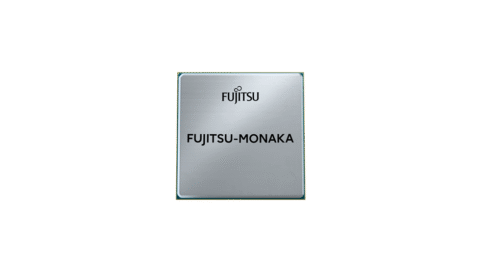

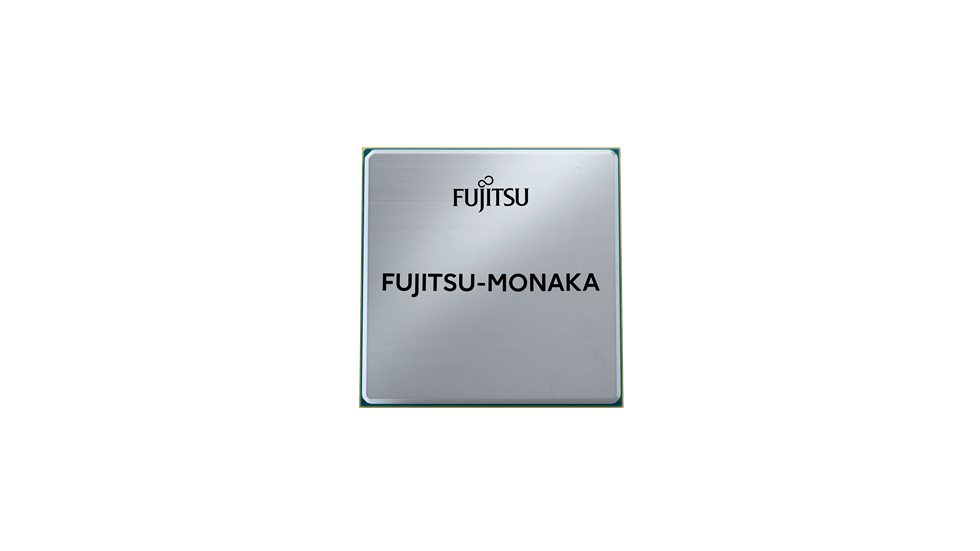
Fujitsu has announced FUJITSU-MONAKA, a next-generation processor designed and manufactured entirely in Japan. The company will begin selling the chip on its own to cloud providers and server vendors starting in November 2026, alongside a domestically built server, the Fujitsu MONAKA Server, that ships with it. As power constraints and data center capacity increasingly limit the global expansion of generative AI, Fujitsu is positioning the chip as a processor that combines high performance with strong power efficiency.
Different Process Nodes for Compute and Peripheral Circuits
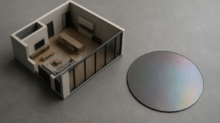
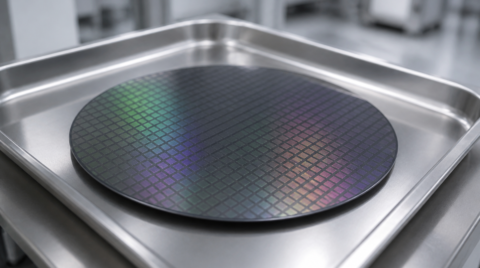
FUJITSU-MONAKA uses a cutting-edge 2nm process for its compute cores, paired with a 5nm process for cache and I/O circuitry in a 3D-stacked structure. Matching each function to the most suitable process appears aimed at controlling cost while maximizing performance. The chip reaches a maximum clock speed of 3.8GHz and a memory transfer rate of 8,800MT/s. It includes dedicated hardware to accelerate the matrix operations at the core of AI inference, delivering twice the throughput of competing CPUs. For some workloads, that means practical inference performance can be achieved with the CPU alone, opening up configurations that don't require large arrays of GPUs.
Clock speed also depends on the cooling method: liquid-cooled models run at a higher base frequency than air-cooled ones. The idea appears to be that sites without dedicated cooling infrastructure can choose the air-cooled option, while deployments prioritizing performance can opt for liquid cooling.
Servers Come in 2U and 1U Configurations, With Defense and Finance Among the Targets
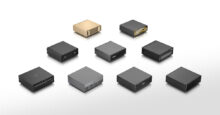
The Fujitsu MONAKA Server will be offered in a 2U model with two CPUs and a 1U model with one or two CPUs. The 1U model uses technology that lets memory and accelerators be shared across server boundaries, easing the memory shortages that often constrain AI inference. On the cooling side, Fujitsu says the 1U model runs air-cooled in ambient temperatures up to 40°C, or with water cooling at water temperatures up to 45°C, without dedicated cooling equipment — cutting the power consumed by server cooling by as much as 80 percent. The company also estimates that, for the same workload, its configuration needs roughly half the number of servers and half the power of competing CPU-based setups.
Server sales are set to begin in November 2026, with early access going first to select customers in finance, telecommunications, and manufacturing, followed by full shipments to Japan and Europe from April 2027. For academic and HPC use, Fujitsu will also offer a multi-node server that bundles four nodes, each with two CPUs, for simulation and other high-performance computing workloads. Looking ahead, the company says it plans to supply the platform for security-related applications, including defense, and to add high-density servers for data centers as well as rack-scale servers built for autonomous, robot-assisted maintenance.
A Push for a Domestically Built Sovereign AI Platform
A central theme of the announcement is Fujitsu's commitment to keeping design and manufacturing entirely within Japan. Both the CPU and the server are manufactured domestically, which the company says ensures traceability of component origin and manufacturing history. As competition for compute resources intensifies alongside the growth of generative AI, more companies want to keep sensitive data under their own control rather than hand it to outside providers, and geopolitical risk is pushing supply chain transparency higher on the list of priorities. Fujitsu is targeting that demand with hardware-level protection for data in memory, among other security features.
FUJITSU-MONAKA also relies on Fujitsu's own ultra-low-voltage operation technology to balance performance with power efficiency. By boosting compute performance while keeping power draw down, the company says it has built in enough flexibility that AI infrastructure can be deployed at whatever scale a site needs, even without dedicated liquid-cooling equipment. Going forward, Fujitsu plans to pair the server with its own generative AI platforms and industry-specific models in a vertically integrated offering, positioning it as infrastructure that lets domestic companies and public institutions run AI autonomously.
Summary
Fujitsu will begin selling FUJITSU-MONAKA, a next-generation CPU designed and built entirely in Japan, along with the Fujitsu MONAKA Server that houses it, starting in November 2026. The 2nm process delivers twice the AI inference throughput of competing CPUs, while a cooling design that curbs power use lets the same workload run on roughly half the servers and half the power. Positioned as a domestically sourced, traceable sovereign AI platform, the launch signals Fujitsu's ambitions across finance, telecommunications, manufacturing, academia and HPC, and even security-related fields.