
A joint team from RIKEN, Cleveland Clinic and IBM has been named a finalist for the 2026 ACM Gordon Bell Prize for calculating a 12,635-atom protein complex with quantum computers. It is described as the largest biologically meaningful molecule ever modeled this way. The winner will be announced at SC26 in November.
Where the 12,635 atoms come from
The molecules in question are T4-Lysozyme and Trypsin. The first is an enzyme that breaks down components of bacterial membranes, the second is produced in the pancreas and takes part in digestion. Both are textbook cases in biochemistry.
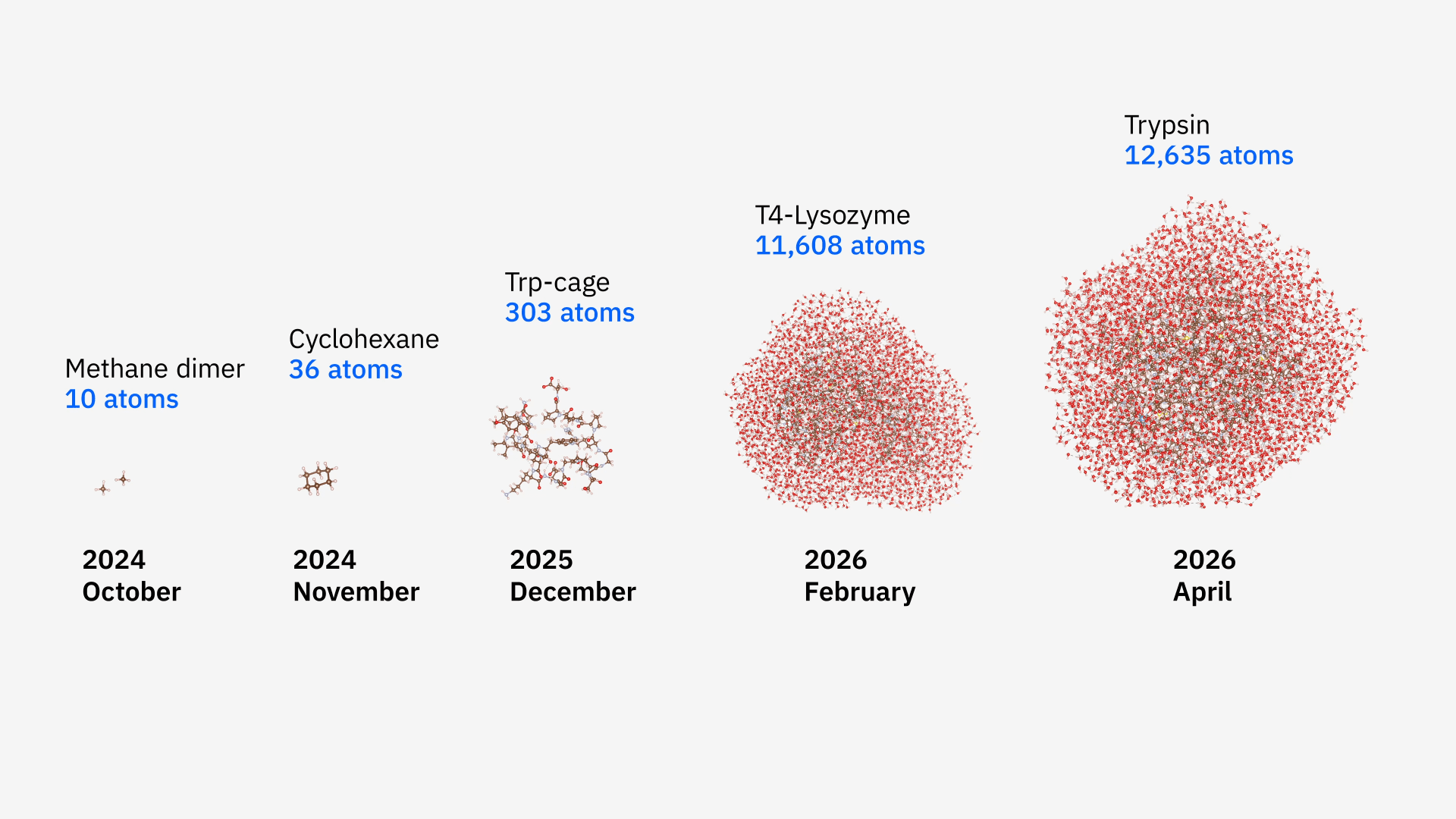
What makes this calculation unusual is that the proteins were not treated in isolation. Each was paired with a molecule it actually binds to in nature and then surrounded by liquid water. Under those conditions the systems reached 11,608 atoms for T4-Lysozyme and 12,635 atoms for Trypsin. In other words, the electronic structure was computed in a setting much closer to what happens inside the body.
The point of comparison is the 303-atom miniprotein Trp-cage, which the same team handled not long ago. From there, the system size grew roughly 40 times and accuracy improved 210 times in one specific step of the workflow. That is a two-order-of-magnitude jump in quantum chemistry over a very short period.
Splitting the work between quantum and classical machines
The framework is called quantum-centric supercomputing, or QCSC. Instead of solving a large molecule entirely on a quantum computer, the calculation is broken into smaller pieces called clusters. Classical machines handle the simpler ones, the quantum computer takes only the clusters where electron entanglement is too strong for classical methods, and the classical side stitches the molecule back together.
Breaking the molecule apart required its own innovation. With conventional methods, doubling the size of a molecule multiplies the required classical resources by 25, which made the fragmentation step impractical at the scale of Trypsin. The team exploited the fact that information from more than 7 to 10 angstroms away has almost no quantum mechanical effect, restricting the calculation to a sphere centered on each atom.
The quantum side was updated as well. On top of sample-based quantum diagonalization, or SQD, the team introduced a variant called TrimSQD that splits the search space into subspaces before exploring them, making it easier to identify the configurations worth handing to the quantum computer.
Two 156-qubit Heron processors, Fugaku and Miyabi-G
The hardware setup is a highlight in itself. Quantum sampling was distributed across two 156-qubit IBM Quantum Heron r2 processors, one installed at Cleveland Clinic and one at RIKEN, meaning quantum computers in the United States and Japan contributed to a single calculation. Up to 94 qubits were used in practice, running 9,200 circuits for more than 100 hours and collecting 1.3 billion measurement outcomes.
Diagonalizing the subspaces returned by the quantum processors fell to two classical supercomputers: Fugaku at RIKEN and Miyabi-G, the GPU-accelerated system operated by the University of Tokyo and the University of Tsukuba. QPUs, CPUs and GPUs each took the stage they are best at, which shows quantum computing being absorbed into a larger computing platform rather than standing alone.
The method does not yet beat the best classical approaches, and IBM says so plainly. The result is positioned as evidence that quantum computers have become useful tools for scientific research today.
The September update that removed manual data transfers
The original results were published in May, and an update followed in September. Accuracy improved further for binding energies, the numbers that describe how tightly two molecules are held together. In drug discovery, predicting how strongly a candidate compound binds to a target protein is the central question, so this accuracy translates directly into practical value.
The other change was validating the workflow on ROQUO, RIKEN's newest GPU supercomputer. Data used to be passed between quantum and classical machines by hand. Orchestrating CPUs, GPUs and QPUs together eliminated that manual step, cutting both transfer errors and waiting time. It is an unglamorous improvement, but it moves the workflow closer to something researchers can actually use.
Kenneth Merz of Cleveland Clinic, who led the work, described the result as the kind of thing you dream about. The methods developed here are said to port directly to IBM Quantum Starling, the fault-tolerant machine IBM expects in 2029, so the groundwork survives a change of hardware generation.
Summary
The figure of 12,635 atoms looks like a scaling contest, but the substance is a design question about how to divide labor between quantum and classical machines. On the Japanese side, Fugaku and ROQUO at RIKEN and Miyabi-G from the University of Tokyo and the University of Tsukuba carried the bulk of the computation, and the project is backed by NEDO and Japan's Ministry of Economy, Trade and Industry. Whether the team wins will be decided at SC26, held in Chicago from November 15 to 20.