
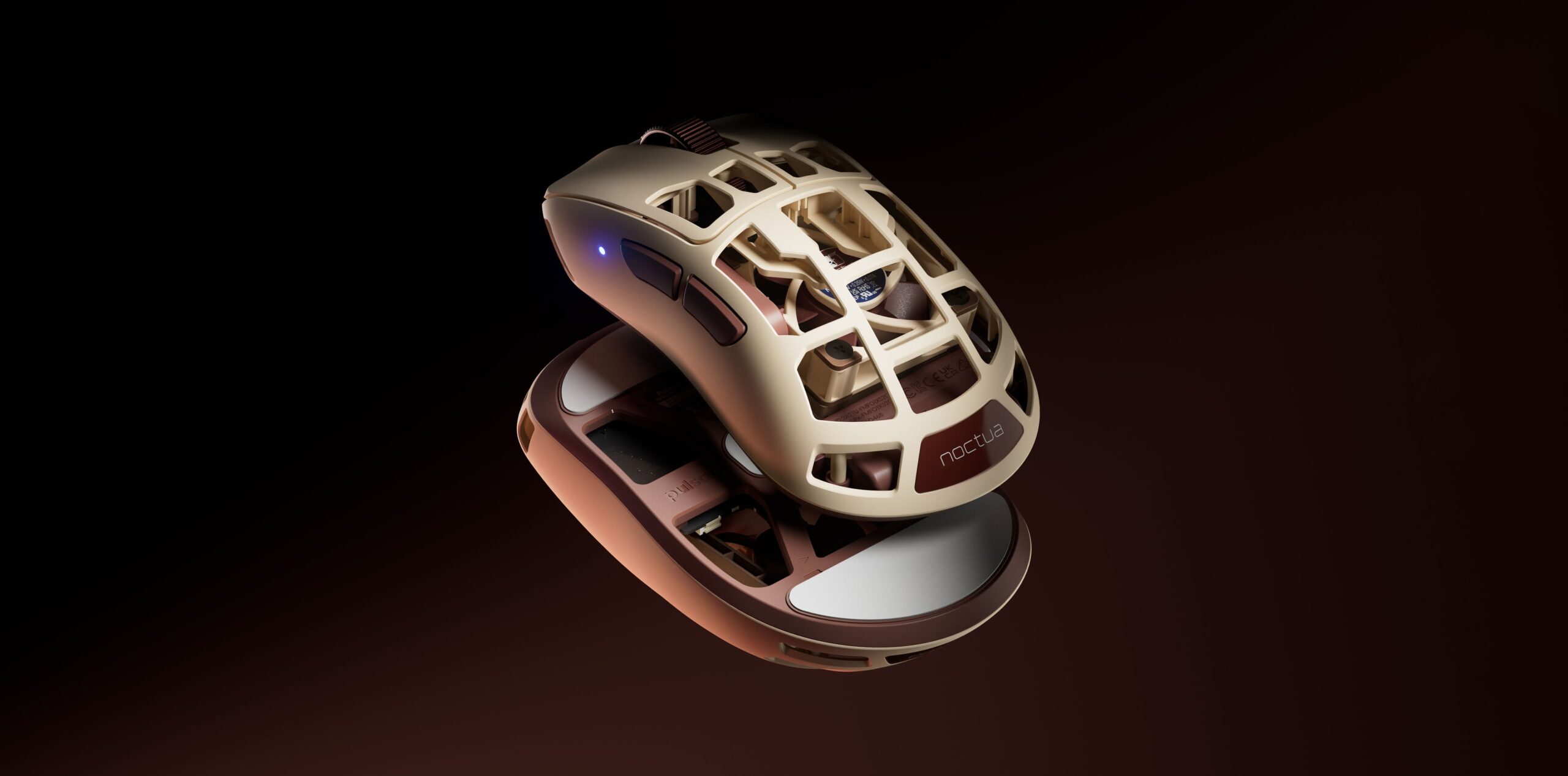
Sweaty palms during long gaming sessions rarely get treated as an engineering problem. Pulsar Gaming Gears has decided to treat it as one. The Feinmann F01 Noctua Edition is a wireless mouse with a 40mm fan from the Austrian cooling specialist Noctua built into its shell. Even with the fan and a battery on board, the mouse weighs 73g, and it sells for 179.95 USD (about 29,000 yen).
Moving Air Instead of Just Venting It
Shape and weight are the areas mouse makers have refined for years. Heat and moisture under the palm, by contrast, have usually been handled with nothing more than a perforated shell. The Feinmann F01 adds active airflow to that equation.
The fan is Noctua's NF-A4x10 5V PWM, a 40mm unit 10mm thick, with PWM speed control that raises airflow only when it is needed. Noctua was founded in Vienna in 2005 and its fans turn up not only in high-end gaming PCs and workstations but also in medical and laboratory equipment, where quiet operation and long service life cannot be compromised. Adapting that fan to the cramped interior of a mouse is what this partnership set out to do.
Air travels through the interior and exits through the perforated shell, so heat has less chance to build up beneath the hand. A cooler grip is a more stable grip, and the goal is to keep the feel of the mouse from drifting over the course of a long session.
A Fan and a 500mAh Cell, Still at 73g
Adding a cooling system normally adds weight. The Feinmann F01 comes in at 73g (±2g). The body uses a high-strength carbon composite, with perforations that open up airflow without giving up rigidity.
It measures 121.7mm long, 66.5mm wide and 43.3mm tall, with an ergonomic right-handed shape that lands in the medium size class. A 500mAh battery powers both the mouse and the fan. Running the fan naturally drains it faster, so runtime shifts with polling rate and fan speed. Switch the fan off and you prioritize battery life; leave it on and you prioritize cooling. That trade-off is left to the user.
The New XS-2 Sensor and 8,000Hz Polling
Tracking comes from Pulsar's new flagship sensor, the XS-2. It reaches 42,000 DPI, tracks at 800 IPS and tolerates 70G of acceleration, with DPI adjustable in single-count steps. A 32-bit ARM processor sits behind it.
The bundled LINK 8K receiver supports polling rates up to 8,000Hz, cutting response latency to 0.125ms. The main switches are Pulsar optical units rated for 100 million clicks, which structurally avoid the double-click chatter that mechanical contacts tend to develop. Lift-off distance is adjustable across 11 steps from 0.7mm to 1.7mm, and the scroll wheel is machined from an alloy.
Fan Control Without Installing Anything
The control scheme is the interesting part. Fan speed can be changed from the receiver or from the mouse itself. On the mouse, holding both side buttons and scrolling up turns cooling on; scrolling down turns it off. Speed steps use the same gesture, so adjustments happen without lifting your hand mid-match.
The receiver carries a dedicated DPI button plus a function button that can be remapped to polling rate, profile, lift-off distance, turbo mode or debounce time. For finer tuning, Pulsar's browser-based configuration tool, Bibimbap, handles DPI, fan speed and macros, which means no driver installation is required.
179.95 USD, Three Items in the Box
The price is 179.95 USD (about 29,000 yen), sold through Pulsar's own sites and authorized resellers worldwide. The box contains the mouse, the LINK 8K receiver and a USB-C cable.
Judged on the fan alone this could read as a novelty, but the sensor and switches are the company's current top-tier parts, and the spec sheet matches its flagship models. For anyone who has fought with sweaty hands, this is the first option that adds cooling without conceding weight or sensor performance.
※1 USD = 162 JPY (as of July 21, 2026)
Summary
The Feinmann F01 Noctua Edition, built by Pulsar Gaming Gears together with Noctua, is a wireless gaming mouse that houses a 40mm NF-A4x10 5V PWM fan and still weighs 73g. It pairs a 42,000 DPI XS-2 sensor with 8,000Hz polling and optical switches rated for 100 million clicks, and the fan can be driven from either the mouse or the receiver. At 179.95 USD, its argument is that heat and sweat during long sessions belong in the spec sheet rather than in the user's tolerance.