
Samsung has explained in detail the technology that underpins call quality on its Galaxy Buds4 Pro true wireless earbuds. The centerpiece is Sensor Fusion, a system that combines several sensors to lift the user's voice out of surrounding noise. By pairing three microphones and a bone-conduction sensor with AI that runs on the earbud itself, Samsung says it can keep your voice clear to the person on the other end even in noisy places. Here is a summary of what the company shared.
Why calls through earbuds are hard to hear
For anyone who uses wireless earbuds every day, being hard to hear on a call is a familiar frustration. The reason is simple: an earbud's microphone sits much farther from your mouth than a phone held near your face, so your voice is harder to pick up. On a typical earbud with a single microphone, call quality drops as soon as the ambient noise grows louder than your voice.
Galaxy Buds4 Pro answers that problem with Sensor Fusion, which reads and adapts to the surrounding environment. Rather than relying on a single input, it combines the information from multiple sensors to recognize what kind of place you are in, then isolates your voice accordingly.
Three microphones and a bone-conduction VPU capture your voice
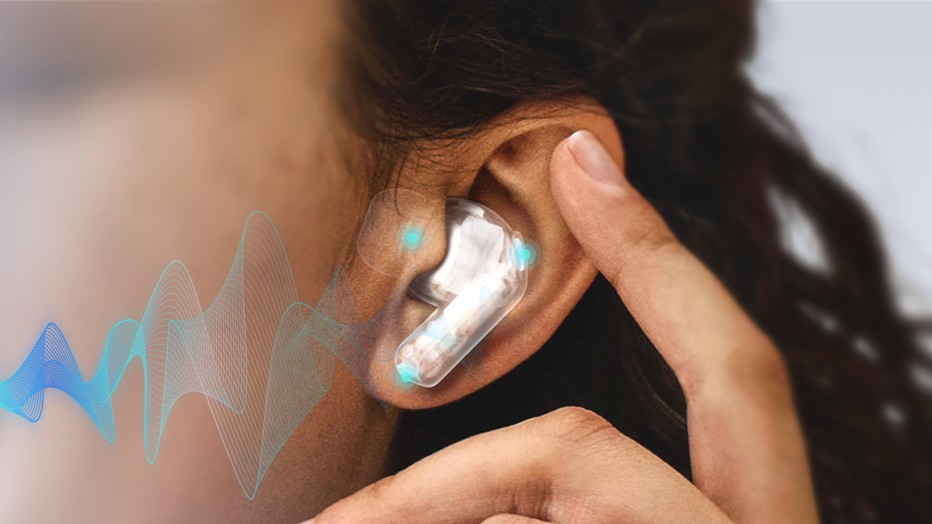
Galaxy Buds4 Pro carries three microphones. Two external mics pick up the user's voice directly, while one internal mic captures speech that travels through the body. On top of that, a bone-conduction VPU (Voice Pickup Unit, a dedicated sensor for capturing the voice) detects the physical vibrations produced in the head when you speak.
Working together, these microphones and the sensor can accurately separate and reconstruct only your voice out of the surrounding noise. Using not just the sound of the voice but also the vibrations it creates as a second cue is what sets this apart from a conventional single-microphone approach.
Running an AI noise-reduction model inside the earbud
At the heart of the noise reduction is an AI called a DNN (Deep Neural Network), loosely modeled on the structure of the human brain. Software like this normally demands large amounts of computing power, which is hard to fit inside a tiny earbud. Samsung optimized the algorithm for processing on the device, cutting the computing load to roughly 10 percent of the original and shrinking the model to 30 percent of its size. That brought on-device AI voice processing to a compact earbud.
Suppressing noise alone does not make a call sound natural. Galaxy Buds4 Pro analyzes past, present and predicted sound data to adapt on the spot to fast-changing surroundings. Samsung also raised the precision of capturing vocal detail to 16 times that of previous models, so everything from high tones to consonants and faint word endings stays intact.
Fit-leak correction and real-world tuning
Earbuds shift slightly as the body moves, and gaps can let noise seep in through what Samsung calls fit leakage. Galaxy Buds4 Pro constantly analyzes signals from the inner and outer microphones to estimate that leakage in real time, then adjusts the audio dynamically to keep the call clear. Paired with a Galaxy smartphone, it can also use a Super Wideband connection of up to 16 kHz for a richer, more natural voice.
During development, Samsung went beyond lab tests that recreate the sounds of real locations with large wind simulators. It ran field tests in noisy settings such as busy cafes, large stores and echoing train stations, and even checked performance while walking outdoors at night or riding in a car with the windows down, aiming for results that hold up in genuinely real-world situations.
Price and positioning
The Galaxy Buds4 series first appeared at Galaxy Unpacked in February 2026. The flagship Pro model is priced overseas at 249 USD (about 40,000 yen), holding the same level as the previous Buds3 Pro. The call technology detailed this time is, in effect, a closer look inside that flagship.
*1 USD = approx. 162 JPY (as of June 25, 2026)
On the audio side, the driver uses a new wider woofer that expands the effective speaker area by about 20 percent over the previous generation. Battery life is rated at up to about 7 hours per earbud and up to about 30 hours with the charging case, enough for everyday use. Note that pricing and how the earbuds are sold vary by region, so it is worth checking the latest local information before buying.
Summary
Galaxy Buds4 Pro's call quality rests on Sensor Fusion, which combines three microphones with a bone-conduction VPU, and on AI noise reduction trimmed down to run inside the earbud. The story here is how Samsung tried to overcome the physical limits of a tiny earbud through more sensors, optimized algorithms and extensive real-world tuning. For anyone who has struggled with calls in noisy places, it looks like an option worth watching.