On May 18, 2026, a group of mobile battery makers and Japan's major telecom carriers signed a cooperation agreement to deliver mobile batteries and charging cables to disaster-stricken areas when large-scale disasters strike[1][2]. Seven manufacturers — including Anker Japan, CIO, and Elecom — will supply the equipment, while NTT Group, KDDI, SoftBank, and Rakuten Mobile will handle the last-mile delivery to evacuation shelters. Operations begin on June 1, 2026[1][2].
Seven makers and four major telecom groups team up
On the maker side, the seven companies are Anker Japan, INFORICH, EcoFlow Technology Japan, Elecom, Owltech, CIO, and Ugreen Japan[1][2]. Each of them already sells high-capacity mobile batteries or portable power stations, so the lineup is heavy on companies that specialize in the kind of charging infrastructure people actually need during a disaster.
On the carrier side, the participants come from the NTT Group's "Tsunagu × Kaeru Project," which spans NTT, NTT East, NTT West, NTT DOCOMO, and NTT DOCOMO Business — five companies — plus KDDI, SoftBank, and Rakuten Mobile[1]. The result is a cross-industry framework that puts every major Japanese mobile carrier and NTT's fixed and mobile arms on the same line.
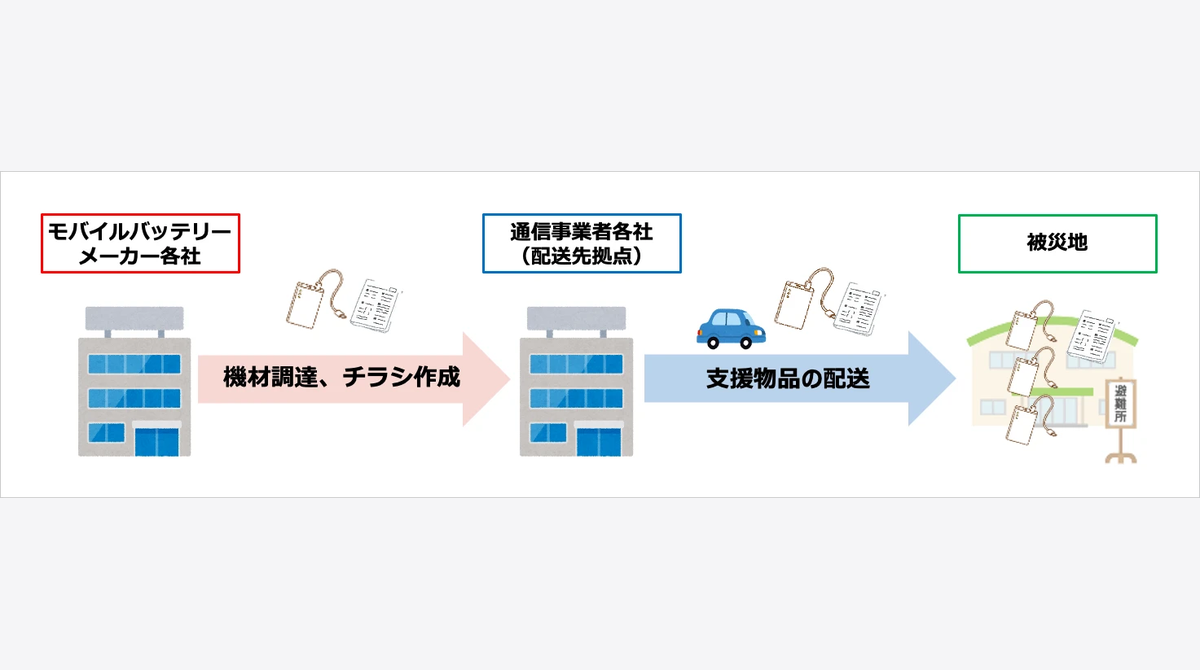
The flow chart released alongside the announcement shows manufacturers consolidating gear and informational flyers at telecom-operated hubs, from which the carriers fan the supplies out to disaster areas[1]. The fact that this same workflow is standardized across all seven makers is arguably the most important part of the deal.
What gets delivered, and how the operation runs
The goods on offer are mainly mobile batteries and charging cables[1]. Item types and quantities are decided case by case based on the needs on the ground, the severity of the damage, and each maker's current stock — there is no fixed stockpile of specific models, so the program is designed to move flexibly rather than rigidly[1].
Each shipment also includes flyers covering how to use the gear, contact points, and return procedures[1]. Building the return flow into the program from day one is notable: equipment is meant to circulate back rather than be handed out one-way, so the same hardware can be redeployed for the next event.
In practical terms, makers ship the equipment and flyers to consolidation hubs designated by the telecoms, and the telecoms then move it onward to evacuation shelters as needed, drawing on their own field presence[1]. Carriers are already on the ground during disasters to keep communications running, so this essentially adds "power" to a network they already operate[1].
Each maker will publish a shared status update on its own website in a common format, making it easier for users to see which equipment is moving where[1]. Standardizing the message across companies — rather than letting each maker post in its own way — is a meaningful piece of design from the user's point of view.
Why now, and what comes next
The stated rationale is that today's disaster response increasingly depends on smartphones — for reaching family, checking on relatives, and getting official information — and the partnership is meant to address the reality that handsets quickly become useless once the power goes out[1]. Lines of evacuees waiting at a single power strip have been a recurring scene in past disasters. Individual makers have run their own relief programs, but the last-mile logistics are hard for any one company to cover alone; pairing the makers with the carriers' field network is what makes it realistic to get equipment to the shelters that actually need it[1].
The seven participating companies are all firms whose main business revolves around mobile batteries and charging accessories, which aligns nicely with the "ready-to-use charging infrastructure" that evacuation shelters require[1]. With multiple brands working in parallel, the equipment mix can be tuned to the size of each shelter and how long people will be sheltering there.
The group says it will run joint drills and look at adding more partner companies going forward[1]. In other words, the current seven-maker / four-carrier setup is the starting line, not the finish.
Summary
The cooperation agreement signed between seven mobile battery makers and NTT Group, KDDI, SoftBank, and Rakuten Mobile is essentially an industry-wide framework for delivering mobile batteries and charging cables to evacuation shelters during disasters[1][2]. With the launch set for June 1, 2026, along with shared status reporting and joint drills, the deal stands out as a piece of infrastructure for the part of modern daily life that depends on a charged smartphone.
Source [1]: https://www.softbank.jp/corp/news/press/sbkk/2026/20260518_02/