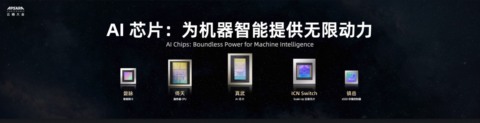


Chinese CPU maker Zhaoxin presented computing solutions built around its in-house, x86-compatible "ZX86" processor family at the China International Finance Expo, which opened in Shanghai on June 16, 2026[1]. The display spanned the KaiXian KX-7000 for desktops, the KaiSheng KH-50000 server processor with up to 96 cores, and AI computing platforms aimed at the financial sector. The message was clear: a fully domestic computing foundation positioned as the base for the financial industry's push toward digital and intelligent operations.
The full picture of ZX86 at the expo
This year's China International Finance Expo was held at the Shanghai World Expo Exhibition Hall under the theme of building the foundation for a strong financial nation and pursuing the future through digital-intelligent innovation, with eight core exhibition zones covering areas such as financial infrastructure and financial technology[1].
There, Zhaoxin brought together its lineup of in-house CPUs based on the ZX86 architecture. The company says it defines and extends its own instruction set while maintaining compatibility, following a principle it describes as remaining independent without being closed off, and compatible without being dependent[1]. The centerpieces were the KaiSheng KH-50000 for high-performance servers and the KaiXian KX-7000 for desktop and embedded use, combined with AI computing solutions for financial institutions.
The 96-core KH-50000 at the core
At the top of the lineup sits the flagship KaiSheng KH-50000 server processor. According to Zhaoxin, it uses an in-house microarchitecture and a chiplet-based interconnect that links multiple dies, offering up to 96 cores and 384 MB of L3 cache per processor[1]. It supports two- and four-socket scaling and targets AI inference, cloud, and large-scale data processing in data centers.
According to third-party media reports, the KH-50000 is built from 12 compute chiplets and one I/O die, with a base clock of 2.2 GHz that boosts to 3.0 GHz[2]. Memory support is 12 channels of DDR5-5200 with ECC per socket, up to 3 TB, and external connectivity includes 128 lanes of PCIe 5.0, supporting both Zhaoxin's proprietary ZPI 5.0 interconnect and the industry-standard CXL[2][3]. A four-socket configuration reaches up to 384 cores in a single system, though the thermal design power (TDP) has not been disclosed[2]. The instruction set is compatible with 32- and 64-bit x86, and the company reportedly improved per-clock performance (IPC) by about 30 percent over the previous generation[3]. Zhaoxin says the KH-50000 has earned a place on China's 2025 craftsmanship product list and several semiconductor and IC design awards since its launch[1].
Expanding financial computing through an ecosystem
Zhaoxin did not display CPUs alone; it also lined up hardware from partner companies that adopt the KH-50000[1]. Examples include a general-purpose server carrying two KH-50000 chips for up to 192 cores, Lenovo's KaiTian KR722z G3 2U rack server, and an all-in-one machine combining an AI computing card. On the GPU side, it showed a configuration using a compute accelerator from Moore Threads, underscoring the goal of assembling everything from hardware to software domestically.
The company also presented four AI solutions for finance developed with software partners[1]. These include a platform that lets enterprises deploy their own large language models, and an AI agent platform that automatically structures over-the-counter quotation data and assists with report analysis. The idea is to layer applications tied directly to financial operations on top of the ZX86 computing foundation.
The aim behind "self-controllable" computing, and the questions that remain
Behind this series of exhibits lies China's policy drive to keep its computing foundation self-controllable, meaning controllable in-house. In a field like finance, where availability and security are scrutinized heavily, demonstrating that everything from the CPU to servers and AI software can be built domestically was the central aim of this showing.
At the same time, the KH-50000's power metrics such as TDP have not been disclosed, so there is limited basis right now for judging real-world power efficiency or performance against the latest generations from AMD and Intel[2]. How far the design philosophy of balancing compatibility and independence holds up in actual financial systems will need to be assessed through future adoption records.
Summary
At the China International Finance Expo, Zhaoxin showed, as an integrated package, its in-house ZX86 architecture at the core, the 96-core KaiSheng KH-50000, the desktop-oriented KaiXian KX-7000, and partner servers and financial AI solutions. The push to sell a fully domestic computing foundation to the financial sector came into clear focus, while points such as power efficiency and comparisons with rivals' latest products remain open questions to be verified going forward.
出典:https://www.zhaoxin.com/news_view.aspx?nid=2&typeid=289&id=2048
出典:https://www.techpowerup.com/341487/zhaoxin-kh-50000-cpu-family-brings-96-cores-ddr5-and-zpi-5-0