Sony has announced the Xperia 1 VIII, the newest model in its flagship smartphone line. It goes on sale on June 11, with an estimated street price starting around 236,000 yen. The phone wears a new design built around the theme of a raw, uncut stone, enlarges the telephoto camera sensor to roughly four times that of the previous model, and adds a new AI Camera Assistant aimed at people who struggle with photography. Familiar touches such as the headphone jack and microSD card slot carry over as well.
A New "Raw Stone" Design and Four Colors
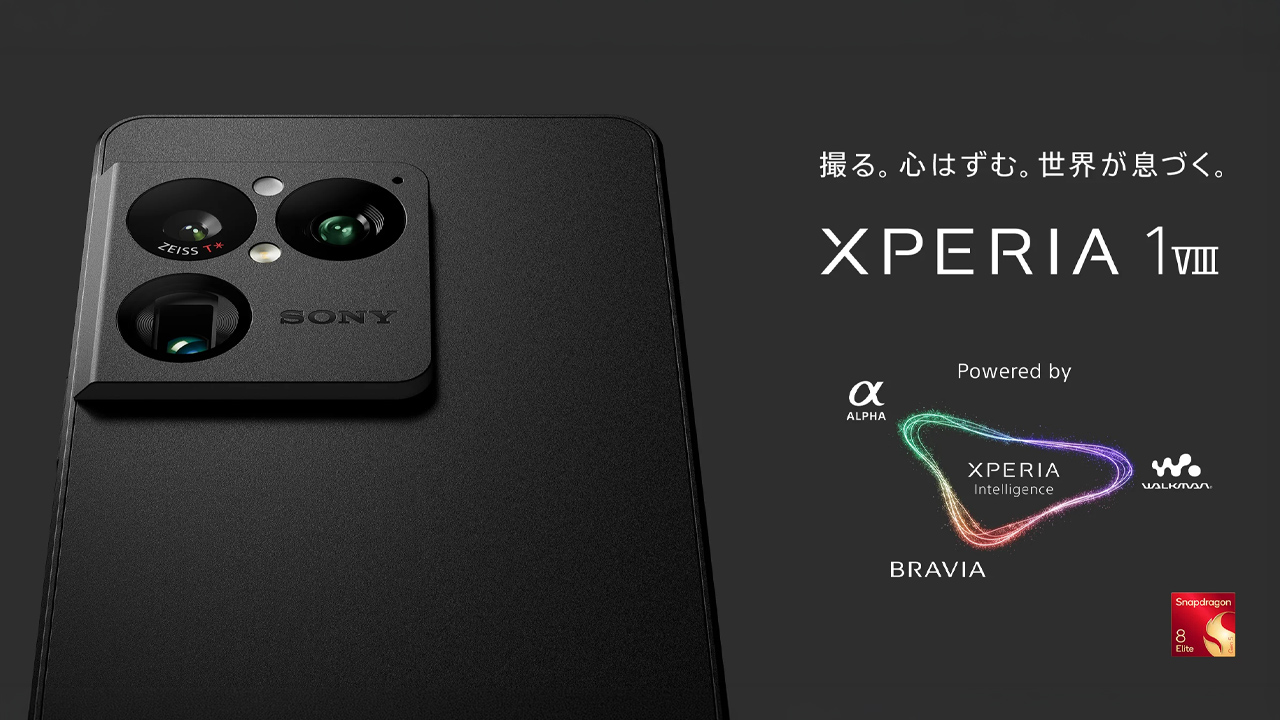
The Xperia 1 VIII sits at the top of the Xperia lineup as the flagship model. It adopts a new design called ORE TEXTURE. ORE refers to raw stone or mineral ore, and the texture of both the rear glass and the aluminum frame has been carefully finished to heighten the sense of presence when you hold it.
The phone comes in four colors: Graphite Black, Iolite Silver, and Garnet Red, plus Native Gold exclusive to the SIM-free model. Each shade evokes stone or natural materials, tying the palette back to the design concept.
One thing that stands out is the redesign of the vertical camera arrangement that had continued since the original Xperia 1. The change accompanies the larger sensor, and the rear camera section now has a more assertive look than before. At the same time, the microSD card slot, the 3.5mm headphone jack, and the dedicated shutter button are all retained.
Telephoto Sensor Grows About 4x, and RAW-Stage Processing Evolves
The camera uses a triple-lens layout: a 16mm ultra-wide, a 24mm wide-angle, and a telephoto covering 70mm and 140mm. Image quality has improved across all lenses, but the telephoto camera is the centerpiece this time. Its sensor measures 1/1.56 inch, roughly four times larger than the one in the previous model.
In exchange for the bigger sensor, the telephoto optical zoom has been dropped. Even so, by cropping from 48 megapixels the phone delivers a 140mm-equivalent zoom that Sony says is on par with the previous model in quality. The camera also supports RAW Multi-frame Processing, which performs the image-stacking step at the RAW stage. This is said to suppress blown highlights and crushed shadows while raising the sense of detail, allowing for full-frame-like texture even in dark settings.
Close-up shooting has become easier to handle, too. Tele-macro shooting, which previously offered manual focus only, now supports autofocus including Eye AF and Touch AF. There is no longer a need to launch a dedicated mode; you can move straight into macro from the photo, video, and Pro modes. The Auto Framing feature, which captures both the full scene and a close-up of the subject at once, now works with the telephoto lens, reaching up to 2.9x optical and 5.8x digital zoom so you can catch a distant subject's expression.
"AI Camera Assistant" for Beginners
A new feature worth noting is the AI Camera Assistant. Designed for beginners who want to take good photos but do not know where to start, it suggests recommended looks based on the scene the AI recognizes. The suggestions draw on Creative Look, the color expression also found in Sony's Alpha mirrorless cameras, broadening the room for creative shots even when you leave the work to the camera.
High-performance cameras tend to have many settings, and that complexity can be a weak point. By lowering the barrier to getting started, this feature looks like a smart move for putting flagship capability into more people's hands.
Sound, Display, and a Phone Built to Last
On the audio side, the built-in speakers have been redesigned. Smartphones usually use different-sized left and right speakers because of internal space constraints, but the Xperia 1 VIII is the first in the Xperia series to use identically sized speakers on both sides. The newly developed speakers raise the volume and add a greater sense of presence in both the low and high ranges.
The 3.5mm headphone jack remains, and the phone inherits technology from Sony's WALKMAN digital audio players. Even over Bluetooth, Sony says that pairing with its WF-1000XM6 wireless earbuds produces almost no audio dropouts and accurately picks up the wearer's voice during calls.
The display draws on technology from Sony's BRAVIA televisions. It has one illuminance sensor on the front and one on the back to adjust brightness automatically, keeping the screen readable in direct sunlight or in the dark. The refresh rate is variable from 1Hz to 120Hz.
The battery is built for the long haul as well. Capacity is 5,000mAh, said to last two days under certain test conditions, and to retain more than 80 percent of its original capacity even after four years of use. For heat management, the phone includes a heat-spreading sheet and a vapor chamber. On the software side, Sony promises four Android OS version upgrades and six years of security updates.
Price, Release Date, and Key Specs
The Xperia 1 VIII goes on sale on June 11. Estimated street prices vary by configuration: about 236,000 yen for the 12GB/256GB model, about 252,000 yen for the 12GB/512GB model, about 269,000 yen for the 16GB/512GB model, and about 300,000 yen for the 16GB/1TB model.
The body measures 162 x 74 x 8.3mm and weighs 200g. The display is about 6.5 inches with a 19.5:9 aspect ratio, and the chipset is Qualcomm's Snapdragon 8 Elite Gen 5. The SIM-free model also supports 5G mmWave. A genuine accessory, the Style Cover with Stand for Xperia 1 VIII, comes in a semi-transparent design that lets the phone's own texture show through, at an estimated price of around 5,500 yen.
Summary
The Xperia 1 VIII centers on a design themed around raw stone, sharpens its camera with a larger telephoto sensor and RAW-stage processing, and addresses the difficulty of mastering a camera through a beginner-friendly AI Camera Assistant. By keeping the headphone jack, microSD support, and long-term updates, it also stays an appealing choice for anyone who wants to use a flagship for years.