SHARP announced its high-end smartphone, the AQUOS R11, on June 16. It adds the series' first telephoto lens to a Leica-tuned triple camera and introduces a new feature that lets AI automatically adjust the zoom factor to match the subject. On the back, an LED called "Akarium" sits in the center of the camera ring and sets a mood with light and sound. Pairing a 3,600-nit peak Pro IGZO OLED display with the Snapdragon 8s Gen 4, the phone rolls out from July 9 through docomo, SoftBank, and as a SIM-free model.
Leica-Tuned Triple Camera, the Series' First Telephoto at Up to 5.9x Optical Zoom
The AQUOS R11 carries a three-lens camera tuned by Leica. The main and ultrawide cameras use high-resolution sensors of roughly 50.3 megapixels each, and a new telephoto camera of about 38.5 megapixels has been added. This is the first time the AQUOS R series has included a telephoto lens, and optical zoom reaches up to 5.9x.
By adding telephoto to the existing standard and ultrawide lenses, the phone can now cover everything from everyday snapshots to expansive landscapes and distant subjects while preserving image quality. Combining the high-resolution sensors SHARP has long developed with a telephoto lens is a clear move to shore up the distant-shot weakness that has dogged the AQUOS R series.
AI Assists Both Composition and Privacy
AI plays a prominent role in the shooting experience. Tapping a dedicated icon in the camera app activates "Smart Fit Zoom," which recognizes the subject and sets the zoom factor automatically. Even when one hand is occupied, it makes it easier to get close to the ideal framing.
The phone also includes "Privacy Safe," which uses AI to detect text on signs and billboards during shooting and blur it automatically. Because addresses and personal information caught in a street snapshot can be hidden on the spot, it cuts down on the manual editing usually needed before posting to social media. The design supports both composition while shooting and safety after the shot, all through AI.
The Rear LED Ring "Akarium" Sets a Mood with Light and Sound
A distinctive part of the AQUOS R11's look is "Akarium," an LED placed at the center of the rear camera ring. Instead of lighting up the screen, it gently signals notifications and incoming calls through the light on the ring. The light comes in eight colors inspired by hues found in nature, so it can be used differently depending on the situation.
There is also a feature that links healing sounds recorded from nature with light themed on motifs such as a campfire or a babbling stream. The idea of using the phone like indirect lighting before bed or during a break is a new angle that earlier AQUOS models did not offer. It is unusual in that a single LED serves both the practical job of checking notifications and a relaxation effect.
A 3,600-nit Pro IGZO OLED and the Snapdragon 8s Gen 4
The display is a roughly 6.5-inch Pro IGZO OLED, with peak brightness raised to 3,600 nits. It stays readable under strong sunlight, and by automatically correcting low-gradation areas it keeps visibility even in dim outdoor conditions. The resolution is Full HD+ (1,080 x 2,340), and the refresh rate supports variable operation from 1 to 240 Hz, balancing smoothness and power savings according to what is on screen.
At its core is Qualcomm's Snapdragon 8s Gen 4. According to SHARP, CPU performance is up about 13 percent and GPU performance about 40 percent compared with the previous model. Memory is 12 GB, and storage is 256 GB for the docomo and SoftBank versions and 512 GB for the SIM-free model. The battery is a sizable 5,100 mAh, and a newly designed heat-dissipation component is said to keep performance stable through long stretches of video and gaming. Water and dust resistance covers IP68 as well as IP69, which withstands high-temperature, high-pressure water jets.
Price and Release Date
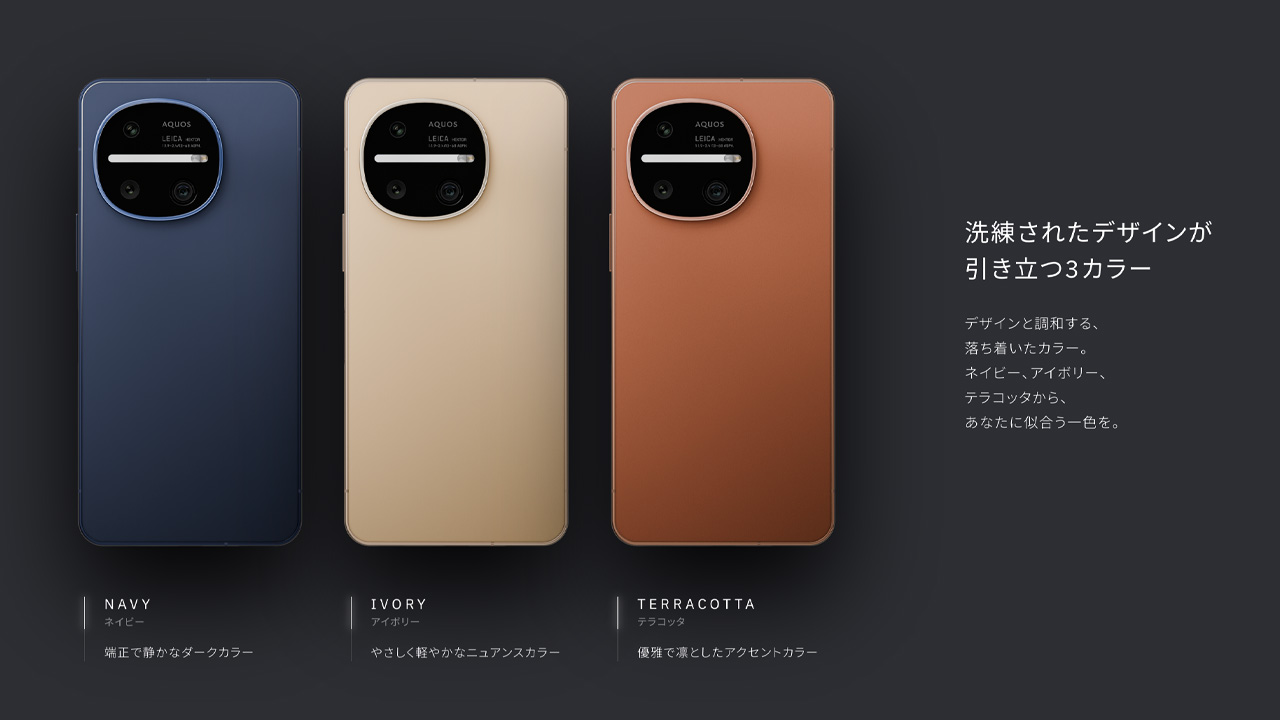
The AQUOS R11 will roll out from July 9 onward through docomo, SoftBank, and an open-market SIM-free model. Prices are 162,470 yen for the docomo version, 156,960 yen for the SoftBank version, and 163,900 yen for the 512 GB SIM-free model. The body comes in three colors: navy, ivory, and terracotta.
At around 160,000 yen, the price is relatively accessible for a recent flagship. Considering the first telephoto camera, the boost in processing power, and the distinctive Akarium, it adds up to a natural, easy-to-accept evolution of the AQUOS R series.
Summary
The AQUOS R11 is a summer 2026 flagship that packs unique features: a Leica-tuned camera with its first telephoto lens, AI-driven zoom adjustment and privacy protection, and the rear "Akarium" light. It also raises its baseline strength with a 3,600-nit Pro IGZO OLED, the Snapdragon 8s Gen 4, and a 5,100 mAh battery. How well owners put the telephoto and AI features to use in daily life will likely shape their satisfaction after buying.