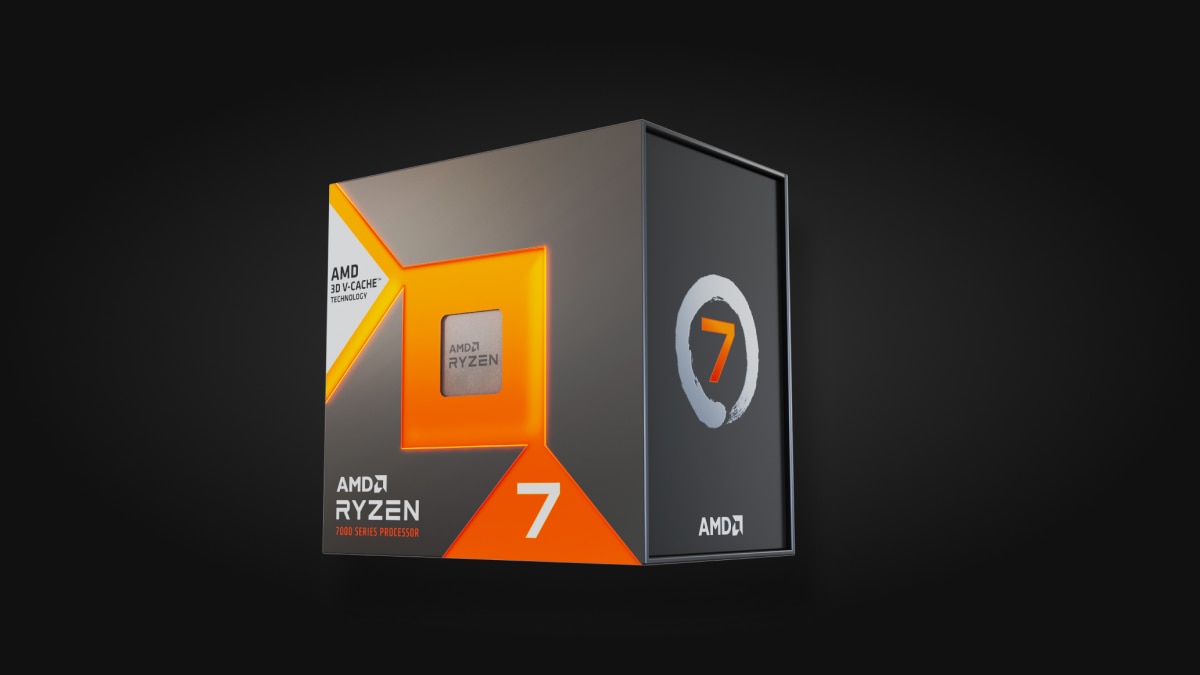
AMD's gaming-focused Ryzen 7 7700X3D is now on sale in Japan. It carries 96MB of L3 cache courtesy of 3D V-Cache technology, yet sits below the existing Ryzen 7 7800X3D in AMD's lineup. The suggested price in North America is a modest 329 USD, but the Japanese retail price is 63,980 yen including tax. That leaves the chip more expensive than the very model it is meant to sit under.
Eight cores, sixteen threads and 96MB of L3
The Ryzen 7 7700X3D is a Zen 4 desktop processor for Socket AM5. It offers 8 cores and 16 threads, a 4.0 GHz base clock and a 4.5 GHz maximum boost clock, with a default TDP of 120W.
The defining feature is the L3 cache expanded by AMD 3D V-Cache technology. The 96MB total comes from stacking a dedicated cache die directly on top of the compute die. Add the 8MB of L2 and 512KB of L1, and the chip carries well over 100MB of cache in total.
Cache matters in games because game workloads scatter memory accesses in small, unpredictable chunks. When the data a frame needs is already sitting in cache, the CPU never has to walk out to main memory, and the frame time dips that follow shrink. That single-minded focus is why the X3D line has earned its reputation among gamers.
The compute die (CCD) is built on TSMC 5nm and the I/O die on TSMC 6nm. The CCD measures 71 square mm and the I/O die 122 square mm. Two AMD Radeon Graphics cores are integrated and run at 2200 MHz. A discrete GPU is assumed for this class of chip, but having video output on board means you can still build and troubleshoot the system without one.
Only the clocks separate it from the 7800X3D
With the same eight cores and the same 96MB of L3, the Ryzen 7 7700X3D shares almost identical foundations with the higher-end Ryzen 7 7800X3D. Clock speed is what divides them.
The 7800X3D runs at a 4.2 GHz base and a 5.0 GHz boost, against 4.0 GHz and 4.5 GHz for the 7700X3D, a 500 MHz gap at the top end. Since cache capacity is unchanged, it is reasonable to expect the gaming performance difference to land roughly within that clock gap. The big cache that makes X3D worth buying is fully intact, which should have made this an easy value pick.
Should have, because Japanese pricing has not lined up the way it was supposed to.
329 USD abroad, 63,980 yen at home
The North American suggested price is 329 USD (about 53,000 yen). Set against the 449 USD (about 73,000 yen) that the Ryzen 7 7800X3D launched at, AMD has effectively opened an entry point into X3D that costs 120 USD less.
*Converted at 1 USD = 162 JPY (as of July 20, 2026)
In Japan, however, the retail price is 63,980 yen including tax. And on July 16, the day before it went on sale, the higher-tier Ryzen 7 7800X3D was selling for 48,000 yen. The lower model ended up more than 15,000 yen more expensive, an inversion that rarely happens.
The 7800X3D launched in 2023 and has spent long enough in the channel for street prices to fall well below its debut figure. The 7700X3D is brand new and still carries its opening price. When a fresh product shares shelf space with a mature one, this kind of inversion is possible. Even so, looking at current Japanese pricing, it is hard to find a reason to pick the 7700X3D.
Until prices settle, the 7800X3D with its identical 96MB cache is the straightforward choice. The 7700X3D will only start working as the entry-level X3D chip it was designed to be once Japanese pricing drifts down toward the 329 USD equivalent.
Platform requirements and one easy oversight
The chip uses Socket AM5 and supports the A620, B650, B650E, X670, X670E, B840, B850, X870 and X870E chipsets. Memory is dual-channel DDR5 with a 128GB maximum. AMD EXPO memory overclocking is supported, and ECC memory works if the motherboard allows it. PCI Express 5.0 is supported with 28 total lanes and 24 usable.
The easiest thing to miss is the cooler. The boxed version (part number 100-100002235WOF) does not include one, so you need to budget separately. AMD recommends a liquid cooler for optimal performance, and the maximum operating temperature is set at 89 degrees Celsius. Choosing a cheap air cooler based on the 120W TDP alone will leave boost clocks short of their potential.
Summary
The Ryzen 7 7700X3D is the entry model of the X3D line, carrying the same 96MB L3 cache as its bigger sibling while trimming clocks to bring the price down. The 329 USD North American figure reflects that intent clearly. In Japan, though, it arrived at 63,980 yen including tax, above the roughly 48,000 yen that buys the faster 7800X3D. If you are building an AM5 system for the benefits of 3D V-Cache, watching how prices move for a while is the wiser move right now.