
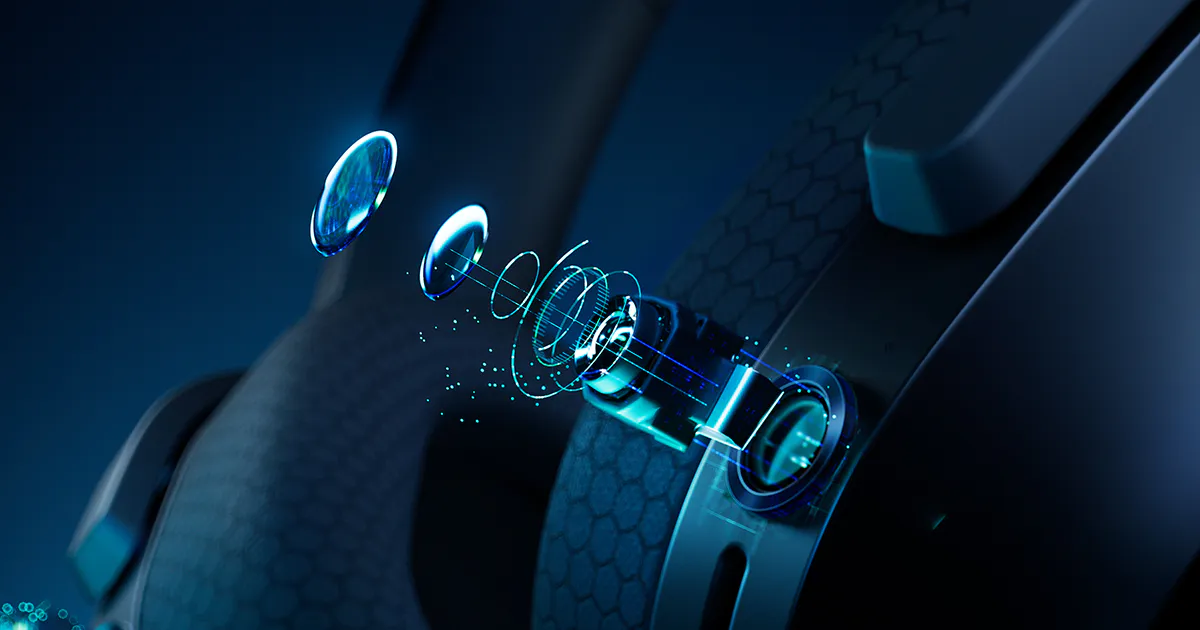
Razer has confirmed that Project Motoko, the wearable AI headset it showed as a concept at CES 2026, is heading to market as a real product. The design puts a first-person-view camera in each earcup so the device can work with what the wearer sees and what the wearer hears at the same time. A release date and price have not been announced.
From Show Floor Concept to Shipping Plan
Project Motoko first appeared at CES in early 2026 as an experimental device. The shell is a full-size wireless gaming headset, but the internals are built around AI processing. At the time it was framed as a prototype meant to sketch out a direction. Razer has now said it intends to sell it, and that the product is coming soon.
While most companies chasing wearable AI have settled on smart glasses, Razer picked a headset instead. Glasses limit how much hardware can be packed into lenses and frames, whereas an over-ear enclosure leaves room for a larger battery and a real processor. There is no display, so the device is designed to answer by voice rather than show anything.
Two Cameras Sitting at Eye Level
The core of Motoko is a pair of cameras, one in each earcup, positioned so they sit at roughly the same height as the wearer's eyes and capture whatever the wearer is facing.
Using two cameras adds depth. Razer says the stereoscopic setup can locate objects with sub-millimeter accuracy. It also keeps a wider field of attention than human vision, so signs and text at the edge of view can still be picked up.
Audio is handled the same way, with multiple pickup points. Near-field and far-field microphones work together to separate the wearer's own voice, speech from whoever is in front of the cameras, and ambient sound. Matching the visual scene against the audio is how the system tries to work out what is happening.
Snapdragon Inside, With a Choice of AI
Compute runs on Qualcomm's Snapdragon platform. Razer is working with Qualcomm on this device, and the design assumes a meaningful amount of processing happens on the headset itself.
The other notable decision is that Motoko is not tied to one AI service. It connects to Grok, OpenAI models, and Gemini, and users can switch between them depending on the task. For a hardware maker without its own model, that is a practical route, and it lets buyers use one service for translation and another for summarization.
Razer lists use cases such as real-time translation of street signs while traveling, reading out cooking steps, walking through a repair, summarizing documents, and offering guidance during games. The common thread is situations where both hands are busy. The company has also said first-person video is valuable training data for humanoid robots, which points to uses beyond the consumer market.
The Open Questions: Privacy and Comfort
Outward-facing cameras running for long stretches raise an obvious problem: people nearby may not know when they are being captured. Recording indicators, where data is stored, and how much is sent to the cloud have not been detailed, and those choices are likely to draw the most scrutiny when the product ships.
The second question is physical. Gaming headsets are built for a few hours at a desk. The scenarios Razer describes involve cooking, traveling, and exercising. Weight, heat, clamping pressure, and battery life all matter far more once the device leaves the desk. There is also the plain question of how many people want to wear a large headset through an ordinary day.
Summary
What sets Project Motoko apart is the decision to build wearable AI into a headset rather than glasses. Stereoscopic cameras in both earcups, near- and far-field microphones, Snapdragon processing, and a choice of AI services are all on the table. What remains is whether the finished hardware holds up. Once the price, battery life, and privacy controls are published, it should become clear whether this stays a niche gaming accessory or turns into a device people actually use every day.