
Preferred Networks and Preferred Robotics announced on September 9 that they are beginning joint development of PLaMo-SemGround, an advanced environmental understanding foundation model for indoor mobile robots. The model combines natural-language instructions with RGB camera images and depth information to judge where a robot may and may not travel, with the goal of handing 90 percent of the setup work to AI. The project has been selected for GENIAC, a program run by Japan's Ministry of Economy, Trade and Industry and NEDO.
The unglamorous work that starts after you buy the robot
Demand for automating transport, patrol and cleaning tasks in warehouses, factories and commercial facilities keeps growing as labor shortages bite. But an indoor mobile robot does not start working the day after it arrives.
Someone has to build a map of the site and then configure site-specific travel constraints one by one: this aisle is one-way, that zone is off-limits, there is a step here. Change the floor layout and the settings have to be rebuilt, which often means calling in a specialist engineer again. That time and cost has remained a barrier to adoption.
PLaMo-SemGround targets exactly this bottleneck. The two companies have set a numerical goal of delegating more than 90 percent of initial setup and operational tasks to AI and on-site staff. The idea is to reach a state where floor staff can simply describe the situation in words instead of booking a specialist.
What the second half of the name, SemGround, refers to
The name combines PLaMo, the domestically built generative AI foundation model PFN develops from scratch, with grounding, a technical term for linking the semantic information carried by language to objects, regions and positions in images and three-dimensional space.
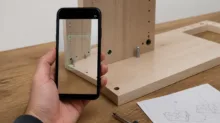
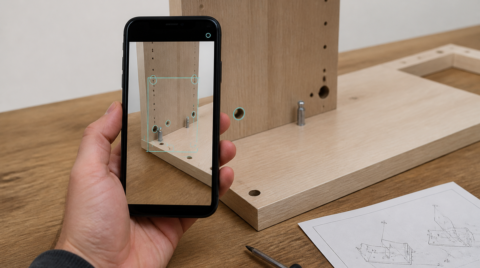
In practice, PLaMo-SemGround takes an instruction such as avoid the packages left on the floor, cross-references it against camera footage and depth measurements to surrounding objects, floors and walls, and pinpoints where those packages are in both two and three dimensions. The result is passed to a semantic map and a path planner, which turn it into the robot's actual movement.
The model is kept at or below the 2 billion parameter class. That is because it is meant to run without going through the cloud, on a computer mounted in the robot itself or on a local PC installed at the site. In factories and warehouses, network latency or an outage translates directly into a stopped robot, and it is not unusual for footage and layout data to be barred from leaving the premises. PFN will apply what it has learned from PLaMo and its vision language model PLaMo-VL to shrinking and optimizing the model.
50 sites and 800,000 frames of real-world data
The development plan has five pillars. PFR handles data collection, gathering RGB images, depth information, travel logs and site rules from more than 50 factories, commercial facilities and other locations that have granted permission. The target is more than 800,000 frames of usable data, collected using transport and cleaning robots as well as a dedicated data-capture cart.
PFN will merge that with public and synthetic data to build a training and evaluation data foundation of more than 20 million samples, usable for visual question answering (VQA) and visual grounding. On the evaluation side, the public benchmark EmbodiedScan will be adapted for the tasks in this project, and a proprietary benchmark will be built using existing data PFR has accumulated across more than 400 sites.
The resulting model will then be installed on PFR transport and cleaning robots and put through field trials across 5 industries and more than 10 sites. Those trials will measure not only spatial recognition performance but also how close the project gets to the 90 percent delegation target.
Field knowledge from Kachaka, and a road map to external sales
PFR has shipped the Kachaka series of autonomous transport robots since 2023 and holds the top manufacturer share of Japan's AMR market for factories and logistics, according to a 2026 Fuji Keizai survey. The operational knowledge accumulated across more than 400 deployments becomes raw material for model development. PFN, for its part, owns everything from generative AI foundation models to its own AI processors. The point of this pairing is that both the data and the compute stay inside the group.
The exit path is spelled out as well. The results will first be implemented in PFR products during fiscal 2028 (April 2028 through March 2029), after which PFN plans to sell them commercially in stages to domestic robot makers, system integrators and facility management operators in the form of model licenses, SDKs and evaluation infrastructure. Selling it as a foundation that can also run on other companies' robots, rather than keeping it closed to PFR hardware, was built into the plan from the start.
The scope is not limited to AMRs and AGVs either. Application to legged robots and humanoids is also in view, so the plan is not confined to wheeled machines.
Summary
PLaMo-SemGround is a foundation model aimed not at robot hardware performance but at the unglamorous setup work that precedes it. Even the modest scale of 2 billion parameters or less reads as a design derived from the requirement to run at the edge. First implementation comes in fiscal 2028, so results are still some way off, but a plan that starts by collecting real data from 50 sites reflects companies that know how messy the field really is. It is a project that names, once again, exactly where robot adoption in Japan gets stuck.