
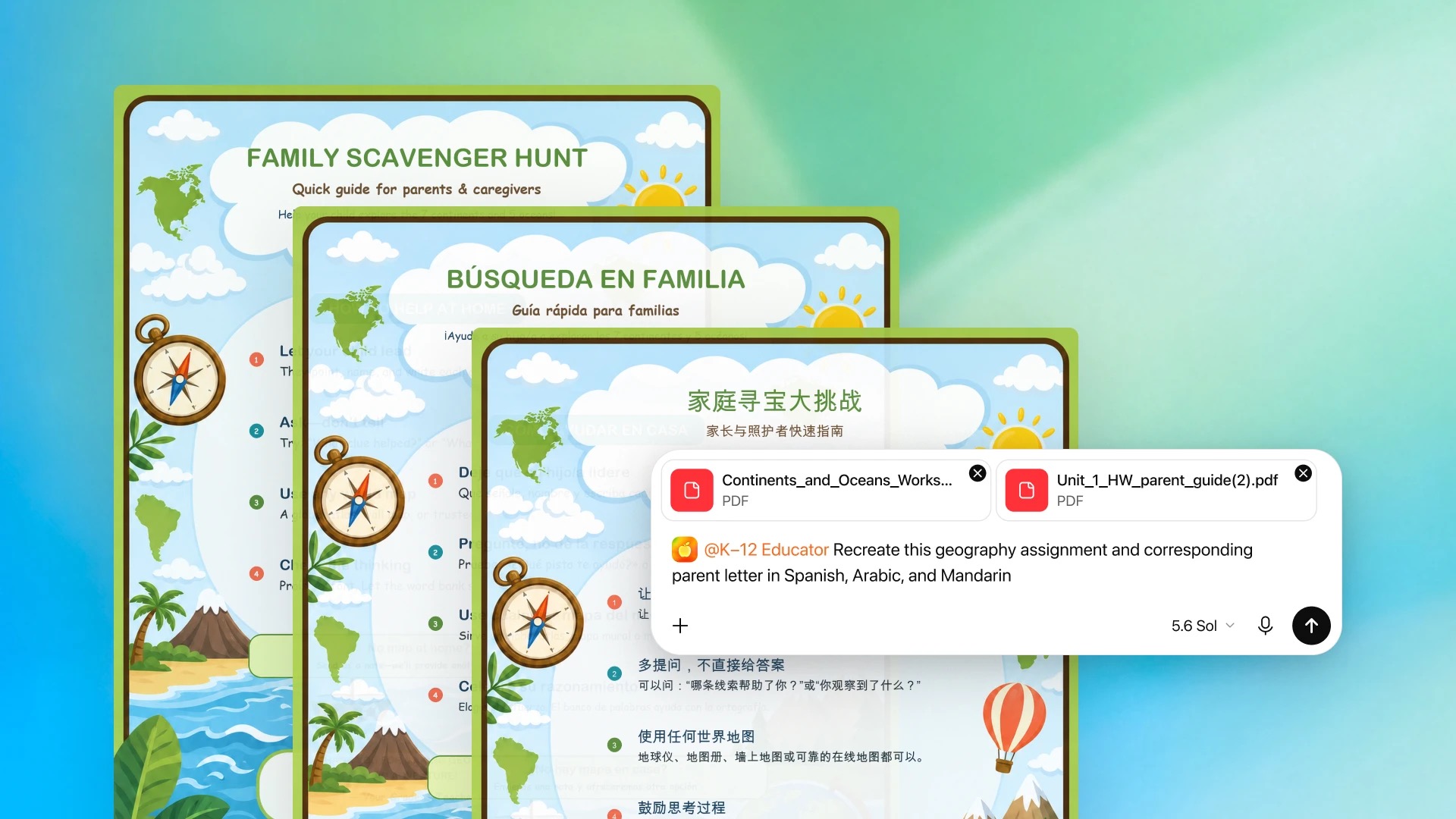
On August 4, OpenAI released three education plugins for ChatGPT Work and Codex. They target K–12 teachers, college educators, and college students, and all three are available through ChatGPT Edu and ChatGPT for Teachers district deployments[1]. What sets them apart is that they can take on substantial work such as course design and study planning once they have access to the materials and schedules a user already has on hand.
What Each of the Three Plugins Covers
The three new plugins are built for K–12 educators, college educators, and college students. What they share is a connection to the documents, course materials, calendars, and school-approved apps people already use, from which they read the context and carry the task forward[1].
The K–12 Educator plugin focuses on lesson planning and material creation. Teachers can differentiate resources by ability level, prepare visuals for explanations, and surface actionable insights about what to do next in class. It was developed alongside K–12 educators and integrates with Learning Commons, a nonprofit, so teachers can create materials aligned to local academic standards, frameworks, and pathways. Decisions about pedagogy, grading, and whether an agent actually takes an action remain with the teacher[1].
The College Educator plugin handles syllabus updates, interactive websites and multimedia assessments, adapting materials for diverse learners, and packaging content for an LMS (learning management system). With calendars and documents connected, instructors can move between teaching, research, and everyday tasks without recreating the context for each new project[1].
The College Student plugin leans toward learning itself. Students work with a guided tutor, practice concepts they are stuck on, and build study guides, quizzes, flashcards, and interactive visual explanations from sources they choose. It was designed with students across majors, geographies, and levels of AI fluency, and it draws on learning science to prioritize depth of understanding and stronger study habits over rote memorization[1].
The Plugin as a Unit Changed in July
A plugin here means a package that bundles apps, role-specific skills, instructions, and common workflows. The goal is to let people start immediately without constructing complex prompts on their own[1].
That unit came to the front on July 9, when OpenAI migrated the app directory to the Plugin directory. Apps remain the pieces that connect to external data and actions, while a plugin acts as a container that layers workflows and skills on top so a whole workflow can be enabled at once[2].
For schools and universities, the important part is that administrative controls carry over. In the Plugins section of workspace settings, admins choose whether a plugin is Available for a role or automatically Installed. Permissions for the apps a plugin requires, whether access stays read-only or extends to writes, and whether a confirmation step runs before an action, all inherit from existing app-level management[2]. Approving an app in ChatGPT does not open up permissions the user does not already hold in the connected system[2].
The Gap Between What AI Can Do and How It Gets Used
OpenAI framed the release around a mismatch between capability and actual use. More than 200 million young adults ages 18–24 now use ChatGPT every week. By volume they are a core user group, but among college-age users the company sees a widening global gap between what AI tools can do and how people actually use them[1].
There is a figure attached. Even advanced student users leverage ChatGPT's capabilities roughly 90 to 99 percent less than power users. Read the other way, that is how much room is left to grow[1].
OpenAI argues structured access is what closes that gap. Across ChatGPT Edu deployments, students develop more advanced patterns of use over time, outperforming free users across nearly every capability and moving closer to power-user behavior, particularly in analysis, calculation, and learning[1]. Deployments cited include Houston ISD in Texas, Fairfax in Virginia, and Fulton in Georgia, along with hundreds of college and university campuses including the Wharton School of the University of Pennsylvania, The University of Texas at Austin, and the California State University system[1].
The Programs Built Around the Plugins
The announcement does not stop at features. Several surrounding programs are moving at the same time[1].
For college students, the OpenAI Student Collective is a student-led community, and applications are now open for Campus Leads who will bring it to life on their campuses. Partnerships with platforms such as Handshake are meant to connect the practical skills students build to internships and early-career opportunities.
On the K–12 side, OpenAI Academy, in partnership with the Walton Family Foundation, is bringing together more than 1,600 teachers, administrators, and district leaders across eight U.S. cities for free in-person workshops. On teacher training, building on its work with the American Federation of Teachers (AFT), OpenAI is the founding partner in the National Academy for AI Instruction, a five-year initiative to equip 400,000 K–12 educators, about one in every 10 teachers in the US.
There are country-level efforts as well. In Estonia, ChatGPT Edu now reaches more than 20,000 students and 4,600 teachers, alongside a longitudinal research initiative with the University of Tartu and Stanford. For researchers, the new ChatGPT for Academic Researchers program gives eligible researchers 12 months of free Pro-level access.
Summary
On August 4, OpenAI added education plugins for K–12 educators, college educators, and college students to ChatGPT Work and Codex. They are available through ChatGPT Edu and ChatGPT for Teachers district deployments, and they can build materials, assignments, and study guides grounded in the documents and context a user already has. Behind the release is a gap: more than 200 million people ages 18–24 use ChatGPT weekly, yet even advanced student users leverage its capabilities roughly 90 to 99 percent less than power users. Because permission settings inherit from existing app management, institutions can roll the plugins out while keeping scope tightly defined.
[1] Source: https://openai.com/index/learn-teach-chatgpt-work-codex
[2] Source: https://help.openai.com/en/articles/20001256-plugins-in-chatgpt-and-codex