At the ISC supercomputing conference in Hamburg, Germany, NVIDIA introduced a set of new software tools designed to accelerate AI for science. From chemistry and materials discovery to the hunt for dark matter, the goal is to turn work that once took hours or days on CPUs into near real-time, GPU-accelerated pipelines. At the center are three releases — cuPhoton, DAQIRI, and ALCHEMI — all delivered as part of NVIDIA's CUDA-X software platform[1][2].
cuPhoton: Astronomy Data, Orders of Magnitude Faster
cuPhoton is a reference code (a sample implementation that serves as a starting point for development) for loading, processing, analyzing, and visualizing the multidimensional data produced by telescopes, X-rays, and laser experiments[1]. It is built to help researchers in astrophysics and astronomy handle petabyte-scale datasets.
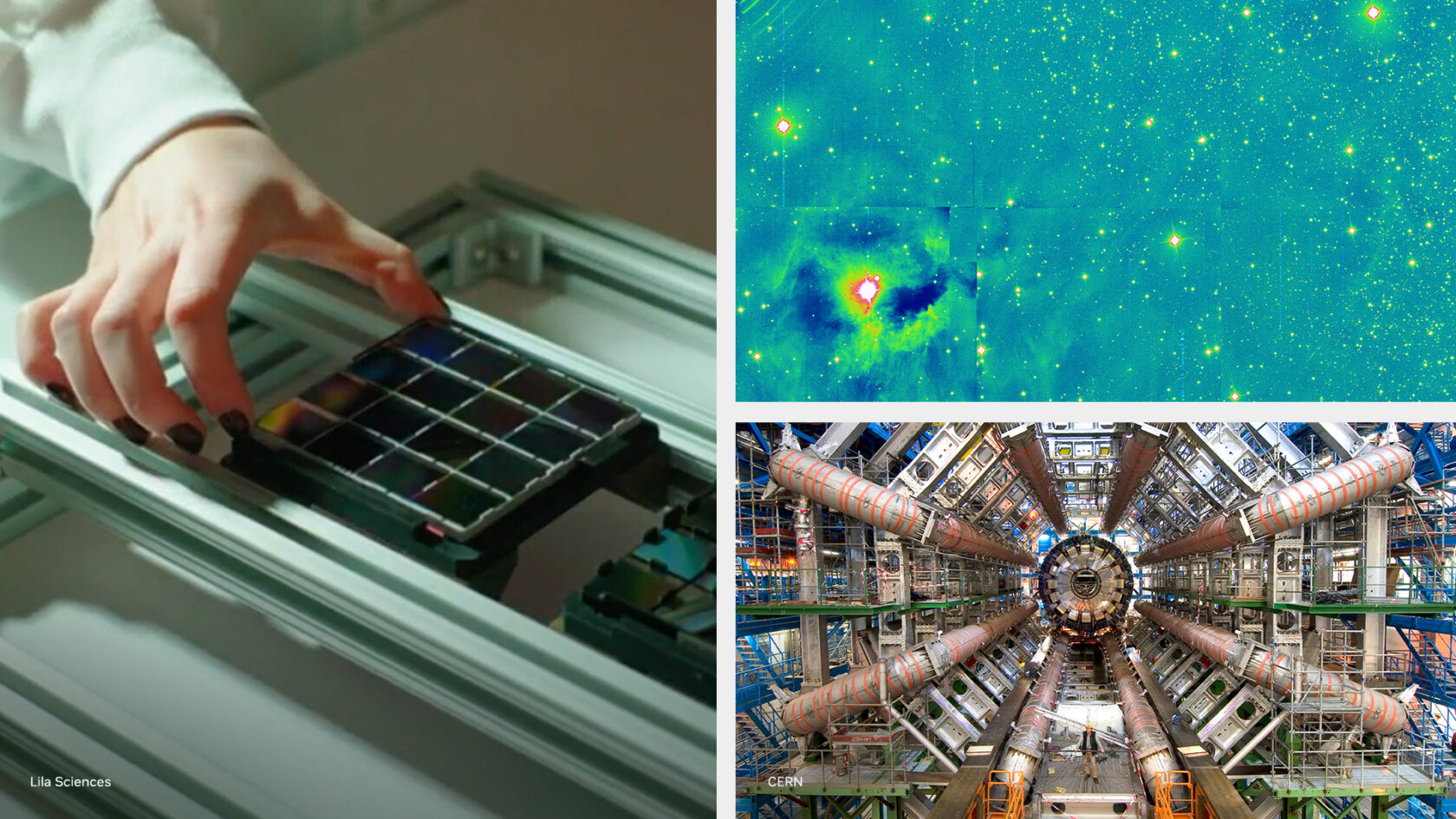
The impact shows up in the numbers. Running on NVIDIA's flagship GB200 NVL72 system, cuPhoton accelerated the loading of FITS data — the standard file format used in astronomy — by up to 14,900x in early access[1]. The target was image data gathered by the Legacy Survey of Space and Time (LSST) at the Rubin Observatory. Using 32 Grace Blackwell superchips, signal processing and analysis ran up to 8,400x faster. The LSST camera is described as one of the largest digital cameras ever built, capturing everything from distant galaxies to faint objects that reflect little light.
cuPhoton was developed by NVIDIA together with Princeton University, and — alongside Harvard University — it is set to be used for processing and analyzing the massive data collected from observatories and dark energy surveys[1]. General availability is expected this summer.
DAQIRI: Handling Experiment Data in Real Time Without Dropping It
DAQIRI — short for Data Acquisition for Integrated Real-time Instruments — is a high-performance networking library that streams data from fast detectors and sensors into NVIDIA software without bottlenecks[1]. Older systems were tied to fixed hardware and could drop data when instruments produced it faster than it could be saved. DAQIRI keeps up by handling the stream as it arrives.
One example is the A-GHOST research project at CERN (the European Organization for Nuclear Research). Developed by researchers from CERN, the University of Chicago, and University College London (UCL) within the CERN openlab framework, A-GHOST uses DAQIRI to apply AI in real time to the collision data recorded by CERN's ATLAS experiment[1]. Because of storage limits, more than 99 percent of ATLAS data is normally discarded, but A-GHOST aims to catch the interesting signals buried within it. DAQIRI is already available on GitHub.
ALCHEMI: Parallelizing the Search Across Materials and Chemistry
ALCHEMI is a collection of domain-specific microservices and a development toolkit for accelerating chemistry and materials discovery[1][3]. Its envisioned applications span battery materials, catalysts, OLED displays, beauty products, and more. In March, NVIDIA released two NIM microservices (units that package specific AI functions so they can be called on demand) for batched geometry relaxation (BGR), which finds stable structures, and batched molecular dynamics (BMD), which simulates how molecules move[1]. Together they let researchers simulate millions of molecules and materials at once.
As a concrete example, Lila Sciences — which is building an autonomous research platform — used the ALCHEMI BGR microservice to accelerate the screening of promising materials by 50x[1]. It also sped up the calculation of magnetic properties for shortlisted candidates by 30 percent, while ALCHEMI's specialized processing delivered a 6x speedup in AI model training and inference and cut memory use to one-third. Simulations that previously took weeks could be done in days.
In addition, for geometry optimization — arranging atoms into their most stable configuration — a microservice for the widely used VASP package is expected to arrive this summer, with a projected 3x speedup achieved by running multiple calculations on a single GPU[1]. The ALCHEMI toolkit is available on GitHub and PyPI, and the NIM microservices can be obtained from NVIDIA's NGC catalog.
Summary
The cuPhoton, DAQIRI, and ALCHEMI tools NVIDIA unveiled at ISC are all part of CUDA-X and are aimed at processing the enormous volumes of data generated in scientific research at high speed. cuPhoton sped up astronomy data loading by up to 14,900x, DAQIRI handles previously dropped experiment data in real time, and ALCHEMI narrowed materials screening by 50x — each shown with concrete results. By letting researchers test more hypotheses faster, these tools look set to advance fields such as drug discovery, new materials, and space observation.
出典:https://blogs.nvidia.com/blog/ai-for-science-software-cuda/
出典:https://www.nvidia.com/en-us/technologies/cuda-x/
出典:https://developer.nvidia.com/cuda/cuda-x-libraries/alchemi