Danish pharmaceutical giant Novo Nordisk announced a collaboration with Anthropic on September 16. The company will trial Anthropic's frontier models and Claude Science, the AI workbench for researchers, in selected research and development (R&D) workflows, with the goal of discovering and developing new medicines faster. Novo Nordisk will also use Anthropic's models for in-house software development, laying the groundwork for scaling AI across the company. Having already teamed up with OpenAI and Amazon Web Services (AWS) earlier in 2026, the drugmaker's lineup of AI partners behind its ambition to become "the world's most AI-driven healthcare company" has grown deeper still.
Claude Science Will First Be Tested in Specific R&D Workflows
The collaboration is not a company-wide rollout from day one. The two companies will identify drug discovery challenges faced by Novo Nordisk's scientists and computational teams, then build targeted solutions for each problem to support biological reasoning. In the initial phase, they will pick the themes where combining their strengths is expected to have the greatest impact and pilot Claude Science in specific R&D workflows.
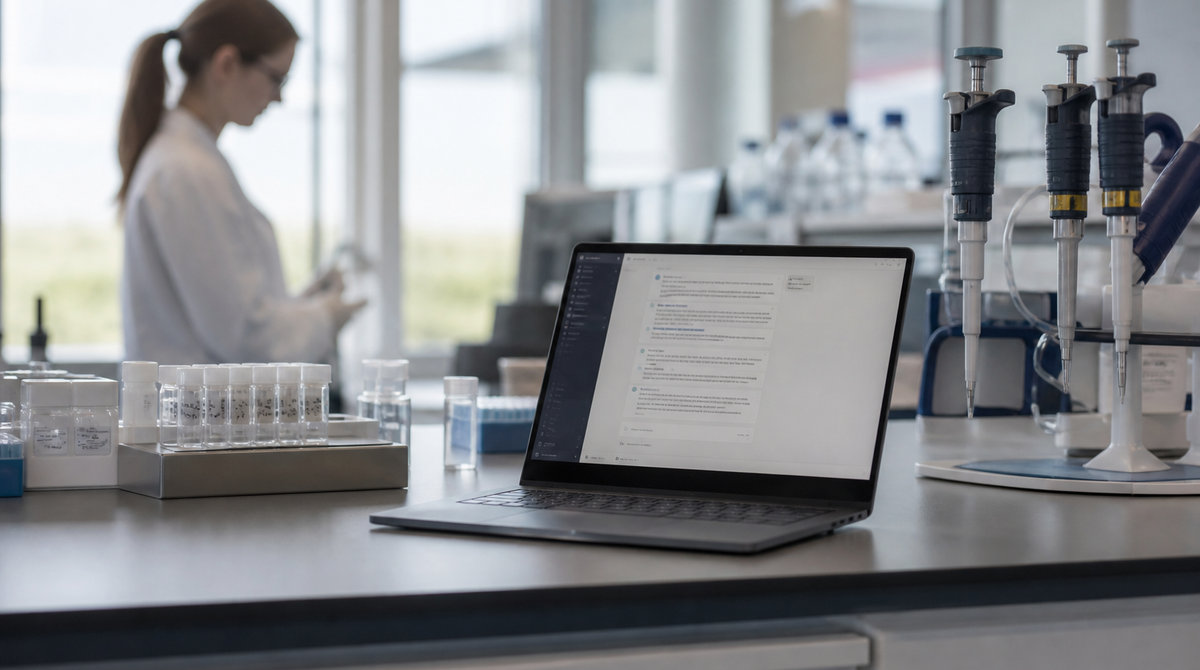
Claude Science is the researcher-oriented AI workbench that Anthropic released in beta at the end of June 2026. It lets users move from literature review through data analysis to figure and manuscript creation inside a single environment, and every output comes with the code, execution environment, and conversation history that produced it, making verification and reproduction easier later on. It ships with more than 60 skills and connectors tailored to fields such as genomics, structural biology, and cheminformatics, and can search across specialist databases like UniProt, PDB, and ChEMBL using plain-language queries. For a pharmaceutical research organization, the ability to hand work to AI agents while keeping existing tools in place is likely to be a deciding factor.
Mike Doustdar, president and CEO of Novo Nordisk, said AI can raise R&D productivity and compress the path from research to marketed product, adding that AI tools can also open up entirely new scientific opportunities and aid reasoning about human biology and drug mechanisms. Anthropic CEO Dario Amodei said that AI's growing capability brings the potential to compress a century's worth of biological and medical breakthroughs into a decade, and that giving leading researchers access to safe and trusted frontier models is meant to shorten research timelines and improve outcomes.
Anthropic Models Will Also Power Software Development
The other pillar of the collaboration is strengthening AI-driven software development. Novo Nordisk regards shifting its internal software development to an AI-driven model as a key enabler for scaling AI across the company. It plans to bring Anthropic's frontier models into that effort and pursue agentic software engineering. Anthropic signed an enterprise-wide agreement with Bristol Myers Squibb in May that put Claude Code in the hands of its engineering and data science teams, and the Novo Nordisk deal points in the same direction.
Financial terms and the duration of the agreement have not been disclosed. Both companies say the collaboration has been designed with robust data governance and human oversight, so that AI is applied responsibly and in line with Novo Nordisk's ethical and compliance standards. Since AI outputs cannot simply be taken at face value in drug discovery, the two sides have made explicit that humans remain the final decision-makers.
The Third Major AI Partnership After OpenAI and AWS
For Novo Nordisk, this is the third partnership with an AI company in 2026. In April, it partnered with OpenAI and set out plans to deploy AI across the company, from drug discovery to commercial functions. On August 10, it selected AWS as its preferred cloud provider and strategic AI partner and opened a co-innovation hub inside its existing London site, where engineers and scientists from both companies work side by side. Under the AWS deal, the company plans to use Amazon Bio Discovery, which provides models trained on biological data, and Amazon Bedrock AgentCore, a platform for building AI agents, to identify drug targets and automate research workflows.
In other words, rather than relying on a single vendor, Novo Nordisk is pursuing a strategy of drawing on the respective strengths of OpenAI, AWS, and Anthropic. The Anthropic collaboration stands out for reaching directly into the researcher's working environment through Claude Science, and for its emphasis on software development.
Across the pharmaceutical industry, partnerships between AI companies and major drugmakers have accelerated this year. In addition to the Bristol Myers Squibb deal, Anthropic announced integration with NVIDIA's BioNeMo Agent Toolkit when it launched Claude Science. OpenAI is also working with Sanofi and Moderna, while Isomorphic Labs, the Google DeepMind spinout, has signed drug discovery partnerships with Novartis and Eli Lilly. The trend of pharmaceutical companies working with multiple AI providers in parallel looks set to continue.
Summary
Novo Nordisk is partnering with Anthropic to pilot Claude Science in specific R&D workflows and to bring Anthropic's models into its in-house software development. It is the company's third AI partnership of 2026, following OpenAI and AWS, and makes clear its approach of using several AI companies for different purposes. With financial terms undisclosed and the work starting with limited workflows, how much the pace of drug discovery actually changes will only become clear from the results to come.