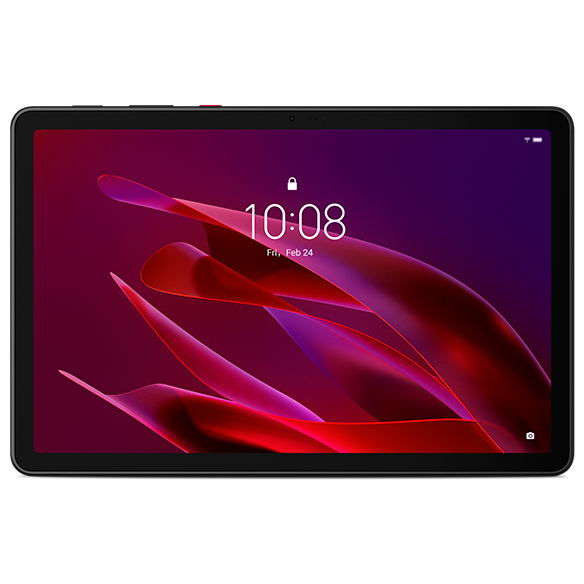
Lenovo's Japanese arm released the ThinkTab X11 Gen 1, an 11-inch Android tablet built for frontline work, on August 5. It carries an NFC and FeliCa reader on the front face, an IP68-rated dust and water resistant body, and a battery pack that can be pulled out entirely so the tablet can run on external power alone. Pricing in Japan is open, meaning retailers set the street price.
Why the FeliCa reader sits on the front
The first thing that stands out is the placement of the NFC and FeliCa reader on the same face as the display. Putting it on the front rather than the back means a worker can hold the tablet steady and have someone tap an ID card without flipping the device over. The person operating it can watch the on-screen result while authentication happens, which suits reception desks, access control, and logins to business systems.
FeliCa support is read-only. The design is not aimed at rewriting cards or turning the tablet into a card-emulating payment terminal; it is squarely about reading cards that are presented to it. Since FeliCa-based employee badges remain widespread across Japanese workplaces, an Android tablet that handles this natively is a rare option.
Built for factories and construction sites
The chassis is IP68 rated for dust and water, so it can go into dusty plants and outdoor construction sites. Touch input works with wet hands and gloves on, so nobody has to stop and dry off first. Lenovo's overseas product pages also list MIL-STD-810H compliance and Gorilla Glass, pointing to a design that assumes drops and vibration.
The display measures 10.95 inches at 2,560 by 1,600 pixels, with peak brightness of 600 nits. Brightness is what decides whether an outdoor device stays readable, and 600 nits clears the practical bar for field use. Overseas product information also cites a 90Hz refresh rate.
The body measures roughly 257.1 by 168.7 by 9.9 mm and weighs about 650 g. That is not light for an 11-inch class tablet, but it is reasonable given the reinforced construction and the large battery inside.
A removable battery and a batteryless mode
Power handling is the other headline. The battery pack holds 10,200 mAh and can be detached. If it runs down mid-shift, swapping in a spare pack keeps work moving without waiting for a charge, and unlike swapping the whole device, there is no settings or account handover involved.
The tablet also supports a batteryless mode that runs it on external power only. When a unit is bolted to a forklift or a cart and kept permanently powered, leaving a battery installed means constant charge and discharge cycles that wear it down. Removing the battery and running straight off the power feed cuts the risk of swelling and heat. For fixed-mount field deployments, that is a quiet but meaningful detail.
Specifications and expansion
The processor is a Snapdragon 7s Gen 3, paired with 6 GB of LPDDR5 memory and 128 GB of storage, running Android 16 as of announcement. It is a midrange chip, but it has enough headroom for business apps and browser-based core systems.
Ports consist of one USB 3.2 Gen 1 Type-C with video output and one USB 2.0 Type-C. Having two Type-C ports lets a barcode scanner or another USB peripheral stay connected while the tablet charges, which beats carrying a hub around a worksite. Cameras are 8 MP front and 13 MP rear, and there is a microSD card slot plus audio in and out.
Accessories coming later include the Lenovo Tab Pen XE stylus and a rugged case for the ThinkTab X11. For reference, Lenovo's US online store lists an 8 GB memory and 128 GB storage configuration at 499.99 USD (about 79,000 yen). Street pricing in Japan is left to retailers.
※1 USD = 157 JPY (as of August 5, 2026)
Summary
Three things set the ThinkTab X11 Gen 1 apart from consumer Android tablets: the front-mounted FeliCa reader, the IP68 body, and the combination of a removable battery with a batteryless mode. Rather than taking a general-purpose tablet and bolting accessories onto it, this is a device designed from the start around the worksite. For Japanese buyers, the ability to carry existing FeliCa badge workflows over unchanged is likely the deciding argument.