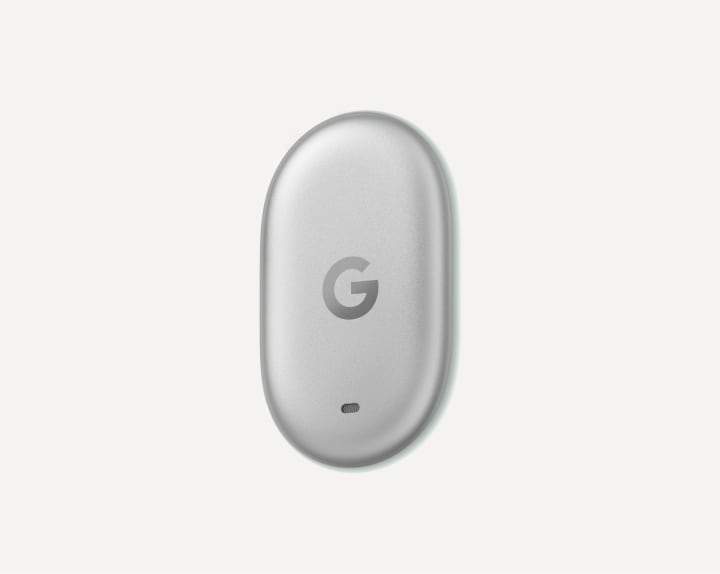
Google has announced the Google Pixel Tag, its first own-brand item tracker. It arrives in Japan in November 2026, priced on the Google Store at 5,010 yen for a single unit and 16,940 yen for a four-pack. Attach one to your keys or wallet and you can follow it through Find Hub, the Android device-finding service, with UWB providing direction guidance down to the meter at close range. Android users have waited a long time for a first-party tag, and it has finally taken shape.
A Billion Android Devices Become the Search Network
Pixel Tag is built on Google's Find Hub. More than a billion Android devices worldwide pick up a tag's signal as they pass by and report its location back to the owner, so even luggage left far behind, such as a suitcase forgotten on a trip, can be traced on a map.
Until now Google had limited itself to opening Find Hub to third-party tags. Compatible products from Xiaomi Tag, Pebblebee and Eufy had been accumulating, but this is the first time the company running the network has shipped hardware of its own. Having the platform holder supply a reference device carries real weight.
Stronger Up Close: UWB and Channel Sounding Together
If Find Hub handles the long-distance search, radio technology handles the search inside a room. Pixel Tag supports both UWB (ultra-wideband) and Bluetooth Channel Sounding, and when paired with a compatible Android phone it shows the distance to the item in one-meter increments while pointing you in the right direction. You can tell whether the item is under the sofa or in the next room from a number and an arrow.
You can also make it ring. The built-in speaker can be triggered from the Find Hub app, and you can simply ask Gemini to sound it.
The reverse direction is the more interesting trick. Pressing the button on the Pixel Tag itself makes the paired smartphone ring. That alert sounds even while the phone is in silent mode, which addresses the everyday problem of losing a muted phone somewhere in the house. Pairing uses Fast Pair, so with a Google Pixel the setup begins simply by bringing the two together.
An 11.8-Gram Slim Body with a User-Replaceable Battery
The tag measures 28mm wide, 46.1mm tall and 5.4mm thick, and weighs 11.8g. Because the thickness stays in the 5mm range, it is meant to slip into a card slot in a wallet as readily as it clips onto a keyring. The materials are polycarbonate and metal, with a stainless steel exterior. It comes in a single color, Fog.
Water and dust resistance meets IP67 under IEC standard 60529, surviving immersion in 1m of water for up to 30 minutes. The battery is a user-replaceable CR2032 coin-cell lithium battery that runs for more than a year per change. An accelerometer is built in, and the warranty period is one year.
Supported devices are smartphones running Android 9 or later; use from an iPhone is not part of the plan. This is squarely a device for the Android camp.
On privacy, Google states that device location data is encrypted and is not stored on the Find Hub network. Misuse such as slipping a tracker into someone else's bag has been a recurring problem in this category, so the company is putting its design-stage safeguards front and center. Google also notes that the packaging uses no plastic at all.
5,010 Yen in Japan, on Sale in November
Japanese pricing through the Google Store is 5,010 yen for one unit and 16,940 yen for four. The four-pack works out to 4,235 yen per tag, a little over 10 percent cheaper than buying singly. Given that keys, wallet, bag and suitcase are all candidates, that bulk discount is a practical one.
In the United States the tag costs 29 USD (about 4,600 yen) for one and 99 USD (about 15,800 yen) for four, going on sale November 11. Japan sits slightly above US pricing, but it lands within the normal range for this class of tracker.
※1 USD = 159 JPY (as of August 14, 2026)
Summary
The Google Pixel Tag is the first item tracker from Google itself, the company that runs the Find Hub network. It uses UWB and Bluetooth Channel Sounding for direction guidance accurate to a meter, and packs IP67 water and dust resistance plus a replaceable CR2032 cell into an 11.8g slim body. It reaches Japan in November 2026 at 5,010 yen for one unit and 16,940 yen for four, and requires Android 9 or later. For Android users, a first-party option with the reassurance that brings has finally arrived.