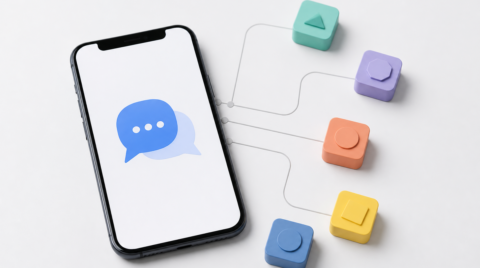
Google announced on July 16, 2026, that AI Mode, its conversational search experience, can now call directly into the apps people already use. Instacart, Canva and YouTube Music are supported at launch. Whatever you look up can be turned into a shopping cart, a design draft or a playlist on the spot, moving search one step closer to being a place where work gets finished rather than merely answered.
Answering the question is no longer the end of the job
Until now, AI Mode's job ended once it returned a summary and its supporting sources. What this update adds is a route for handing that answer off to another service.
Google's own barbecue example makes the point clearly. Ask AI Mode to plan a menu and build a grocery list, then connect your Instacart account, and the ingredients drop straight into your cart. All that remains is checking out in the Instacart app or on the website, with no need to hunt down each item by hand.
Saying that search is changing may sound like an overstatement. Still, the gap between looking something up and acting on it, the part where you open a second app and retype everything, has always been quietly tedious. This feature is aimed squarely at closing it.
What the three connected apps actually do
The other two integrations target situations that also generate a lot of manual work.
Canva comes into play when you need a first draft of a document or a flyer. Tell AI Mode you want a flyer for an event you are planning, and it will have Canva surface template options you can pick from and take into editing. Being handed a set of choices often beats starting from a blank page.
YouTube Music covers playlist creation. Ask for a party selection by genre and mood, and the result is saved as a YouTube Music playlist you can open in the app, instead of jotting down track names and adding them one search at a time.
Users decide what gets connected
The links are not switched on automatically. If a service is not yet connected, a link button appears in the AI Mode interface, and the feature only works once you attach the account there.
Users choose which apps to connect and can revoke access from their account settings at any time. Given that search is reaching into personal shopping habits and creative work, having that entry point clearly marked matters. The rollout is starting in the United States, and Google says it plans to add support for more apps.
A mechanism first tested in the Gemini app
This did not appear out of nowhere. At Google I/O earlier in 2026, Google introduced a way to call third-party services from the Gemini app, with support for Canva, OpenTable, Spark and Instacart among others. The company is now bringing that same idea into Search itself.
AI Mode has been growing steadily since its debut in early 2025. Google added the ability to check whether an item is in stock at a nearby store, and a side-by-side view that lets users browse the web alongside AI Mode to compare details and ask follow-up questions without losing the context of their search. Personal Intelligence, which draws on Gmail and Google Photos to personalize responses, belongs to the same push. App connections add the final piece: execution inside someone else's service.
The contest shifts to how many services connect
Google is not first here. OpenAI's ChatGPT and Anthropic's Claude both already support app integrations. That means the differentiator is no longer whether the capability exists, but how many services are usefully wired in.
Google's advantage is the width of its front door. People who never open a dedicated AI app will still encounter these connections as an extension of ordinary search. For app makers, appearing in Google's interface is a significant distribution channel and, at the same time, one more dependency on a company that already controls search and advertising. Whether Google treats its own services differently from everyone else's is worth watching.
Summary
Google has added third-party app connections to AI Mode, starting with Instacart, Canva and YouTube Music. Adding items to a cart, generating a design draft and saving a playlist can all be completed without leaving the search screen. Connections require explicit user approval, the rollout begins in the United States, and more apps are planned. As search shifts from a place to look things up to a place to get things done, how far the list of supported services expands will be the next thing to watch.