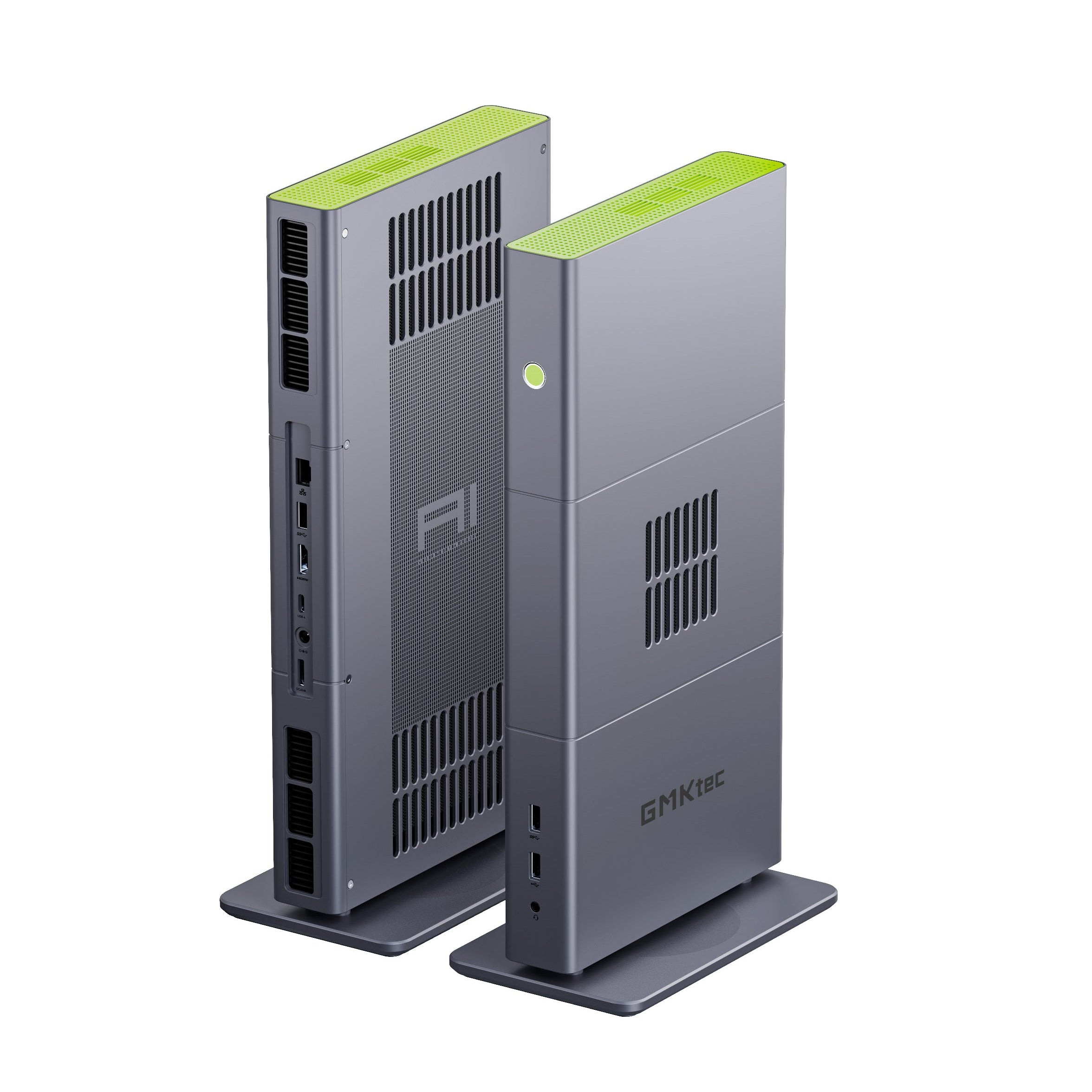
GMKtec is bringing its EVO-X3, a compact desktop PC billed as an AI workstation, to the global market on July 6. It pairs AMD's top mobile-class processor, the Ryzen AI Max+ 395, with 128GB of memory, and is built first and foremost to run large language models (LLMs) locally rather than in the cloud. The base configuration is priced at 3,600 USD (about 580,000 yen), marking the worldwide rollout of a product that had already launched in China.
An AI Mini PC Built Around the Ryzen AI Max+ 395
At the heart of the EVO-X3 is AMD's Ryzen AI Max+ 395. It is a 16-core, 32-thread chip built on a 4nm process, with a maximum clock of 5.1GHz. For graphics, it integrates the Radeon 8060S, which has 40 compute units and is based on AMD's latest RDNA 3.5 architecture.
The chip also carries an XDNA 2 NPU (Neural Processing Unit, a dedicated block that handles AI math efficiently). The NPU alone delivers 50 TOPS, and combined with the CPU and GPU, the whole system reaches 126 TOPS of AI performance. TOPS measures operations per second, and a higher figure means the machine can handle tasks such as image recognition and generative AI more quickly.
128GB of Memory for Local LLMs
The biggest reason the EVO-X3 calls itself an AI workstation is its memory configuration. It ships with 128GB of LPDDR5X memory running at 8000 MT/s. Because the CPU and GPU share this memory in a unified architecture, up to 96GB can be allocated to the GPU.
Running a large AI model normally requires a graphics card with a lot of dedicated VRAM, but the EVO-X3 leans on that shared memory to load big models on the machine alone, without an expensive external GPU. GMKtec says it can handle local AI models of up to roughly 235B parameters. On the software side, the company's own tool called GMKtec Claw comes preinstalled for one-click AI setup, and the system is designed to run fully offline. Because everything is processed on the device, GMKtec highlights that data never has to leave the machine.
Storage, Cooling, and Ports
Storage is handled by PCIe 4.0 NVMe SSDs, with a choice of 2TB or 4TB at purchase. The unit has two M.2 2280 slots, so it can later be expanded up to 16TB.
To sustain heavy workloads in a small chassis, power is managed through three modes: a 54W silent mode, an 85W balanced mode, and a 120W performance mode, with peak power reaching 140W. Cooling relies on a dual-fan system paired with three heat pipes, and GMKtec says it fits all of this into an ultra-slim 41mm blade-style design.
The port selection is geared toward workstation use. The rear panel carries a USB4 port (with 100W power-delivery input and 4K video output), HDMI 2.1, 2.5-gigabit Ethernet, and USB-A 3.2 Gen 2. There is also an OCuLink port for connecting an external GPU (eGPU), though it does not support hot-plugging. According to GMKtec, OCuLink can drive desktop GeForce RTX 40 and 50 series GPUs. Wireless connectivity covers Wi-Fi 7 and Bluetooth 5.4.
Price and Availability
The EVO-X3 goes on sale worldwide on July 6. The base configuration with 128GB of memory and a 2TB SSD costs 3,600 USD (about 580,000 yen), while the 4TB SSD model is 3,849 USD (about 620,000 yen). Both ship with Windows 11 Pro.
※1 USD = 161 JPY (as of July 3, 2026)
Summary
The GMKtec EVO-X3 is an AI mini PC centered on the Ryzen AI Max+ 395 and 128GB of unified memory, aimed at running large language models on the device without relying on an external GPU. With storage expandable to 16TB, three power modes, and OCuLink-based eGPU support, it also delivers real practicality as a workhorse despite its small size. At 3,600 USD and up it is far from cheap, but for developers and specialists who want to handle AI locally without sending data outside, it looks like a compelling option.