
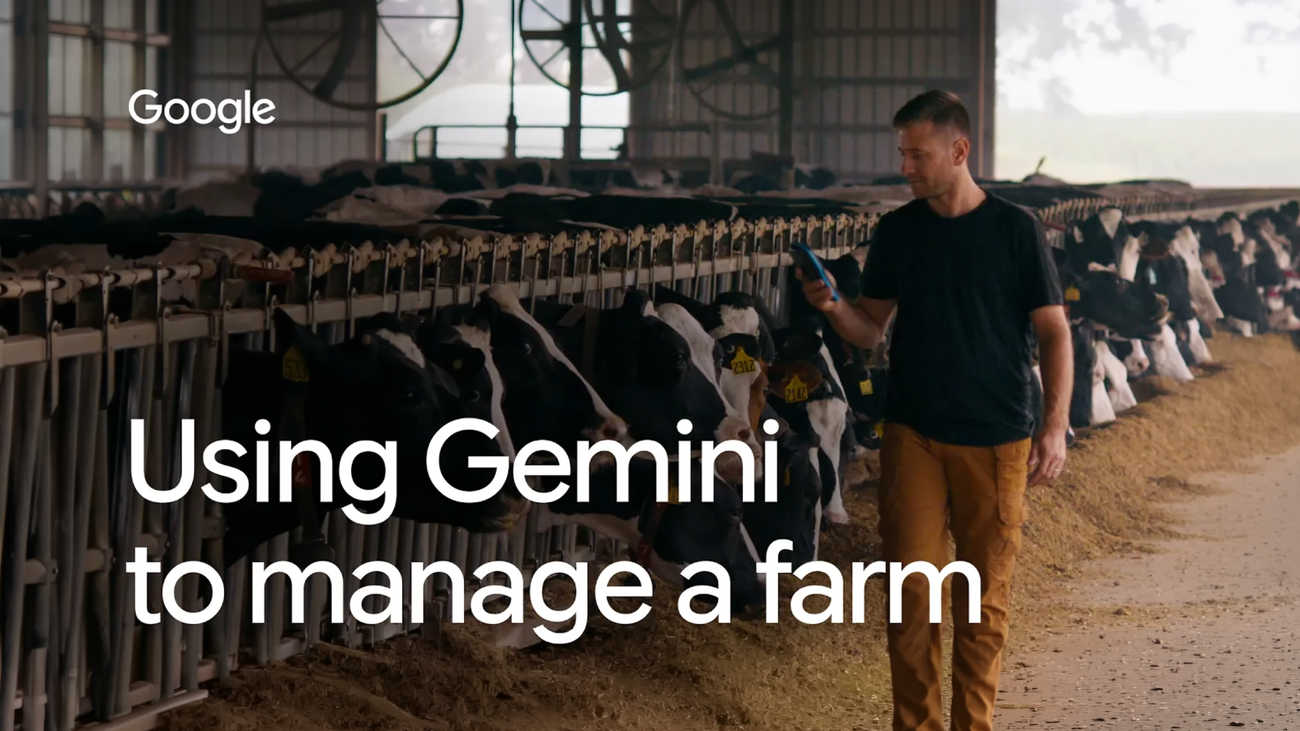
A dairy farmer in Michigan milking 260 cows built a multi-agent AI system on Gemini 3.6 Flash and automated the several hours of spreadsheet work that used to start his day[1]. Sensor data, weather readings and shipment records that lived in separate software now flow through a single local folder, and the system calculates the day's profitability on its own. Google featured the build as a case study on its official blog.
Siloed Data Was Eating His Mornings
The farmer is Paul Windemuller. In 2014 he and Brittany started Dream Winds Dairy with 30 leased cows, and over 12 years grew it into a highly automated operation milking 260 Holsteins. As a 2024 Nuffield International Farming Scholar studying ag tech and AI, he approaches dairy farming as a technological problem[1].
Dairy runs on tight margins, and the biological and environmental variables involved make data analysis essential. On his farm, sensor collars on each cow, an on-site weather station, and an online portal logging milk quality and shipments all produce continuous streams of information[1].
The problem was that each of these lived inside its own isolated software. Every morning he spent hours downloading files, merging spreadsheets and calculating performance by hand, and that time came straight out of actually looking after the cows.
Four Kinds of Agents Built Inside Antigravity
What he built is a local, multi-agent system running Gemini 3.6 Flash inside Google Antigravity, Google's development platform[1]. Antigravity is published as an agent-first development environment in which agents autonomously plan, execute and verify work across the editor, terminal and browser[2].
The interesting choice is that it uses no APIs and no web scraping. A local directory serves as the interface instead. Drop a CSV export into a monitored folder, or a photo of a paper receipt, a PDF or an invoice, and Gemini's multimodal capabilities extract and merge the visual and numeric metrics. Because nothing leaves the farm, the data stays under his control[1].
Rather than one long prompt, the work is split across orchestrated roles: an Orchestrator that manages the overall daily workflow, Ingestion Agents that standardize raw files such as milking robot exports and feed logs, an Analysis Agent that evaluates biological and weather impacts, and a Reporting Agent that turns results into clear natural-language summaries[1].
The Metric Is Static Variable Margin
The system optimizes for a single number: Daily Static Variable Margin, or SVM. Traditional metrics such as Income Over Feed Cost swing with volatile milk and feed prices, whereas SVM holds market prices constant, stripping out market noise so that only biological and operational efficiency shows through[1].
The calculation is broken out clearly. Ingestion agents parse milk yields, components such as butterfat and protein, somatic cell count and feed. Fixed historical pay standards, the Federal Order 33 January prices, are applied to the actual milk solids produced to derive static revenue. Feed cost is likewise computed at fixed ingredient prices, so only changes in the volume actually consumed move the number. Subtracting static feed cost gives a static Income Over Feed Cost, and per-cow expenses such as replacements, breeding and vet supplies are then deducted. Overhead including labor, utilities and depreciation is deliberately excluded, so SVM movement reflects only biological efficiency and health[1].
A Farm CEO Briefing That Lands at 3:00 AM
Producing numbers is only half the battle. No dairy farmer has time to decode a spreadsheet at 3:00 AM. So the reporting agent translates the results into a daily Farm CEO Briefing that isolates what moved the day's margin[1].
In the example Google gave, when SVM drops by 0.15 USD (about 25 yen) per cow, the briefing breaks it down: dry matter intake at -0.08 USD (about 13 yen, as humidity reduced feed intake), somatic cell count at -0.04 USD (about 7 yen, a slight increase indicating potential health issues), and discarded milk at -0.03 USD (about 5 yen, after two cows entered the treatment pen). It closes with concrete actions, such as adjusting ventilation for heat stress[1].
※1 USD = 164 JPY
The Cost Barrier for Small Operators
His ambition goes beyond his own farm. He wants independent farmers to be able to streamline their operations the same way. Beyond the hurdle of building the tool at all, running it at farm scale every day was a cost problem[1].
Agentic workflows that require continuous reasoning, parsing and tool execution have long been too expensive for small businesses like his. This is where the efficiency of Gemini 3.6 Flash matters. The model is designed for advanced reasoning, tool use and coding, with a 1 million token context window and a 64,000 token maximum output. Benchmark evaluations show roughly a 17 percent reduction in output tokens compared with Gemini 3.5 Flash, at a lower cost per output token, which significantly lowers the cost of running agentic loops[1].
That said, this system was built by someone who has studied ag tech and AI professionally, and not everyone could assemble the same thing overnight. Even so, the decision to treat a local folder as the integration point, rather than chasing external connectors, is a pragmatic answer for operations surrounded by business systems that ship no APIs.
Summary
The multi-agent system a Michigan dairy farmer built with Gemini 3.6 Flash and Google Antigravity pulls siloed data together through a local folder, computes a daily Static Variable Margin that removes market price swings, and delivers it as a briefing with the drivers broken out. Erasing hours of manual spreadsheet work is notable in itself, but the case also shows that the cost of running agents every day has fallen far enough for small operators to reach.
[1] Source: https://blog.google/innovation-and-ai/models-and-research/gemini-models/using-gemini-to-manage-farm/
[2] Source: https://antigravity.google/blog/introducing-google-antigravity