
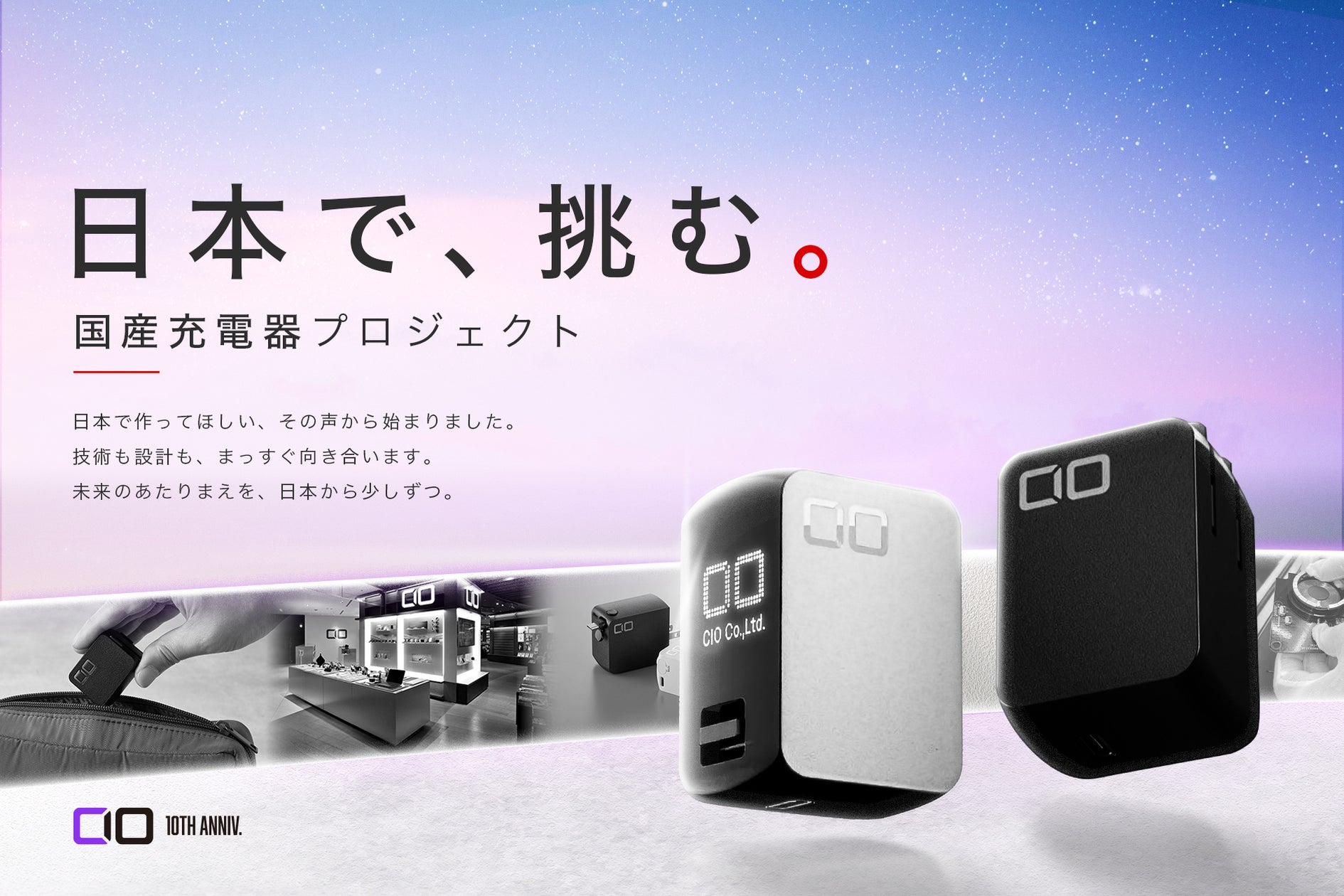
CIO Inc., a Japanese charger maker, has announced the launch of its "Made in Japan Charger Project," an initiative to take on USB charger manufacturing in Japan as the company marks its 10th anniversary[1]. The project is built on three pillars: production through Japanese factories, thermal design that keeps output stable, and the use of components from Japanese suppliers wherever possible. CIO will pursue the project alongside the concept for a new "NovaPort III" series. Ichiken, a YouTuber well known in the electrical and electronics field, joins as technical advisor[1].
The Starting Point Is User Voices Saying "Please Make It in Japan"
CIO has built its lineup through overseas partner factories, focusing on chargers that balance performance, price, and quality[1]. According to the company, this project began with voices repeatedly received from supporters: "Someday, please make it in Japan," "As a domestic brand, please help energize Japan," and "I am looking forward to the day CIO takes flight to the world"[1].
CEO Shota Nakahashi positions the 10th anniversary milestone as "the time to face squarely how far CIO can go inside Japan"[1]. At the same time, he openly acknowledges that "costs are high and there is a lot to coordinate," making clear that this is a medium- to long-term challenge focused on contributing to domestic manufacturing and employment rather than on short-term profitability[1].
CIO says it has been quietly assessing the state of Japan's domestic industry since 2025, and found that much of the equipment and know-how has already been transferred overseas, making it practically impossible at this point to rebuild the entire production flow from scratch within Japan in a short time frame[1]. For that reason, the project is framed with the phrase "completion is not the goal, completion is the starting line," and CIO plans to gradually expand its network of partners while increasing what it can do step by step[1].
Three Pillars: "Japanese Factories," "Thermal Design," and "Domestic Components"
The Made in Japan Charger Project is structured around three themes[1]. The first is the challenge of manufacturing via Japanese factories, with the goal of gradually moving production sites back inside Japan. The second is reliable circuit design and sustained output, aiming for a USB charger that remains stable enough to be trusted as an everyday AC adapter. The third is using Japanese-made components wherever possible, exploring how far domestic sourcing can be pushed even at the parts-selection level[1].
For the second pillar in particular, Ichiken, a YouTuber with deep knowledge of thermal management in electronics, joins as technical advisor and co-develops the design[1]. Compact USB chargers structurally tend to generate heat, but CIO places sustained performance at the core of the proposition, stating that "what matters is not just high output, but the ability to fully maintain that performance through long-term use"[1].
On the third pillar, CIO says it is still in the middle of adjustments around which capacitors, transformers, and power semiconductors can realistically be procured domestically[1]. The company describes its stance as "facing not only the parts you can see, but also the parts you cannot see inside," signaling an intent to look at domestic sourcing all the way down to the internal component layer.
The Connection with Ichiken Started from a Teardown of the "NovaPort SOLO II 65W"
According to CIO, the collaboration with Ichiken traces back to July 2025, when the "NovaPort SOLO II 65W" went on sale and Ichiken disassembled and reviewed the product, releasing a video that examined the specifications around thermal throttling (output reduction triggered by rising temperatures), which generated a strong response in the market[1].
CIO says that, prompted by the video, users sent in comments such as "I love how small and light it is, but I also want a model that does not throttle down on output" and "Even if it is not the smallest, I would be glad if CIO made a charger that does not drop power"[1]. CEO Nakahashi states that he does not deny the concept of the "NovaPort SOLO II 65W" itself, but, taking a different direction, the desire to build "an entirely new and exciting AC charger that not only avoids dropping output" led to the concept work on the new "NovaPort III" series[1].
Looking back on the invitation, Ichiken comments, "It would not have been strange for CIO to keep their distance from someone who tore down their product and gave harsh feedback. Instead, they came back with 'please make it with us.' Seeing that attitude, I felt I could really go all in with this company"[1]. The plan is to make the entire process up to commercialization fully open through video, including design decisions and component-selection rationale[1].
A Dedicated Site and Videos for Updates, with a Call to Japanese Component Makers
Details of the project are published on the "Made in Japan Charger Project" landing page hosted on the CIO 10th-anniversary domain[2]. Design philosophy, the underlying thinking, and progress reports will be rolled out through that page and through YouTube videos[1]. For the project announcement, a video on the CIO official channel[3] and one on Ichiken's own channel[4] have been released in parallel.
Ichiken also addresses Japanese component manufacturers directly: "If you have technology or products in capacitors, transformers, or power semiconductors that could contribute, please raise your hand"[1]. The charger market today is dominated by overseas-made parts, and CIO and Ichiken aim to use the project to bring more Japanese component makers into the supply network[1].
Nakahashi adds that he hopes the project "does not end as one company's effort, but creates a chain of empathy that gradually broadens the base of Japanese manufacturing," positioning the project not as a one-off anniversary campaign but as a sustained challenge[1].
Summary
CIO's "Made in Japan Charger Project" is a medium- to long-term effort to face up to USB charger manufacturing inside Japan, launched to mark the company's 10th anniversary[1]. It is built on three pillars: production through Japanese factories, thermal design with sustained output in mind, and active adoption of Japanese components. It moves forward together with the concept for the new "NovaPort III" series. Ichiken, joining as technical advisor, became involved through his teardown video of the "NovaPort SOLO II 65W," and the project will openly share design judgments and parts-selection reasoning along the way[1]. Finished products are still ahead, but it will be worth watching how far CIO can push a charger that is "domestic on the inside as well" in terms of both sourcing and thermal design.
Source: https://prtimes.jp/main/html/rd/p/000000645.000043212.html
Source: https://cio-c10.com/madeinjapan/
Source: https://youtu.be/NaOHvsoPGIk
Source: https://youtu.be/wOYg67r9oL0