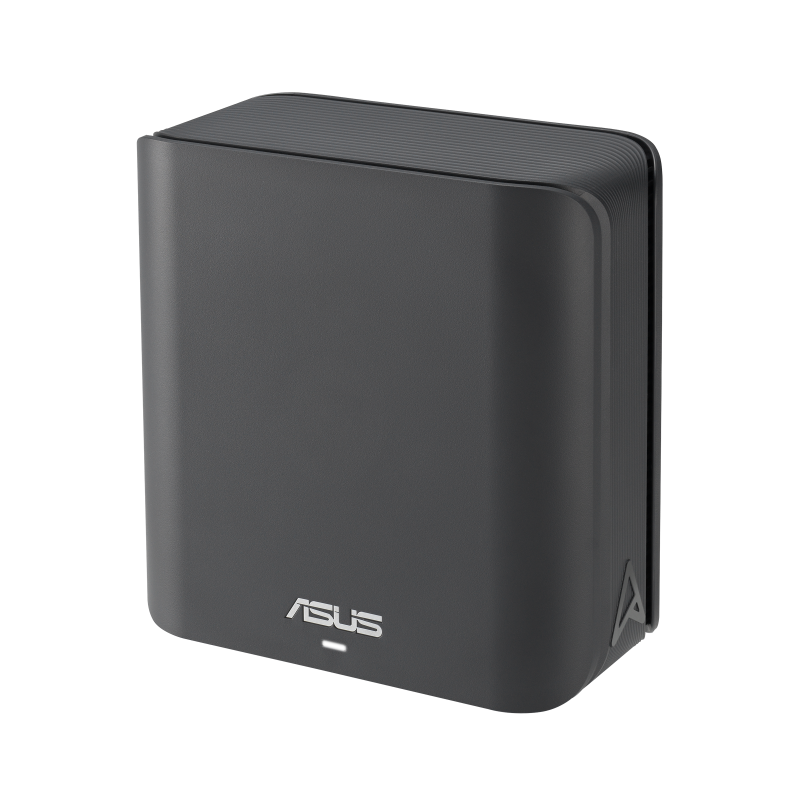
ASUS JAPAN released the RT-BE3600J Pro, a Wi-Fi 7 router, on September 11, 2026. It delivers up to 3,600 Mbps across two bands and carries two 2.5 Gbps wired ports, with a manufacturer's suggested retail price of 16,920 yen. It also supports AiMesh, the company's mesh networking feature, making it a practical upgrade path for households that want to move their home network toward 2.5G without paying flagship prices.
Two 2.5GbE ports at an entry-level price
The headline feature of the RT-BE3600J Pro is its pair of 2.5 Gbps wired ports. Neither port is locked to a single role: both auto-detect and can serve as either WAN or LAN. For homes that do not need a 10G contract but have outgrown gigabit, this is a well-judged configuration.
Where that port layout really pays off is in mesh setups. When you add a second ASUS router through AiMesh, the two units can be linked over a 2.5G wired backhaul, avoiding the throughput loss that comes with relaying wirelessly. In houses with thick walls, reinforced concrete, or multiple floors, having that option changes the experience considerably.
Note that the unit has no USB port. Anyone hoping to attach an external drive for a makeshift NAS will have to look elsewhere.
Wi-Fi 7 tops out at 2,882 Mbps on 5 GHz
On the wireless side, this is a dual-band Wi-Fi 7 (IEEE 802.11be) router rated at up to 2,882 Mbps on 5 GHz and 688 Mbps on 2.4 GHz. The combined 3,600 Mbps figure is where the model name comes from. There is no 6 GHz band, so it sits in a different category from tri-band flagships.
The core Wi-Fi 7 features are all present: Multi-Link Operation (MLO), which aggregates or switches between the 2.4 GHz and 5 GHz bands; 4K-QAM, which packs more data into each signal; and 160 MHz channel support. ASUS states that 4K-QAM improves transmission efficiency by up to 20 percent compared with the 1024-QAM used in Wi-Fi 6 and 6E.
Inside are four built-in antennas and four high-power front-end modules. With no external antennas, the exterior stays clean, and heat is handled by a heatsink with a nanocarbon surface treatment. Processing is handled by a Qualcomm IPQ5322 (1.5 GHz quad-core) with 512 MB of RAM, supporting up to 40 simultaneous connections.
Separate SSIDs for separate purposes
The standout software feature is Smart Home Master, which splits the network by use case. You can create a dedicated SSID for each: an IoT network that groups smart devices together, a Kids network with time limits and site filtering, and a VPN network that routes traffic through a VPN.
The more smart appliances a home accumulates, the less comfortable it is to have devices of uncertain provenance sharing the main network. Being able to isolate them on a separate SSID is an unglamorous feature that earns its keep. Parental controls come with age-based presets and scheduling, and require no additional subscription.
The AiProtection security layer is built on Trend Micro technology and handles router security assessments and malicious site blocking. VPN support includes WireGuard at up to 300 Mbps over Ethernet and OpenVPN at up to 150 Mbps. Setup and day-to-day management run through the ASUS Router smartphone app.
Key specifications
| Item | Details |
|---|---|
| Wireless standards | IEEE 802.11 a/b/g/n/ac/ax/be |
| Maximum speed | 2,882 Mbps (5 GHz) / 688 Mbps (2.4 GHz), 3,600 Mbps combined |
| Antennas | 4 built-in, plus 4 high-power front-end modules |
| Wired ports | 2x 2.5 Gbps WAN/LAN (auto-detecting) |
| USB port | None |
| CPU | Qualcomm IPQ5322 (1.5 GHz quad-core) |
| RAM | 512 MB |
| Security | WPA/WPA2/WPA3-Personal, WPA/WPA2/WPA3-Enterprise |
| Simultaneous connections | Up to 40 |
| Operating modes | Router / Repeater / Access Point / Media Bridge |
| Dimensions | 140 x 70 x 140 mm |
| Weight | Approx. 511 g |
| Suggested retail price | 16,920 yen |
| Release date | September 11, 2026 |

Pre-orders opened on September 4, and the ASUS Store lists the router at 16,820 yen.
Summary
The RT-BE3600J Pro pairs Wi-Fi 7 essentials such as MLO and 4K-QAM with two 2.5 Gbps ports, all at 16,920 yen. Dropping the 6 GHz band is what keeps the price down, and the result is aimed squarely at users who do not need 10G but have run out of room on gigabit. Within its price bracket, the 2.5G wired backhaul for AiMesh and the per-purpose SSIDs of Smart Home Master are the features most likely to justify the purchase.