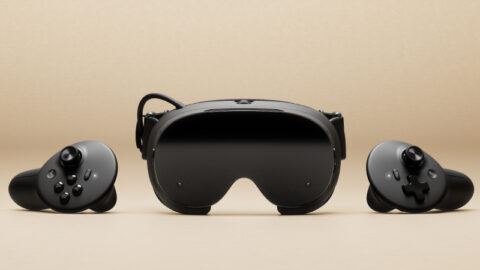
ASUS Republic of Gamers (ROG) and XREAL announced the global pre-order availability of the ROG XREAL R1, the world's first 240Hz micro-OLED gaming AR glasses, on May 15, 2026[1]. The headset is priced at USD 849.99 (around JPY 134,000), with pre-orders starting the same day at 12:00 a.m. CDT through outlets including Best Buy, and global shipments slated for June 1, 2026[1][2]. ※USD 1 = JPY 158
A 240Hz micro-OLED panel and a 171-inch virtual screen
The R1's headline spec is a Sony-made 0.55-inch micro-OLED panel that hits a 240Hz refresh rate and a 0.01ms response time[1]. With most AR glasses capped at 120Hz, ROG and XREAL are doubling the benchmark, and Tom's Hardware notes that the duo "went all-in on the enthusiast end of the AR glasses market by doubling that figure"[2]. Motion-to-photon latency is listed at 3ms, designed to keep fast camera pans free of blur and judder[1].
The virtual screen comes in at 171 inches with a 57-degree field of view, which ASUS says covers up to 95% of the user's focused vision[1]. Peak brightness is 700 nits, the panel covers 106% of sRGB, and the resolution is 1920 × 1080 — a spec sheet that leans hard into pure display performance compared with rival AR glasses[1].
ROG Ally integration and electrochromic lenses
The R1 can be used as a standalone peripheral, but it shines when paired with the ROG Ally handheld[1]. While the glasses project the 171-inch virtual canvas, the Ally's built-in display stays active, letting players tune brightness, screen size, aspect ratio and visual effects without pausing the game[1]. Lens tint, frame-rate boost and 3D mode can all be invoked from the Armoury Crate SE app, keeping the controls close at hand[1].
The lenses themselves use electrochromic technology with three manual tint levels and an Electrochromic Dimming feature that automatically turns the lenses transparent when the wearer looks away from the anchored screen[1]. Head tracking detects when the user looks back at the screen and re-tints the lenses, a touch aimed at making the glasses usable from bright outdoor settings to dim living rooms[1].
XREAL X1, Bose-tuned audio and broad device support
Spatial processing is handled by XREAL's X1 spatial computing chip, which delivers native Three Degrees of Freedom (3DoF) support[1]. Users can toggle between an Anchor mode that pins the virtual screen in space and a Follow mode that lets it move with the wearer's head, with real-time 2D-to-3D conversion bolted on top for existing game libraries[1]. Tom's Hardware points out that the X1 was originally tuned for XREAL's 120Hz One series, so how well it copes with 240Hz playback will be a key question in real-world reviews[2].
On the audio side, the R1 packs Bose-tuned speakers and pitches a three-dimensional soundstage as part of the immersion play[1]. The whole unit weighs 91 grams, which keeps the package squarely in eyewear territory and reads as a deliberate concession to long sessions[1].
Connectivity runs through the optional ROG Control Dock, which bundles DisplayPort, HDMI and USB-A so the glasses can hang off a PC, an Xbox Series X|S, a PlayStation 5 or a Nintendo Switch[2]. Skip the dock and the R1 still plugs straight into smartphones and tablets that support DisplayPort over USB-C[2]. On price, Tom's Hardware is openly cautious: "USD 849 puts the R1 at the high end of AR glasses, and it will need to justify that tag with performance and usability"[2].
Summary
The ROG XREAL R1 layers 240Hz and a 0.01ms response time onto a Sony micro-OLED, then leans hard into ROG Ally, Xbox and PlayStation integration to position itself as a gaming-first AR headset. Electrochromic lenses, spatial audio and a 91-gram chassis show that ASUS and XREAL paid attention to the wearing experience as well as the spec sheet. Even so, USD 849 (around JPY 134,000) is steep for a consumer AR product, and reviews after the June 1 ship date will need to demonstrate that the experience really does pay back the price.
Source [1]: https://press.asus.com/news/press-releases/rog-xreal-r1-gaming-ar-glasses-240hz-micro-oled/