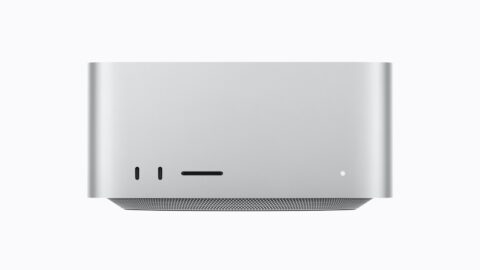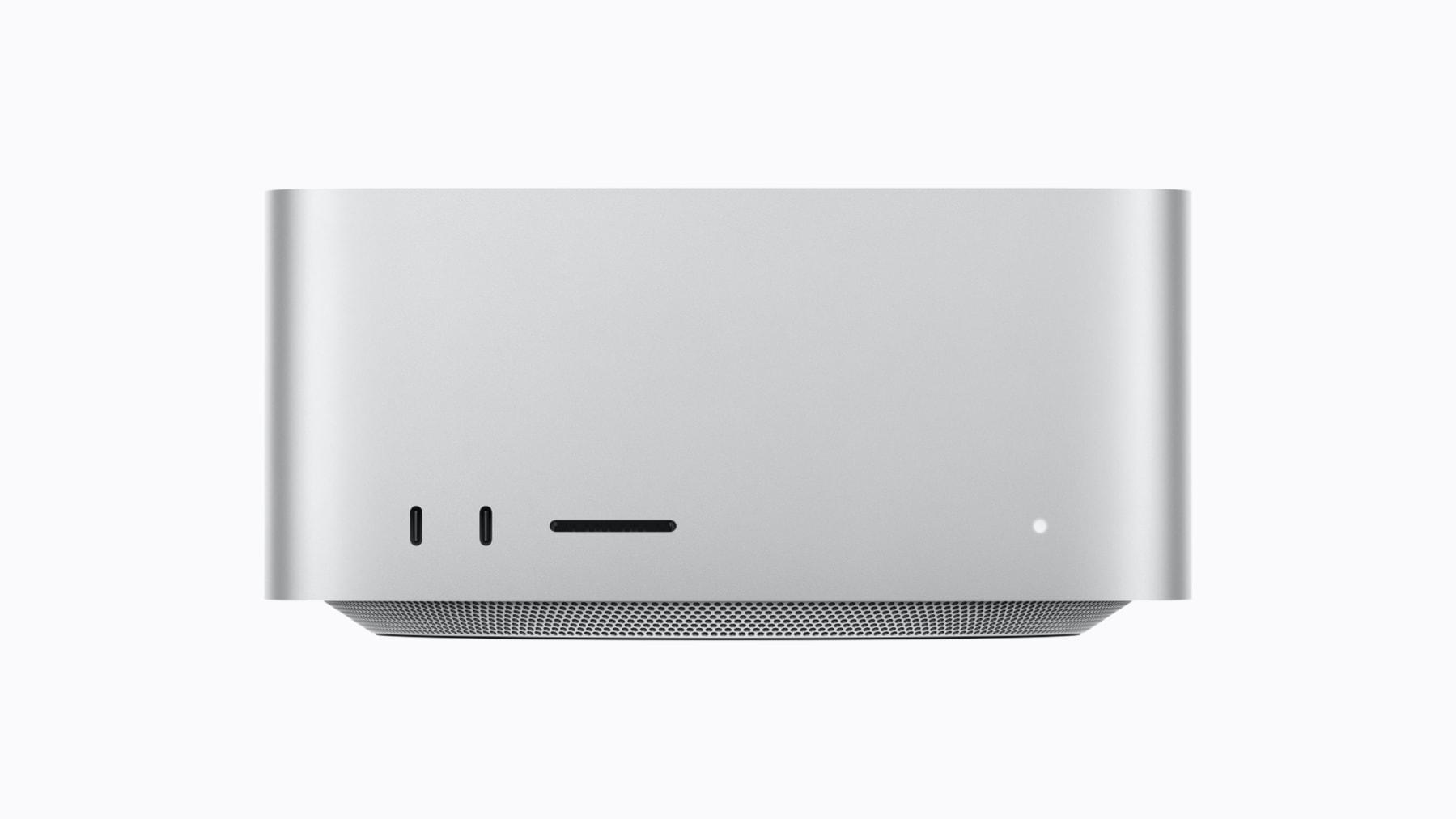
Apple has announced a new Mac Studio, its professional desktop, built around M5 Max and the all-new M5 Ultra. Unified memory now reaches 512GB and memory bandwidth hits 1.2TB/s, a configuration aimed squarely at running enormous language models entirely on the machine sitting on your desk. Pre-orders are already open, and the system ships on September 22.
Neural Accelerators in Every GPU Core, AI Performance Up to 4.3x Faster
The biggest change this generation is inside the GPU. Every core in the M5-generation GPU carries a Neural Accelerator, handling the matrix multiplication at the heart of AI workloads in dedicated hardware. This is the first time that structure has appeared in an Ultra-class chip.
By Apple's own measurements, Mac Studio with M5 Ultra reaches up to 4.3x the peak AI compute performance of the M3 Ultra model, and 9.8x that of the M1 Ultra model. Storage is up to 2x faster, graphics up to 1.8x faster, and CPU up to 1.3x faster. The fact that AI figures stand out so far from the rest says a lot about the character of this refresh.
Memory bandwidth deserves attention as well, now raised to 1.2TB/s. That is 50 percent higher than the previous generation, and for workloads that stream model weights continuously, bandwidth translates directly into speed.
The M5 Max Model: 18-Core CPU and Up to 128GB of Memory
The M5 Max configuration carries an 18-core CPU combining 6 super cores and 12 performance cores. Its GPU scales to 40 cores and runs up to 50 percent faster than the previous generation. Unified memory reaches 128GB, with bandwidth up to 614GB/s.
Apple has published real-application numbers too. Prompt processing in LM Studio, which runs LLMs locally, is 3.9x faster than the M4 Max model, and text-to-image generation is up to 3.5x faster. In video work, Magic Mask in DaVinci Resolve Studio runs up to 3x faster, and in research settings, basecalling for DNA sequencing in Oxford Nanopore MinKNOW is up to 1.9x faster. This is a configuration built for music production, photo editing, software development, and real-time 3D.
The M5 Ultra Model: 36-Core CPU with 512GB of Memory
The higher-end M5 Ultra carries a CPU of up to 36 cores, made up of 12 super cores and 24 performance cores. Its GPU scales to 80 cores and is positioned as the most powerful GPU Apple silicon has ever had. Multithreaded performance is up to 1.3x that of M3 Ultra, and graphics up to 1.8x.
This is the model where unified memory stretches to 512GB. The size of a model you can run locally is bound directly by memory capacity, so a 512GB ceiling means open-weight models that previously had to go to the cloud can now come down to your desk. Inference completes on a single machine, without counting tokens and without sending data anywhere.
The Media Engine has twice the encode and decode blocks of M5 Max, playing up to 33 simultaneous streams of 8K ProRes 422 at 30 fps. CopyCat machine learning training in Foundry Nuke runs up to 3.3x faster than on M3 Ultra, and scene rendering in Maxon Redshift up to 1.7x faster.
Cluster Four Systems for 3x Faster Inference
Another notable addition is the ability to combine multiple systems. With built-in support for Thunderbolt 5 and RDMA (remote direct memory access), several Mac Studio systems can be clustered into a large shared memory pool spanning machines. A four-system cluster delivers up to 3x faster distributed inference than a single system.
The development environment has been built out as well. Core AI is a new framework optimized for Apple silicon, letting developers deploy full-scale LLMs locally across unified memory, CPU, GPU, and Neural Engine. Combined with MLX, Apple's open-source machine learning framework, the whole loop from experimentation through training to deployment can stay on the Mac.
Storage, Connectivity, and macOS 27
Storage moves to a new SSD architecture built on PCIe Gen 6, with read and write speeds up to twice as fast. That matters most in the places where waiting adds up, such as loading huge models or opening large projects.
Connectivity includes up to six Thunderbolt 5 ports at 120Gb/s. Apple's own N1 chip brings Wi-Fi 7 and Bluetooth 6 to Mac Studio for the first time. Genlock over USB-C is newly supported, allowing precise synchronization between a display and professional camera capture such as iPhone 17 Pro. The system drives up to 8 displays, or up to 4 Studio Display XDR units at full 5K resolution and 120Hz.
The operating system is macOS 27 Golden Gate, arriving this fall. Siri AI, integrated into Spotlight and systemwide context menus, along with Apple Intelligence features for photo editing and building shortcuts, pair with the hardware.
On the environmental side, the system is made with 35 percent recycled content overall, including 100 percent recycled aluminum in the enclosure and 100 percent recycled rare earth elements in all magnets. Apple says 40 percent of the electricity used across the supply chain comes from renewable sources such as wind and solar.
Pricing and Availability
In Japan, the M5 Max model starts at 419,800 yen including tax, and the M5 Ultra model at 949,800 yen including tax. Education pricing starts at 385,800 yen and 880,800 yen respectively.
Pre-orders have opened in 30 countries and regions including Japan, with retail availability and customer shipments beginning September 22. The 512GB unified memory configuration is the exception, arriving in late October. Anyone chasing the maximum build will need to wait about another month.
Summary
The new Mac Studio pairs an 18-core CPU and up to 128GB of memory in the M5 Max model with a CPU of up to 36 cores and 512GB of memory in the M5 Ultra model. Neural Accelerators in every GPU core push peak AI compute up to 4.3x that of M3 Ultra, and memory bandwidth reaches 1.2TB/s. Together with four-system clustering over Thunderbolt 5 and RDMA for up to 3x faster inference, the design clearly targets people who want to run large AI models locally. Pricing starts at 419,800 yen, and the system ships September 22.