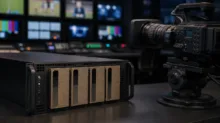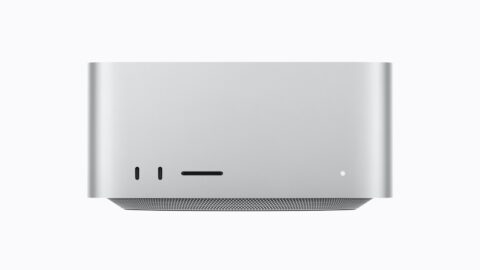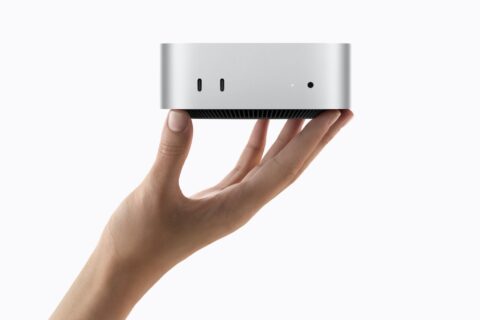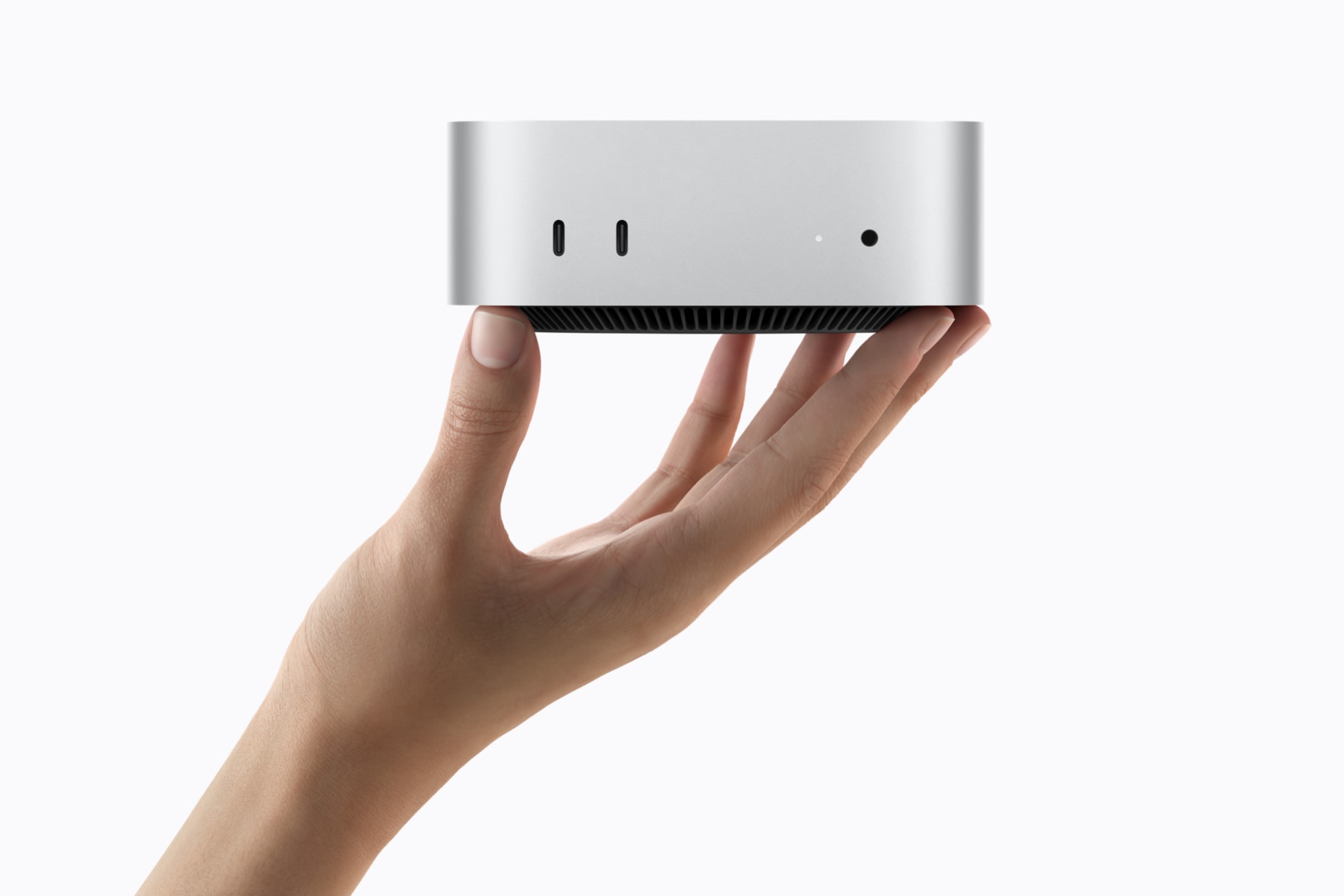
Apple announced a new Mac mini on August 25, 2026. The lineup splits into a standard configuration built around the new M6 chip and a higher-end configuration with M5 Pro. Pre-orders opened the same day, with units reaching customers and stores on September 22. The palm-sized enclosure carries over, but AI performance takes a substantial step up across generations.
Neural Accelerators in Every GPU Core Push M6 AI Work Up to 4x
The story on the M6 model is core count. The CPU has 12 cores, two more than the M4 Mac mini it replaces. The GPU also gains two cores for a total of 12, and for the first time in a Mac mini every GPU core includes a Neural Accelerator.
That change shows up most clearly in AI work. Against the M4 Mac mini, Apple cites up to 4x faster AI performance, 2x faster graphics, and a 40 percent faster CPU. A new dual 16-core Neural Engine runs up to 2x faster than the previous generation, so AI workloads can land on either the GPU or the Neural Engine.
Apple also published application-level numbers. LLM prompt processing in LM Studio runs up to 13.5x faster than on the M1 Mac mini and up to 4.8x faster than on the M4 model. Microsoft Excel spreadsheet calculations are up to 1.5x faster than M4, and game performance in Cyberpunk 2077 Ultimate Edition with ray tracing enabled is up to 2x faster than M4. Unified memory starts at 16GB and configures up to 32GB, with memory bandwidth reaching 170GB/s.
M5 Pro Brings an 18-Core CPU and 64GB of Memory for Always-On AI
The M5 Pro configuration scales up to an 18-core CPU and a 20-core GPU. The GPU adds enhanced shader cores and third-generation ray tracing, aimed squarely at 3D design, VFX, and game development workloads that normally demand a much larger machine.
Unified memory tops out at 64GB with 307GB/s of bandwidth. Since the size of a locally hosted AI model maps directly onto available memory, that 64GB ceiling matters for anyone running local LLMs. Apple's figures put LM Studio prompt processing at up to 8.5x the M2 Pro Mac mini and up to 4x the M4 Pro model, Blender ray-traced rendering at up to 4.5x the M2 Pro, and Affinity image processing at up to 2.1x the M2 Pro.
The phrase Apple keeps returning to is always-on agentic computing. Citing industry-leading performance per watt and quiet operation, the company positions Mac mini as a desktop you leave running beside you while AI agents work. Johny Srouji, Apple's senior vice president of Hardware Technologies, framed it the same way, describing a machine that covers home computing, professional studio work, and always-on agentic duty in one box.
Thunderbolt 5 Lets You Cluster Multiple Units
Connectivity was reworked as well. Both models add Wi-Fi 7 and Bluetooth 6, and wired networking moves to 2.5Gb Ethernet as standard, with a 10Gb Ethernet option.
The front panel carries two USB-C ports with USB 3 support plus a headphone jack that handles high-impedance headphones. On the back, the M6 model has three Thunderbolt 4 ports and the M5 Pro model has three Thunderbolt 5 ports, alongside HDMI and Ethernet.
The interesting part is what Thunderbolt 5 enables. Apple says multiple Mac mini systems can be clustered to run large AI models entirely on device, a direct answer to users who would rather keep inference local than send it to the cloud. USB-C also gains Genlock support, allowing precise synchronization between a display and a camera such as iPhone 17 Pro.
The software side assumes macOS 27 Golden Gate, due this fall. Siri AI integrated into Spotlight and the system-wide contextual menu, along with the next generation of Apple Intelligence features, is what draws the new hardware out.
Pricing Starts at 149,800 Yen, with Recycled Materials Throughout
In Japan, Mac mini with M6 starts at 149,800 yen including tax, or 132,800 yen including tax for education pricing. Mac mini with M5 Pro starts at 299,800 yen including tax, with education pricing from 281,800 yen including tax. Pre-orders began August 25 across 30 countries and regions including Japan, and sales start September 22.
On the environmental side, the machine uses 50 percent recycled content overall, with 100 percent recycled aluminum in the enclosure and 100 percent recycled rare earth elements in all magnets. Apple says all electricity used to manufacture Mac mini is sourced from renewable energy across the supply chain.
Summary
The new Mac mini pairs a 12-core CPU and 12-core GPU in the M6 model, delivering up to 4x the AI performance of the M4 generation, with an M5 Pro model that scales to an 18-core CPU and 64GB of memory for heavier professional work. Thunderbolt 5 clustering and standard 2.5Gb Ethernet point to a machine designed to stay powered on. Pricing starts at 149,800 yen and shipping begins September 22. For anyone looking to keep local AI models running in a small footprint, it is a compelling option.