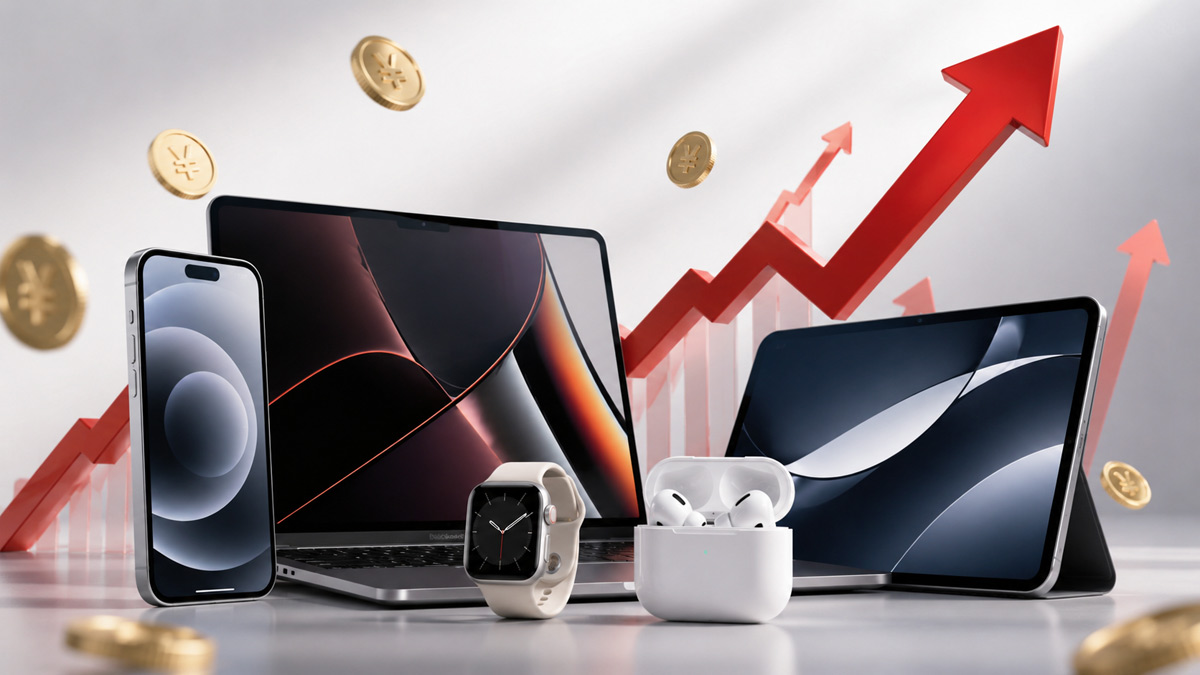
On June 25, 2026 (Japan time), Apple revised the retail prices of a wide range of products centered on the Mac, iPad, and Apple Vision Pro, raising them across the board. The increases apply not only to base prices but also to the build-to-order (CTO) fees for adding memory and storage (SSD) capacity at the time of purchase. Behind the move is a worldwide shortage of semiconductors (memory and storage) driven by surging demand for generative AI. The price revision is not limited to Japan; it has been carried out on a global scale.
Mac, iPad and Vision Pro affected; iPhone left unchanged
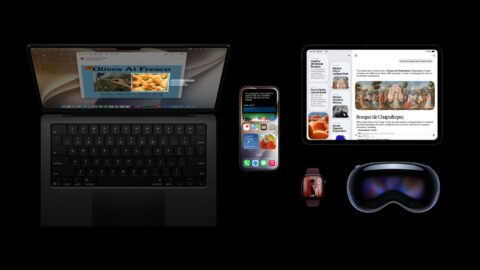
The categories that saw price changes are the three main lines of Mac, iPad, and Apple Vision Pro, plus the HomePod, HomePod mini, and Apple TV 4K. The iPhone, Apple Watch, and AirPods, on the other hand, were excluded this time and kept at their existing prices.
This is the first time Apple has carried out such a sweeping price revision in Japan since July 2022. Back then the review was driven mainly by the weak yen, but this time the main factor is the rising component cost of memory and storage.
New Mac prices: the MacBook Pro rises by ¥60,000
Prices were raised across every Mac model. The before-and-after prices for the main models (tax included, "starting from" the minimum configuration) are as follows.(JPY)
- MacBook Neo: ¥99,800 → ¥119,800 (+¥20,000)
- MacBook Air (13-inch): ¥184,800 → ¥224,800 (+¥40,000)
- MacBook Pro (14-inch): ¥279,800 → ¥339,800 (+¥60,000)
- iMac: ¥198,800 → ¥249,800 (+¥51,000)
- Mac mini: ¥124,800 → ¥134,800 (+¥10,000)
The size of the increase varies by model. While the Mac mini rose by just ¥10,000, the Mac Studio jumped from ¥328,800 to ¥419,800—a ¥91,000 increase, the largest of any Mac product.
iPad, Vision Pro and HomePod revised too
The iPad was also marked up across a wide range of models. The entry-level iPad (128GB) rose ¥16,000, from ¥58,800 to ¥74,800. The iPad mini (128GB) went from ¥78,800 to ¥99,800, the iPad Air (128GB) from ¥98,800 to ¥129,800, and the iPad Pro (256GB) from ¥168,800 to ¥209,800—a clear trend of larger increases on higher-end models.
The Apple Vision Pro rose ¥50,000, from ¥599,800 to ¥649,800. Elsewhere, the HomePod mini went from ¥14,800 to ¥22,800 and the Apple TV 4K (Wi-Fi model) from ¥19,800 to ¥34,800—steep increases even on the smaller peripherals.
Not just the body: memory and SSD upgrades cost more too
In this revision, in addition to the base retail prices, the customization fees for increasing memory (unified memory) and storage (SSD) capacity at the time of order were also raised.
Because current Macs are designed so that memory and SSD cannot be added after purchase, users who want more capacity must choose a higher configuration when ordering. With both the base configuration price and the customization fees going up, the burden grows the more memory or storage a configuration packs in.
The backdrop: AI demand and a semiconductor shortage
Behind the price increases lies a worldwide shortage of memory (DRAM) and storage (NAND) caused by the spread of generative AI. Huge quantities of memory chips are being consumed for AI servers and data centers, and as major manufacturers such as SAMSUNG and SK hynix shift their consumer production lines toward AI, components for PCs and tablets have become scarce and procurement prices have risen.
Research firm IDC estimates that the average selling price of PCs and smartphones could rise by up to 8% in 2026.
Research firm Omdia, meanwhile, suggests that rising memory prices could account for a price increase of roughly $150 on Apple products.
In an interview on June 17, 2026, Apple CEO Tim Cook indicated that price increases on products were unavoidable due to rising component costs, and this revision is in line with those remarks. The increases extend beyond Japan to countries around the world, including China and South Korea.
Why the iPhone is exempt, and the outlook ahead
The reason the iPhone, Apple Watch, and AirPods were left unchanged this time is thought to be the new iPhone (the iPhone 18 series) scheduled for the fall of 2026. Prices are expected to be set in line with the new models' announcement, with increases of around $100–200 anticipated on the higher-storage models.
There is no sign that the spike in component prices will ease in the short term, so for the time being these new prices look set to become the baseline at the point of purchase.
Summary
The Apple product price increases that took effect on June 25, 2026 spanned both base prices and customization fees, centered on the Mac, iPad, and Vision Pro. The backdrop is a semiconductor shortage driven by expanding AI demand, and the increases have been implemented on a global scale. The iPhone and others were left unchanged this time, but the situation will continue to bear watching.
The prices in this article are as of June 25, 2026, based on Apple's official store and various reports. Actual amounts may vary depending on configuration and promotions. Please check the latest information on Apple's official store before purchasing.