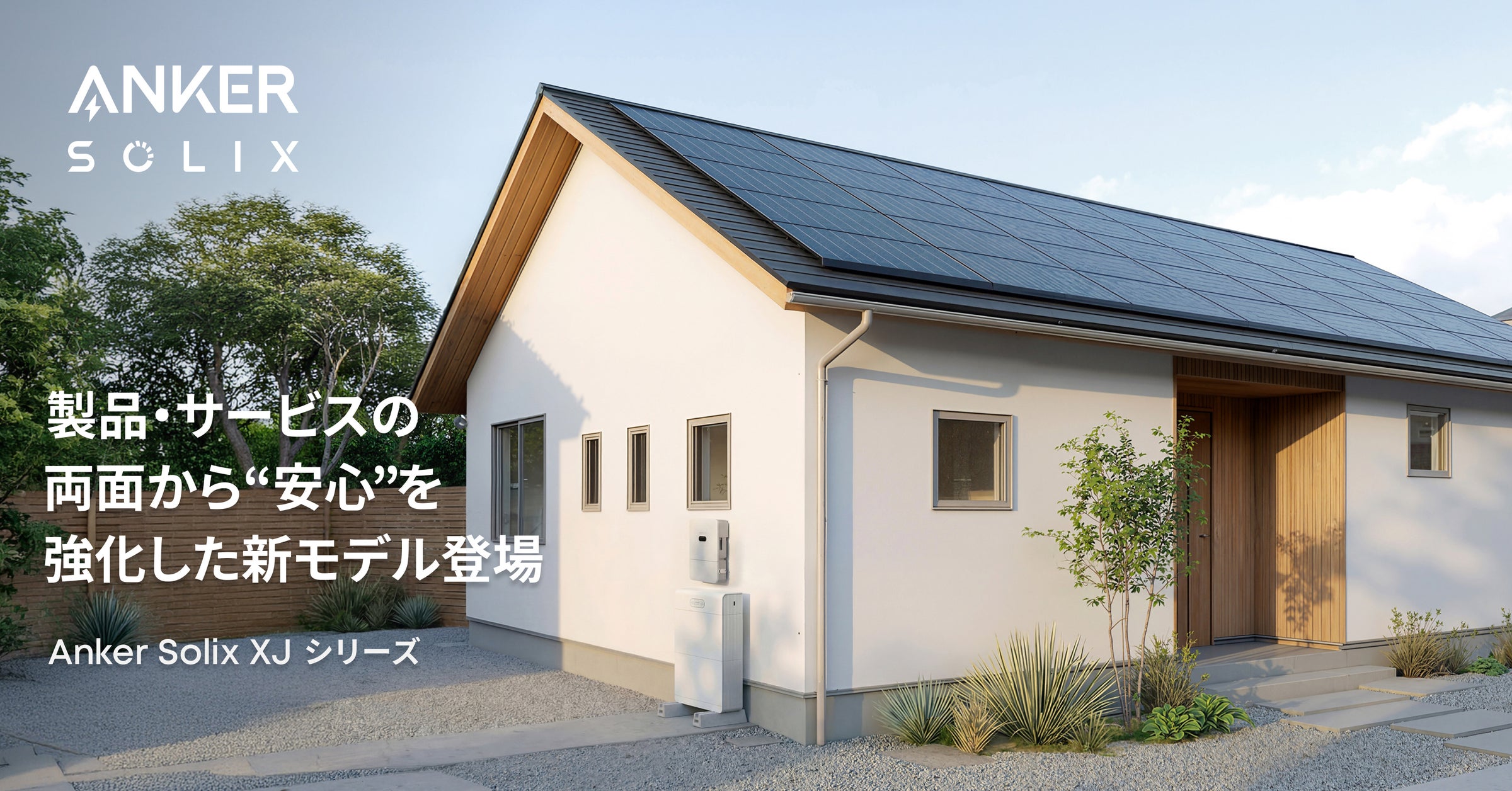
Anker Japan started selling the new "Anker Solix XJ Battery Storage Set 7000Wh / 14000Wh / 21000Wh" on February 18, 2026[1]. Compared with the previous generation (5000Wh / 10000Wh / 15000Wh), the new lineup overhauls capacity, size, input/output, safety, and expandability across the board, and adds bundled natural disaster coverage as a standard feature. The generational update is positioned as a reinforcement of "peace of mind" for households living with the battery long term, from both the product side and the warranty side.
Three capacity tiers covering different household sizes
The new lineup pairs each battery unit with a power conditioner and offers three capacity tiers chosen to fit usage patterns[1]. The entry tier at 7000Wh targets smaller households such as two-person homes. In day-to-day use, it can soak up surplus solar generation, while in emergencies it is positioned to cover about one day of essential power for items like refrigerators and smartphone charging[1].
The mid-tier 14000Wh model is sized for a typical four-person family. Anker frames it as covering large appliances including heating and cooling for about 1.5 days, with the explicit goal of letting households with children maintain near-normal life during outages[1]. The top-tier 21000Wh model targets two-family homes and all-electric households, and is positioned to secure up to two days of power[1]. The capacity headroom is designed to keep the system practical even during the rainy season or winter when solar output drops.
Input/Output raised to 10,500W, about 2.3 times the previous generation
The single biggest change on the performance side is the increase in input and output. The new lineup supports up to 10,500W of input/output, roughly 2.3 times the previous generation, with the 21000Wh model delivering up to 4.95kW of system output[1]. High-draw appliances such as air conditioners and refrigerators can be run simultaneously, so households are no longer pushed into "give up on air conditioning during outages" operation as long as capacity holds out. It is a clear move to extend what a home battery can realistically take on day to day.
Solar charging time is also shorter. For the same capacity tier, the previous generation needed roughly 3.3 hours to top up, while the new model is rated at around 2 hours[1]. The shorter window helps push more energy into storage during the limited daylight of winter or cloudy stretches of the rainy season. The numbers assume a 3,500W solar array paired with the 7000Wh model, 7,000W with the 14000Wh model, and 10,500W with the 21000Wh model[1].
The chassis is more compact than the previous generation, even as the capacity per unit goes up[1]. The smaller footprint should help with retrofit installations on detached homes where placement space is tight.
Five-layer safety protection and expansion up to 42,000Wh
The battery safety design has also stepped up a generation. On top of the existing four layers of cell-level, electrical, structural, and emergency protection, the new lineup adds a fifth layer in the form of an "active pressure release" mechanism that lowers oxygen concentration to reduce the risk of ignition[1]. The cells themselves are lithium iron phosphate (LFP), chosen for their thermal stability and suitability for long-term residential installation[1].
Expandability is preserved. Up to two battery units can be installed side by side, and pairing two 21000Wh units pushes the maximum capacity to 42,000Wh[1]. The architecture leaves room for households to add capacity later as family composition changes, or as EV charging and electricity-cost hedging become bigger priorities. For background, Anker Group has been certified as the world's No.1 mobile charging brand for five consecutive years[2].
20-year product warranty and bundled natural disaster coverage
The other pillar of the new lineup is the warranty package. Buyers receive a 20-year product warranty, described as industry-leading, alongside "Anker Anshin Support," which includes a 10-year coverage program for home appliance repair costs[1]. The scope is structured around a 10- to 20-year installation horizon, aimed at smoothing out the long-tail risk of component failure.
New for this generation, natural disaster coverage is bundled as standard. If solar panels, the power conditioner, or the battery itself are damaged by fire, lightning, wind and water damage, or snow damage, repair and replacement costs fall under the coverage[1]. With concern over outages and household equipment damage growing in the face of frequent earthquakes, typhoons, and heavy rain in Japan, removing the need to shop separately for added insurance is likely to lower the purchase hurdle. Note that coverage scope varies by disaster type and some damage falls outside the program, so the fine print should be checked before signing[1].
Summary
The new Anker Solix XJ lineup keeps the three-tier capacity choice of 7000Wh, 14000Wh, and 21000Wh, while pushing input/output up to 10,500W, cutting solar charging time, and adding a fifth layer of safety protection. Combined with expansion up to 42,000Wh, a 20-year product warranty, and bundled natural disaster coverage, the system is designed to consolidate outage resilience, long-term electricity-cost hedging, and disaster preparedness into a single platform. For households considering their first home battery, the bar for capacity planning and warranty length has been raised in one step.
Source:https://prtimes.jp/main/html/rd/p/000000630.000016775.html
Source:https://corp.ankerjapan.com/