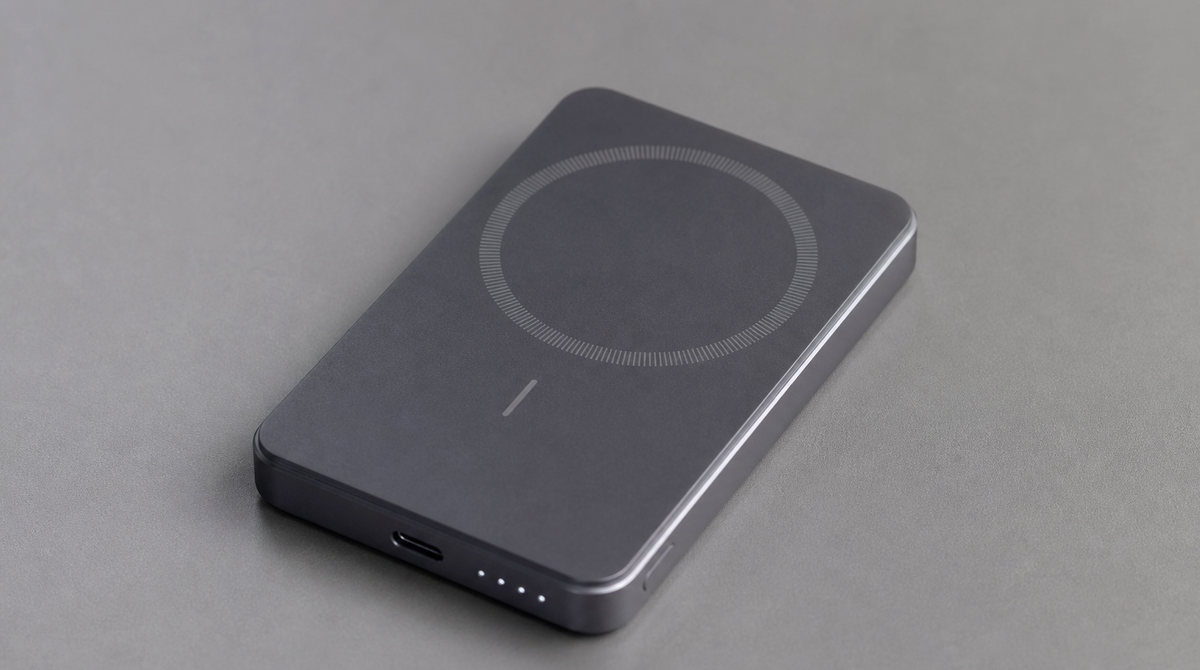
On May 27, 2026, Anker Japan announced "Neo Lithium-ion Battery," a proprietary battery cell developed in-house that takes lithium-ion safety to a new level[1]. Alongside the cell, the company opened pre-orders for "Anker Nano Power Bank (MagGo, Plus)," the first product to use the new cell, on the Anker Japan official online store the same day[1][2]. The retail price is 11,990 yen including tax, with general availability planned for summer 2026[1].
Inside the First Product: Anker Nano Power Bank (MagGo, Plus)
The first product carrying the new cell, the Anker Nano Power Bank (MagGo, Plus), combines the Neo Lithium-ion Battery with a flame-retardant casing and an upgraded Battery Management System (BMS) to push safety on both the hardware and software sides[1]. Capacity is 10,000 mAh, enough to fully charge an iPhone 17-series device about twice[1].
Wireless charging supports Qi2 and delivers up to 15 W of magnetic wireless output[1]. Qi2 is an industry standard for wireless charging that uses a magnetic ring on the back of the phone to lock alignment in place, which makes it a strong match for MagSafe-equipped iPhones. Despite the 10,000 mAh capacity, the body is only about 15 mm thick, slim enough to slip into a pocket or pouch for daily carry, according to Anker Japan[1].
The price is 11,990 yen including tax[1]. The sole distribution channel at launch is the Anker Japan official online store, where the product page already accepts pre-orders[2]. Broader retail availability (electronics stores and the like) is targeted for summer 2026[1].
Three Hallmarks of the New Neo Lithium-ion Battery Cell
Neo Lithium-ion Battery is a proprietary cell that Anker developed with the explicit goal of pursuing both safety and usability without compromise[1]. Anker frames the cell around three pillars[1][3].
The first pillar is a cell material with impurities aggressively eliminated[1]. Across both the electrodes and the electrolyte, which are the two ingredients that most determine the safety of a battery, fine impurities that could trigger ignition have been suppressed. On the positive electrode in particular, magnetic foreign matter, which tends to be a major safety risk, has been held to one part per about 6.67 million, a level Anker calls the strictest impurity limit in the industry's history[1].
The second pillar is suppression of degradation over years of use[1]. Surface treatment on the negative electrode is used to suppress lithium metal deposition, a phenomenon in which metallic lithium grows in needle-like shapes on the negative electrode as charging cycles accumulate, eventually leading to an internal short circuit. The electrolyte formulation has also been optimized to suppress side reactions inside the cell, such as oxygen evolution and decomposition reactions on the electrode surface[1].
The third pillar is clearing demanding tests[1]. Anker says the cell can pass the "nail penetration test," which forces an internal short circuit by driving a steel nail straight through a battery cell, with a 100 percent pass rate, verified at a third-party testing institution under the "GB 47372-2026" standard[1]. The nail penetration test is one of the hardest items in lithium-ion battery safety testing, and clearing it usually requires lowering cell density. With the Nano Power Bank (MagGo, Plus), however, Anker has held 10,000 mAh capacity and about 15 mm thickness in the same body, which the company positions as a design that balances safety with portability[1]. Additional tests covering heat resistance and pressure resistance have also been cleared[1].
Flame-Retardant Casing and Smarter BMS for Multi-Layered Defense
Safety has also been reinforced at the level of the product as a whole, not just the cell[1]. The casing uses a flame-retardant material that resists ignition even when a flame is applied directly[1]. Even in the unlikely event of an internal fire, the casing is designed to contain the flames rather than spread them outward, aiming to keep any damage to a minimum[1].
The BMS (Battery Management System) is also a step above previous models[1]. Each individual cell is monitored at a per-second granularity, which lets the system detect smaller anomalies than before. Any anomalies that are detected are logged, and depending on severity, the system can temporarily lock the product or render it permanently unusable[1].
On top of that, the charge-limit voltage is automatically adjusted as the number of cycles (cumulative charge counts) increases[1]. The battery's status can be monitored in real time through a dedicated app, which also visualizes the right time to replace the unit[1].
A Product Strategy Built Around Safety
This announcement can be read as a concrete realization of the "highest safety standard in Anker's history" that Anker has been signaling for some time. Anker has already shipped products with multi-layer protection features that prevent overvoltage and overcharging, and with "ActiveShield," which monitors the battery's body temperature in real time[1]. The company says it also kept reviewing battery cell options, including alternative materials, and the proprietary cell Neo Lithium-ion Battery is the result of that work[1].
Fires involving mobile batteries have become a major social issue in recent years, and rules around bringing them onto aircraft have been tightened, sharpening both consumer concern and regulatory attention around safety. Having an industry leader like Anker put forward a consistent safety design that runs from cell materials through casing and BMS could become a catalyst for raising the bar across the industry. Further details on the Neo Lithium-ion Battery itself are also published on Anker Japan's explainer page[3].
Summary
The Anker Nano Power Bank (MagGo, Plus) is a 10,000 mAh mobile battery that is the first product to use the new Neo Lithium-ion Battery cell. It combines three layers of safety, a cell with a 100 percent nail penetration test pass rate, a flame-retardant casing, and a BMS that monitors each cell at a per-second cadence, with practical features such as Qi2 magnetic wireless charging and a roughly 15 mm slim body. Pre-orders are open at 11,990 yen including tax, with general availability targeted for summer 2026. For users who put safety first, this looks like a high-profile option to keep an eye on.
出典:https://prtimes.jp/main/html/rd/p/000000654.000016775.html