
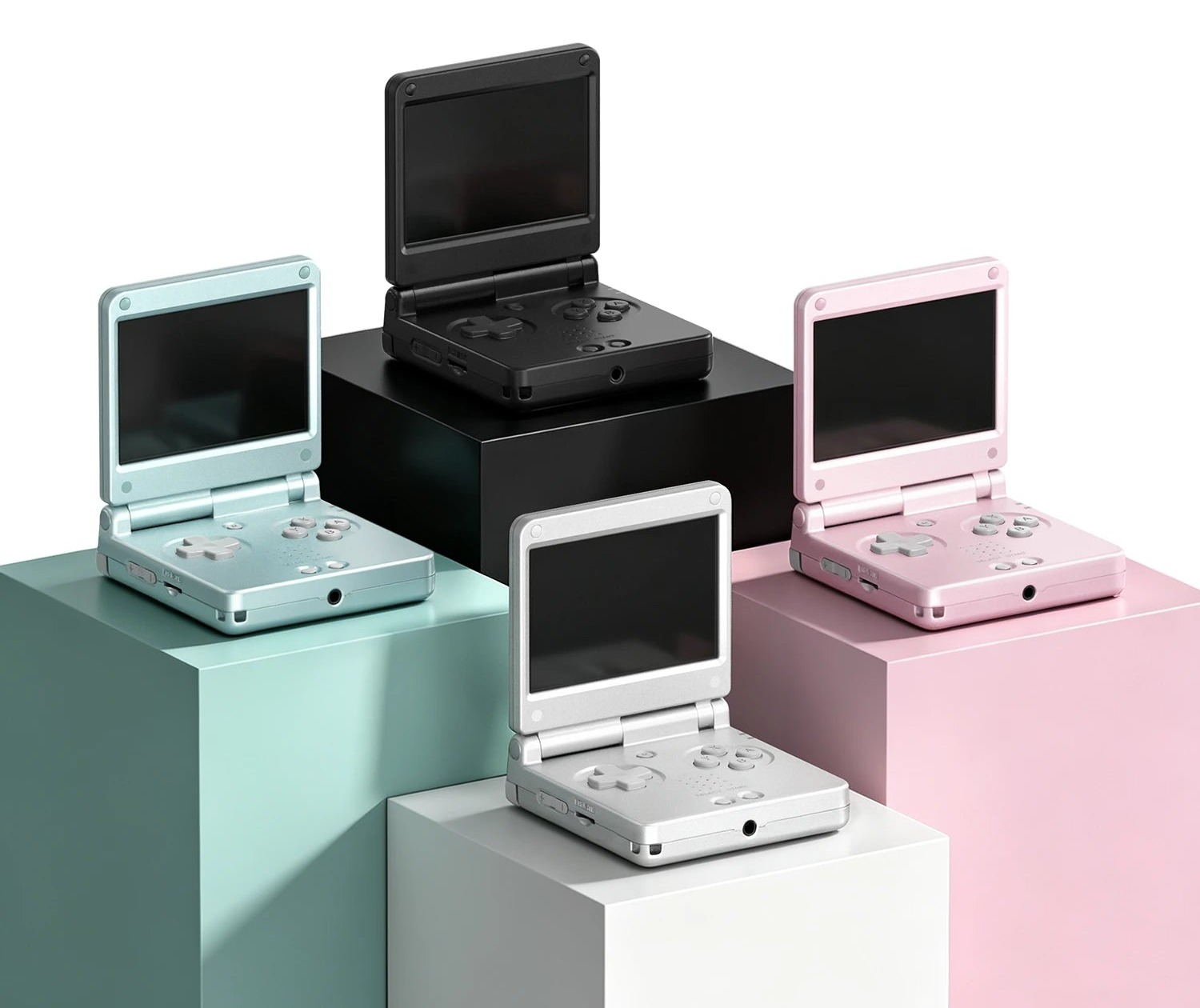
ANBERNIC opens orders for its clamshell handheld, the RG SP, on August 5 at 6 a.m. US Eastern time. The shape recalls the flip-open handhelds of the early 2000s, but the design goes further by dropping analog sticks entirely in favor of a 2D-focused control layout. Closed, it weighs 168 grams. Pricing starts at 64.99 USD (about 10,000 yen), with a 7 USD discount during the first three days.
Dropping the sticks to commit to 2D
The RG SP is ANBERNIC's third clamshell in this lineage, following the RG 35XXSP and the RG 34XXSP. This time the analog sticks that appeared on the previous model are gone. What remains is a D-pad, ABXY buttons, and SELECT and START, the exact control set that defined the 2D era.
Removing the sticks was less an omission than a decision that let the chassis be rebuilt. ANBERNIC says the body is roughly 10 percent thinner and that more than 90 percent of its parts are newly designed. The bezels around the screen are narrower as well, giving the open device a tighter look than its predecessor.
The shell uses a metallic finish, with an acrylic ANBERNIC badge set into the lid. A dual alloy hinge holds the screen at whatever angle the player picks. Magnets sit in the upper and lower covers so the unit snaps shut, and a built-in Hall sensor detects the closed lid and drops the system into sleep, which suits anyone who tosses a half-finished session into a bag.
Closed dimensions are 8.3 by 8.2 by 2.39 cm, at 168 grams. It fits in a palm and slides into a jacket pocket.
A 3.4-inch 720 by 480 panel, exactly triple GBA resolution
The display is a 3.4-inch IPS panel with OCA full lamination, which removes the air gap between the cover glass and the panel itself. Resolution is 720 by 480.
That number is deliberate. The Game Boy Advance rendered at 240 by 160, and 720 by 480 is exactly three times that in both directions. Scale one source pixel into a 3 by 3 block and the result carries no blur and no uneven rows. This is why ANBERNIC advertises 3x pixel-perfect scaling, and it remains the most direct way to put retro artwork on a modern panel without distorting it.
Processing comes from an H700 quad-core chip (ARM Cortex-A53 at 1.5 GHz) paired with a dual-core Mali-G31 MP2 GPU and 1 GB of memory. The operating system is ANBERNIC's own 64-bit Linux build, tuned to get players into a game quickly. Japanese is among the supported interface languages, alongside Chinese, English, Korean, Russian, French, German, Spanish, and Portuguese.
Storage relies on microSD, and a 16 GB card ships in the box. There are 2 card slots, each supporting up to 512 GB. Wireless covers Wi-Fi on 2.4 GHz and 5 GHz (IEEE 802.11a/b/g/n/ac) plus Bluetooth 4.2, with Wi-Fi multiplayer and streaming supported. Controllers connect over 2.4 GHz wireless, wired, or Bluetooth, and video output to a TV is available. A vibration motor is included.
The battery is a 3,300 mAh lithium polymer cell rated at 6 hours. Charging runs at 5 V / 1.5 A and works with C-to-C cables. None of that is dramatic on paper, but for 2D titles it is enough to carry through a day away from an outlet.
From 64.99 USD, with 7 USD off for three days
Orders open at 6 a.m. Eastern on August 5, which is 3 a.m. Pacific.
Pricing splits into 3 tiers by bundled microSD capacity. The standard 16 GB configuration is 64.99 USD (about 10,000 yen), adding 64 GB brings it to 79.99 USD (about 13,000 yen), and the 128 GB configuration is 94.99 USD (about 15,000 yen).
ANBERNIC is also applying a 7 USD discount for the first 3 days of availability. That works out to 57.99 USD (about 9,000 yen), 72.99 USD (about 12,000 yen), and 87.99 USD (about 14,000 yen) respectively. In other words, a modern rebuild of an early-2000s clamshell lands at roughly 10,000 yen.
※1 USD = 157.58 JPY (closing rate on August 3, 2026)
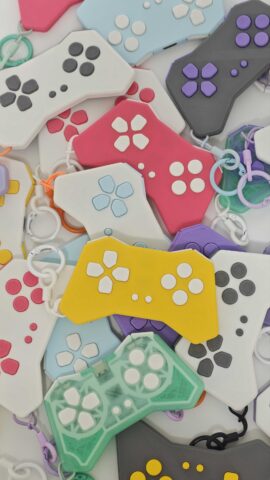
Four colors are offered: Platinum, Graphite, Pearl Blue, and Pearl Pink. The box includes the console, a USB charging cable, a gift box, a user manual, and a screen protector. Buyers can choose shipping from China or the United States, which changes delivery times by region.
Summary
The RG SP defines itself by subtraction: throwing out analog sticks and returning to a D-pad and buttons makes it unambiguously a 2D machine. Its 3.4-inch 720 by 480 screen is triple the GBA resolution, so pixel art scales cleanly with no interpolation. At 168 grams, with 6 hours of battery and Japanese language support, it is a well-judged package for playing on the move. Orders open August 5 at 6 a.m. Eastern, starting at 64.99 USD, with 7 USD off for the first three days.