Alibaba's Qwen team released Qwen-Robot Suite, a set of foundation models for controlling robots, on June 16, 2026. Developed by the company's Tongyi Lab, the suite is built around three models: Qwen-RobotNav, which handles moving to a destination; Qwen-RobotManip, which controls robot arms; and Qwen-RobotWorld, which understands surroundings and predicts what comes next. The move marks a shift away from chatbots that handle text and toward physical AI that moves a body in the real world.
From Language Models to AI With a Body
Until now, the main battleground for generative AI has been the software realm of text and images. Qwen-Robot Suite carries that technology into physical space, aiming to let robots handle three basic actions: moving, grasping objects, and understanding their environment. Alibaba frames it as a full software foundation for how machines behave in the physical world, and a notable point is that it provides a general-purpose base not tied to any single robot.
The three models each have a distinct role, but using them together is designed to carry out an end-to-end flow such as receiving an instruction, moving to a destination, finding a target object, and operating on it. Being able to act from a spoken instruction is the major difference from conventional robot control.
Qwen-RobotNav is a navigation model that guides a robot to its destination. It is built on Qwen3-VL, which handles vision and language together, and was trained on 15.6 million data samples. What stands out is that a single model takes on five different kinds of tasks: following instructions, moving to a specified point, searching for an object, tracking a target, and autonomous driving.
The benchmarks point to concrete numbers as well. On VLN-CE RxR, which tests following spoken instructions under conditions close to a real environment, it recorded a 76.5 percent success rate, and on EVT-Bench, which evaluates the ability to keep tracking a target, it achieved 90 percent tracking accuracy. The model is designed to act on natural-language instructions even in a place it is visiting for the first time.
Qwen-RobotManip: Operating Arms With Different Structures
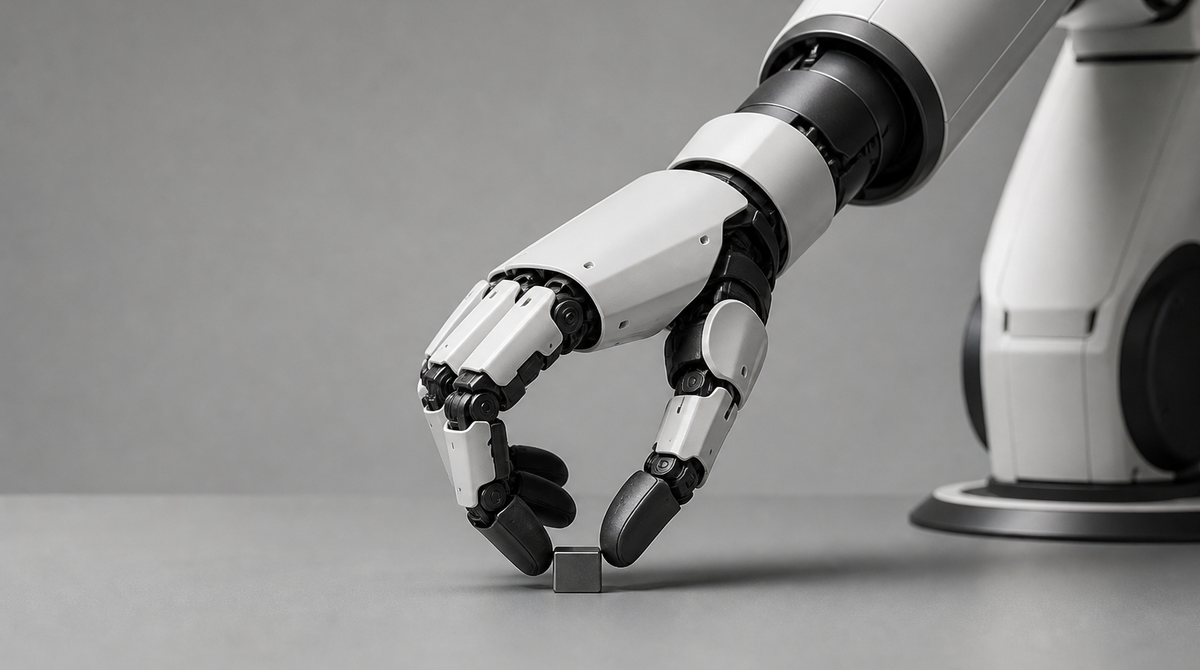
Qwen-RobotManip is the model responsible for grasping and moving objects with a robot arm. Built on Qwen3.5-4B, it was trained on roughly 38,100 hours of data combining open-source robot datasets with videos of humans performing tasks. Rather than relying on proprietary data gathered only from its own hardware, the team scaled the model using widely available data, which is one of the engineering choices worth noting.
Robot arms differ from maker to maker and product to product in the number of joints, arm length, and the mechanics of how they move. These per-machine differences have been a barrier to reusing a single manipulation model. Qwen-RobotManip is designed to work across arms with different structures, taking the top spot on RoboChallenge Table30-v1, which evaluates tabletop tasks, and reportedly outperforming previous approaches by 20 percent.
Qwen-RobotWorld: Reading What Happens Next Before Acting
The most ambitious of the three is Qwen-RobotWorld, which serves as a world model. It simulates and predicts how an environment will change before the robot actually starts to move. Using a vision-language model, it can describe its surroundings in words and forecast physically plausible future developments across navigation, driving, and manipulation scenarios.
Cited use cases include generating the motion of a robot arm from a video of a person working by hand, and producing multi-angle footage that is consistent in both time and space from a single instruction. Being able to picture the outcome of an action in advance is an important foundation for running physical AI safely and efficiently.
Pilot Testing for Enterprises First, as China's Physical AI Race Accelerates
Qwen-Robot Suite is currently in a pilot-testing phase for a limited set of enterprise customers through Alibaba Cloud. Alibaba wants these three models to serve as a common base that a variety of robots can share, and reports have described the effort as an attempt to build an "Android of robotics." Chinese tech giants that have led in language models appear to be strengthening their presence in the field of robots that move a body in the real world as well.
Foundation models for robots are an area where companies and research institutions worldwide are competing. The significance of one company presenting a full set of core functions covering movement, manipulation, and prediction is not small, and the next thing to watch is how far compatible robots and real deployment cases will spread from here.
Summary
On June 16, 2026, Alibaba's Qwen released Qwen-Robot Suite, a set of foundation models for robots. Built around three pillars, Qwen-RobotNav for movement, Qwen-RobotManip for arm operation, and the Qwen-RobotWorld world model for prediction, it aims to carry out everything from a spoken instruction to a full sequence of actions. Each model also shows concrete benchmark results, and it is currently in pilot testing for enterprises via Alibaba Cloud. It is an announcement that signals how the main stage for AI is shifting from chatbots to the real world.