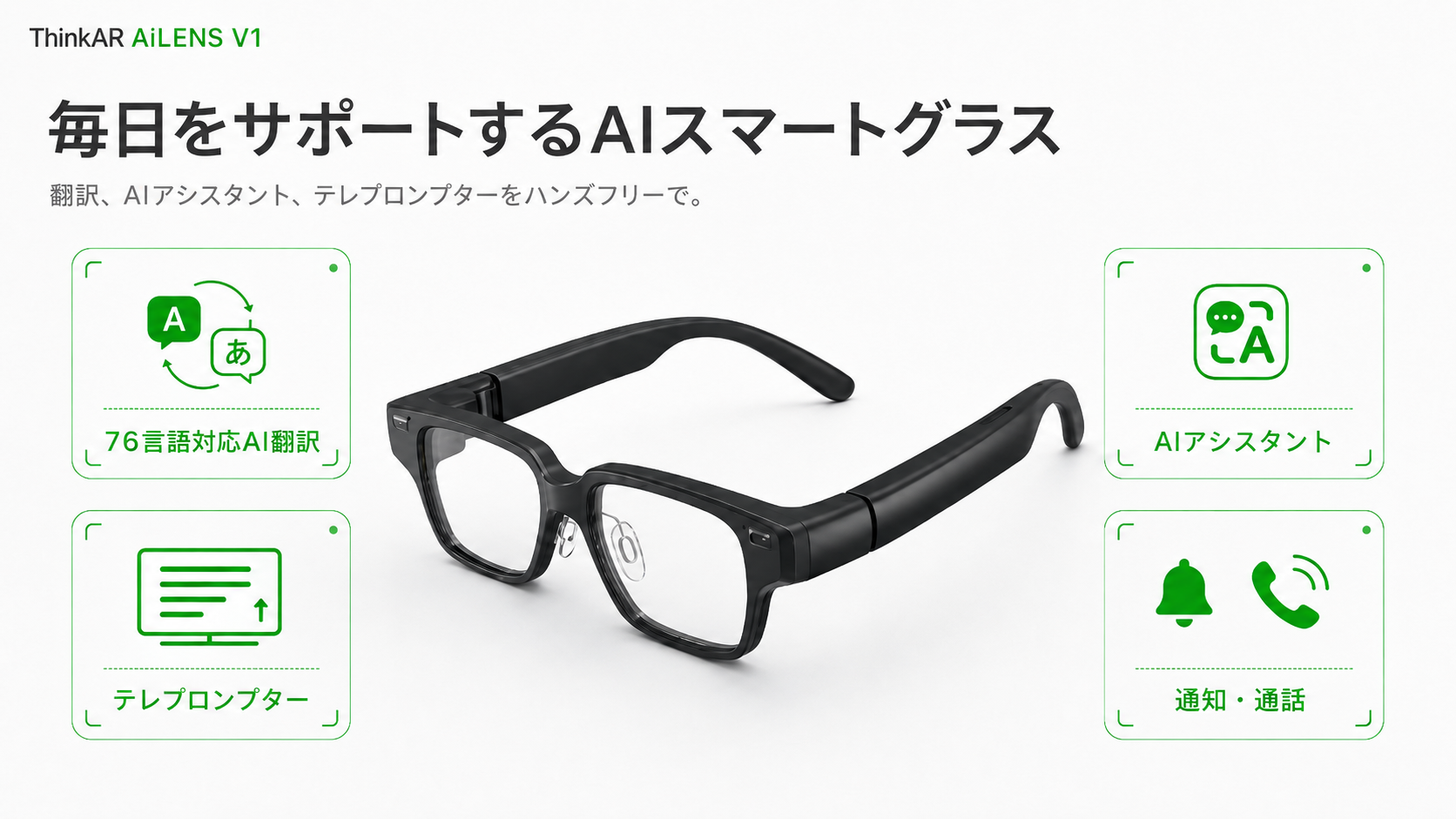
SB C&S began selling ThinkAR's AI smart glasses "AiLENS V1" in Japan on June 5, 2026, at a price of 87,780 yen (tax included). A small display built into the lens shows translations of what others are saying, along with notifications and scripts, right in front of your eyes. The glasses support real-time translation in 76 languages. They take a deliberate approach by leaving out a camera, and the body weighs only about 38 grams.
Smart Glasses With a Built-In Screen
AiLENS V1 is equipped with a "Green MicroLED" display that can show information on the lens. By pairing with the "AiLENS" smartphone app, it can project translation results, various notifications, a teleprompter (script display), and information from an AI assistant directly into your field of view without requiring large eye movements.
Because you wear it on your face like ordinary glasses, it reduces the need to look down at a smartphone screen. It also supports hands-free calling, allowing for use cases where you keep facing the person you are talking with while checking only the information you need at the edge of your vision.
76-Language Translation and Conversation Support Through Transcription
The core feature is real-time translation that supports 76 languages. Because it translates what the other person says and displays it on the lens, it is suited to situations where language barriers tend to arise, such as conversations with overseas counterparts or while traveling. It also includes a teleprompter function that can be used for presentations and lectures, letting you face forward while a script appears in your view.
In addition, it works with the transcription app "YYSystem," which converts speech to text in real time. Since what is spoken is displayed as text on the spot, it can also help support communication with people who have hearing impairments. Completing both translation and transcription within your field of view, rather than on a handheld device, captures the direction of this product.
A Lightweight 38-Gram Design That Omits the Camera
AiLENS V1 does not have a camera. Because there is no shooting function, it is less restricted by the environment in which it is used, such as workplaces and facilities where bringing in a camera requires care. For smart glasses, which often draw privacy concerns, deliberately removing the camera appears to be aimed at widening the range of places where they can be used.
The body weighs about 38 grams, light enough to avoid becoming a burden even over long periods. Folded, it measures roughly 146 (width) x 39 (height) x 47 (depth) mm, and unfolded, roughly 146 (width) x 39 (height) x 149 (depth) mm, keeping a shape close to that of ordinary glasses. The battery supports up to 10 hours of continuous use, securing enough runtime for daytime outings and work.
Price and Availability
AiLENS V1 is priced at 87,780 yen (tax included). SB C&S serves as the official domestic distributor, and the product is handled at Tretech! SoftBank Selection as well as at some electronics retailers nationwide.
In the smart glasses market, companies are pushing different directions, from products that highlight large-screen video display to ones centered on voice interaction with an AI assistant. Among them, AiLENS V1 stands out for bundling "language-handling features," namely translation and transcription, into a lens-based display with a camera-free design. A price in the 80,000-yen range is hardly casual, but for those looking for a practical tool to support face-to-face conversations and presentations, it looks like an option worth considering.
Summary
AiLENS V1 is a ThinkAR AI smart glasses product that shows information in your field of view via a Green MicroLED display. It supports 76-language real-time translation, a teleprompter, and integration with the transcription app "YYSystem," aiming for broad usability with an approximately 38-gram lightweight body and a camera-free design. The battery lasts up to 10 hours, and SB C&S, the official domestic distributor, launched it on June 5, 2026, at 87,780 yen (tax included). Even at the cost of leaving out a camera, it is a device that prioritizes language-handling features and ease of use.