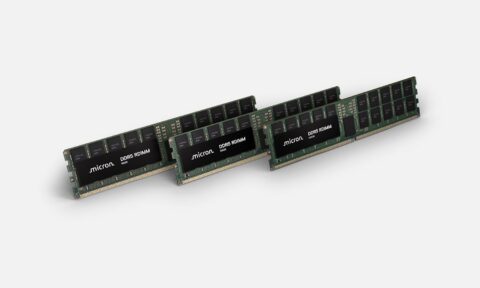
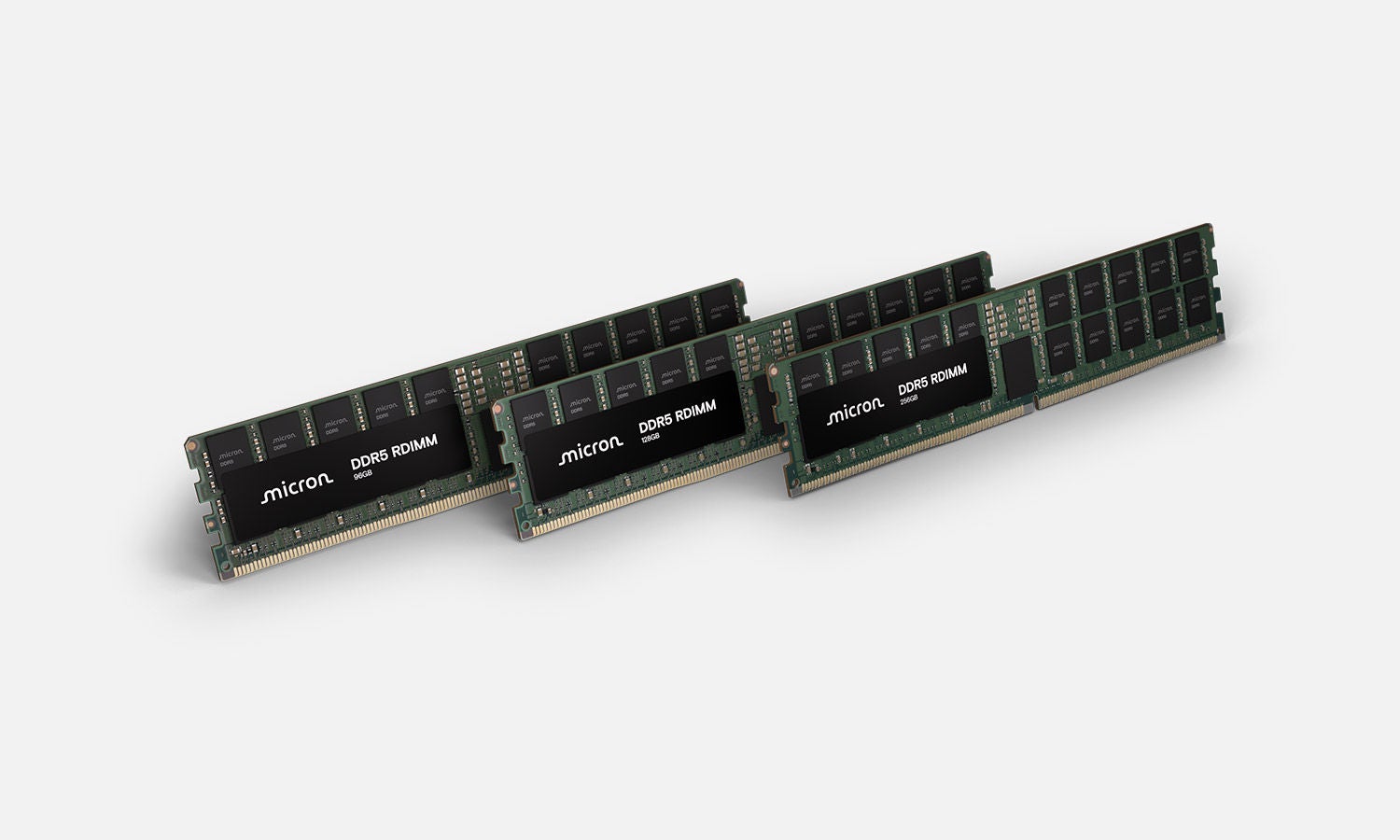
Micron Technology announced on September 15, 2026 (US time) that it has successfully run the world's first 512GB DDR5 RDIMM for servers on multiple server platforms. The module operates at up to 9,200 MT/s, and a dual-socket server with 24 memory slots can hold 12TB of main memory. Compared with building the same capacity from four 128GB modules, operating power drops by more than 60 percent. AMD and Intel are currently validating the module for their next-generation server platforms. Volume production is expected in the second half of 2027, so this is not a product you can buy today, but it marks a turning point for how AI servers will be configured.
Stacking DRAM Dies Vertically to Reach 512GB on One Module
The key to fitting 512GB on a single module is a packaging technique that stacks DRAM dies (the semiconductor chips themselves) vertically. The stacked dies are connected by through-silicon vias (TSVs), which raise the capacity per package without increasing its footprint. It is the same idea used in HBM, applied to the RDIMM, the standard memory module format for servers.
Because the module's form factor and slot count stay the same, servers can increase installed capacity without changing the chassis. In Micron's example, a two-socket machine with 24 slots reaches up to 12TB. With the 256GB modules currently sampling, the same configuration tops out at 6TB, so this is a straightforward doubling.
The module runs at up to 9,200 MT/s. Micron already quotes 9,200 MT/s for its 256GB RDIMM built on 1γ (1-gamma) DRAM, and the 512GB module will arrive in the same speed class, aligned with next-generation platforms.
Operating Power Close to One-Third of Four 128GB Modules
Power efficiency is the point Micron emphasizes most. One 512GB module draws 16.0W in operation, versus a combined 44.2W for four 128GB modules providing the same 512GB. That works out to a reduction of more than 60 percent (roughly 64 percent by calculation). Memory is powered continuously, so the difference feeds directly into the power draw of each server and, by extension, the whole rack.
On performance, Micron points to workloads where memory bandwidth and capacity are the bottleneck. For Spark SVM (support vector machine) based data analytics, it claims up to 1.4 times the performance of a 256GB DDR5 configuration. For memory-resident databases and caching platforms such as RocksDB and Redis, it says throughput and concurrency improve and datasets can scale more efficiently. Actual gains will depend on the workload and server configuration.
Target Uses Span LLM Inference, In-Memory Databases and Virtualization
The use cases Micron lists for the module are large language models (LLMs), agentic AI, real-time inference, workloads on high-core-count CPUs, in-memory databases, caching services and virtual machine consolidation. What they share is a need to keep large datasets in main memory rather than spilling them to storage. Fewer round trips between memory and storage mean less latency and less power.
Raj Narasimhan, who heads the Cloud Memory Business Unit, said a 512GB RDIMM enables multi-terabyte configurations within existing server footprints, supporting larger AI and database workloads, greater virtualization density and improved power efficiency at the same time.
AMD and Intel Are Validating, and JPMorganChase Voices Expectations
Both AMD and Intel contributed comments to the announcement. AMD's Amit Goel said the engineering collaboration with Micron brings compute and memory innovation together, and Intel's Karin Eibschitz Segal said Intel is validating the 512GB RDIMM to help enable future server platforms for next-generation data center workloads. With both companies publicly confirming validation, the module looks likely to be treated as a standard option in the next server generation.
From the user side, Darrin Alves, CIO for Infrastructure Platforms at JPMorganChase, commented that higher-capacity memory will help optimize the balance between compute, memory and efficiency. For industries such as finance that rely heavily on in-memory processing, doubling the capacity per server is no small matter.
Volume Production in Late 2027, Overlapping With Broader Supply Moves
Micron puts volume production of the 512GB RDIMM in the second half of 2027, ramping in line with customer demand. That is more than a year away, so the 256GB module will remain the top of the range for now. Even so, at a time when DRAM demand is concentrating on AI and manufacturers are rushing to invest in new fabs, having a technology that doubles capacity per slot confirmed is significant.
Note that this announcement covers the demonstration and validation stage; no part numbers or pricing have been disclosed. Given how DRAM demand is concentrating on AI, I will be watching what the server memory market looks like when production starts in the second half of 2027.
Summary
Micron has demonstrated the world's first 512GB DDR5 RDIMM on multiple servers, showing speeds of up to 9,200 MT/s and 12TB of capacity in a two-socket machine. The packaging technology stacks DRAM dies with TSVs and cuts operating power by more than 60 percent compared with four 128GB modules, and AMD and Intel are validating it for their next-generation platforms. Volume production is planned for the second half of 2027, targeting workloads that demand large memory capacity, such as LLM inference and in-memory databases.