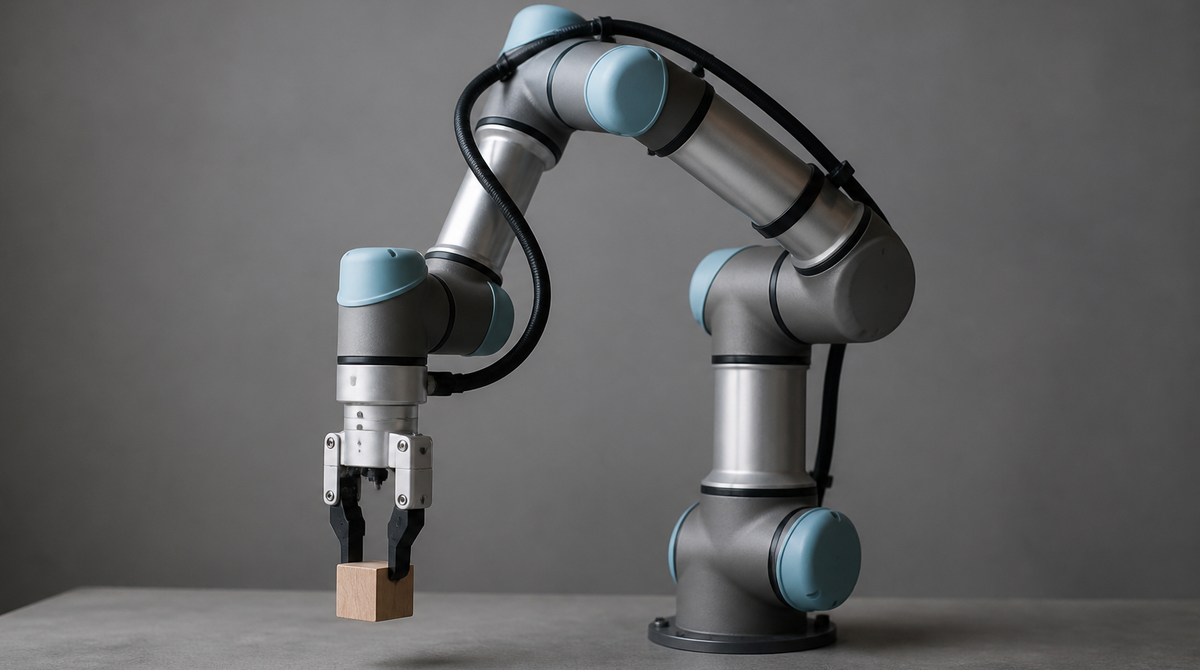
Generalist, a startup developing foundation models for robots, has raised roughly 200 million USD (about 32 billion yen) in a round led by 8VC, pushing its valuation to 3 billion USD (about 480 billion yen), according to people familiar with the deal. The money is an extension of the 400 million USD Series B the company disclosed in June, bringing the round to 600 million USD in total. A company that stayed quiet for most of its two years is suddenly at the center of the market.
※1 USD = 159 JPY
The valuation grew 1.5 times in two months
A regulatory filing puts the fresh capital at close to 200 million USD. The Series B announced in June was led by Radical Ventures and valued the company at 2 billion USD (about 320 billion yen). In roughly two months, that 2 billion turned into 3 billion, and the round as a whole grew from 400 million USD (about 64 billion yen) to 600 million USD (about 95 billion yen). Neither Generalist nor 8VC has commented.
The company's origins make the enthusiasm easier to read. Generalist was founded in 2024 by Pete Florence and Andy Zeng, both former Google DeepMind researchers, along with Andrew Barry, a former Boston Dynamics engineer. Early backers include 8VC and Radical Ventures, plus NVIDIA, Union Square Ventures, Bezos Expeditions, and researcher Fei-Fei Li. Familiar names from both robot learning and generative modeling were behind the company from the start.
Learning a new task from a 3 to 12 second demonstration
Generalist is building a general-purpose robot foundation model that is not tied to a single hardware platform. With GEN-1.5, released in August, the company says a robot can perform a new task after seeing a single demonstration video lasting 3 to 12 seconds. No additional training, no gradient updates. The model assembles the motion from footage it receives as context on the spot.
In the company's own evaluation, one-shot prompting averaged 59 percent success across 10 tasks. Adding 10 gradient steps on five minutes of data raises that to 83 percent. The gap between those two numbers captures the difference between what the model can do immediately after seeing a demonstration and what it can do after a small amount of tuning.
What stands out is the behavior that goes beyond copying. Handed a dustpan instead of the brush used in training, the robot lifts the block and tips it into the bowl. It has used a banana as a makeshift brush. It works with both hands even when every demonstration used only one. A demonstration recorded entirely in simulation reportedly works as a prompt for the physical robot. Place two demonstrations inside the 30 second context window and the model fills in the motion that bridges them, executing the pair as one longer sequence.
For now the company works with a small set of customers and uses their feedback to tune the model for specific applications.
Betting on a ChatGPT moment for robots
Generalist is not alone in trying to build a brain for a broad range of robots. Physical Intelligence has reportedly been valued at 11 billion USD (about 1.75 trillion yen), and SoftBank-backed Skild AI at 14 billion USD (about 2.23 trillion yen). Genesis AI was in talks last month to raise at a 3 billion USD valuation. Among this group, 3 billion sits near the entrance rather than the top.
The money is concentrating around a thesis that robotics is approaching the same inflection point large language models went through: a moment when robots handle general tasks without being explicitly trained for each one.
Skepticism travels alongside it. Language models could be trained on nearly the entire text of the internet, and no comparable archive of robot motion data exists. The ability to pick up a new task from a single short video can be read precisely as a workaround for that shortage. Some venture investors still warn that a genuinely general robotics model may be years away.
Summary
Generalist's valuation moved from 2 billion USD to 3 billion USD in two months. The behavior GEN-1.5 demonstrates, shifting to a new task from one short video, is a persuasive answer to the data scarcity that has held robotics back. At the same time, average success sits at 59 percent, and 83 percent even with a tuning pass. There is still distance between dexterity in a lab and yield on a factory floor. Whether the valuation and the capability are growing at the same rate should become clear over the next year.