
On July 22, NVIDIA released Medical Physics Simulation, an open-source physics simulation framework for medical robotics development[1]. Its defining feature is GPU acceleration, letting developers reproduce in a virtual space how human tissue and medical devices interact. In the company's benchmarks, running 8,192 training environments in parallel cut the time needed to train robot behavior from more than five hours to under two minutes[1].
The Data Shortage Blocking Medical Robotics
Before a healthcare robot can be useful in the real world, it first has to learn how the physical world pushes back. Human anatomy varies widely, instruments bend, press, slip and interact with tissue in complex ways, and imaging can be noisy or incomplete. On top of that, the rare edge cases developers most need to understand do not conveniently appear on the schedule of an experiment[1].
As a result, gathering the enormous amount of varied data needed to train, test and improve robot behavior has become the single biggest bottleneck in medical robotics[1].
Announced as a new capability within NVIDIA's healthcare development platform Isaac for Healthcare, Medical Physics Simulation addresses this by modeling the interaction between anatomy and devices, generating hard-to-capture scenarios, and testing in silico (on a computer) so robot control policies can be trained and evaluated before moving on to hardware-heavy testing[1]. NVIDIA says that being able to prepare reusable simulation environments — instead of rebuilding a dedicated scene from scratch for every workflow — is what shortens development time[1].
A Virtual Training Ground Combining Classical Physics and Generative AI
Medical Physics Simulation runs on NVIDIA CUDA and is built on NVIDIA Warp, Newton and Cosmos, the company's simulation and generative AI technologies[1]. Because it can run hundreds of simulation environments in parallel, teams can explore more scenarios and surface failure-prone patterns earlier in development[1].
As a figure illustrating that scale, NVIDIA cites a benchmark in which GPU-native simulation ran 8,192 robot-training environments at once, cutting training time from over five hours to under two minutes[1]. That said, these are numbers the company itself reported, and results will vary with the comparison conditions. How closely they can be reproduced in actual development settings will require independent, third-party verification going forward.
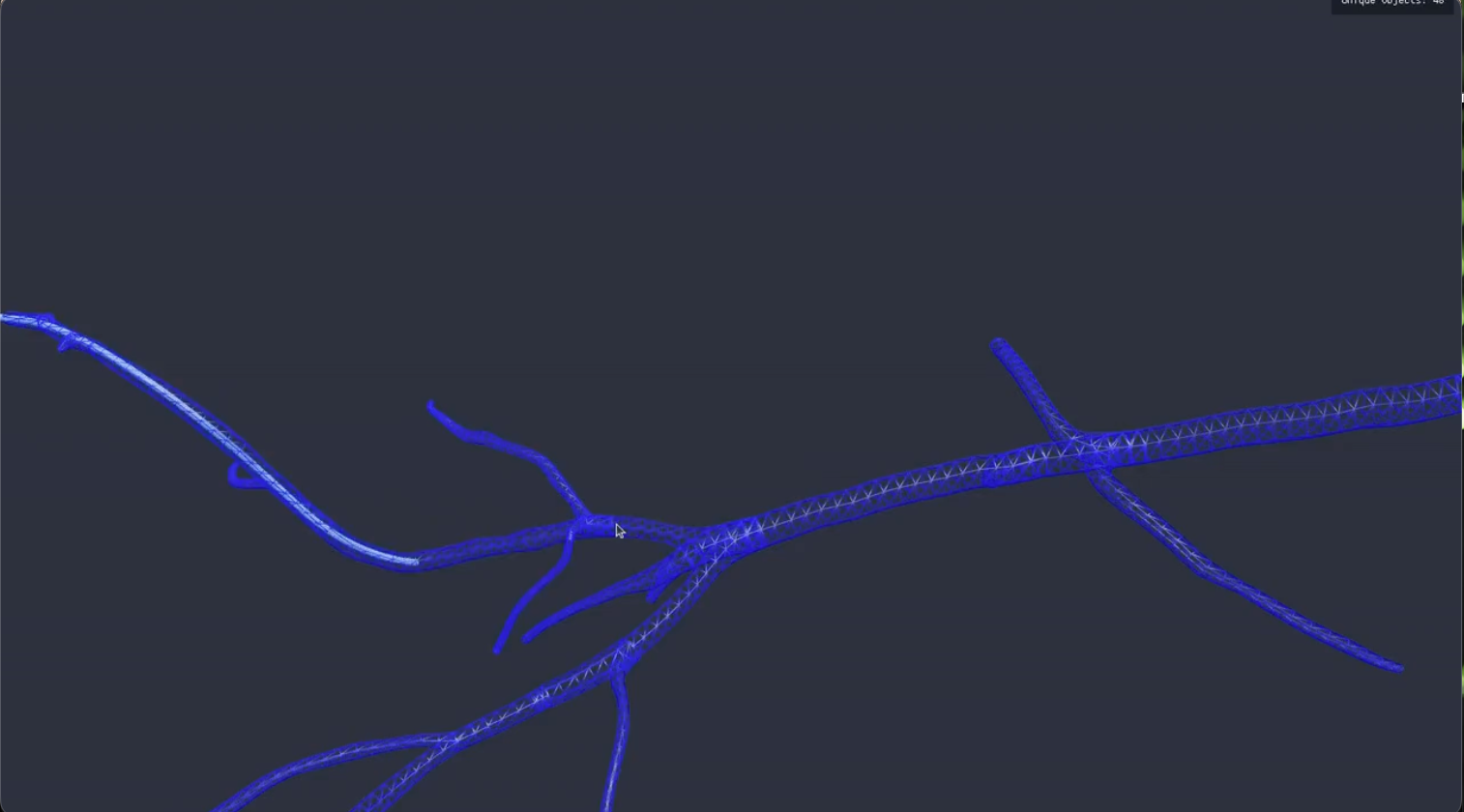
Technically, the framework stands out for combining two approaches. One is classical simulation, which reproduces known physical rules such as contact, friction and motion; the other is NVIDIA Cosmos-H Dreams, the real-time generative AI physics capability embedded in Medical Physics Simulation[1]. The latter reproduces the visual dynamics of a scene learned from procedural data[1]. As a concrete example, developers can connect vascular anatomy, flexible instruments such as catheters and guidewires, simulated X-ray imaging, and reinforcement learning (a method of learning optimal behavior through trial and error)[1]. The framework is designed to extend to other devices, anatomies, sensors and areas of medical robotics[1].
Why Open Source Matters in Healthcare
NVIDIA stresses that being open source is especially important in healthcare, because development teams need transparency into the data, models and weights (parameters) that shape system behavior[1]. With access to open models and weights, developers can more easily reproduce results, evaluate performance across different anatomies and scenarios, identify limitations, and build the evidence needed for regulatory review[1].
Because it is open source, medical robotics developers can inspect the internals of the framework, adapt it to their own devices and workflows, and build on a GPU-accelerated foundation in combination with NVIDIA's broader technology stack[1]. The framework is released as part of Isaac for Healthcare, and developers can review reference workflows as they begin building simulation environments tailored to their own devices, anatomies and applications[1][2].
Surgical Robotics Leaders Line Up to Adopt It
Several leading medical robotics companies are already pursuing simulation-driven development[1].
CMR Surgical and Cambridge Consultants, part of Capgemini, are using Cosmos-H-Dreams to learn the interaction physics of soft-tissue surgery and to generate patient-specific simulations[1]. CMR contributed nearly 500 hours of anonymized clinical data from its Versius Surgical Robotic System to the open dataset Open-H Embodiment, covering procedures including cholecystectomy, prostatectomy, hernia repair and hysterectomy[1]. "Open source models allow us to build on shared knowledge, accelerating responsible innovation and, ultimately, gives us the potential to deliver more consistent care and better outcomes for patients worldwide," said Chris Fryer, chief technology officer at CMR Surgical[1].
Johnson & Johnson MedTech is using Medical Physics Simulation together with a Cosmos-based foundation model to build a digital twin (a real device reproduced in a virtual space) of its endoluminal MONARCH platform for urology, modeling complex anatomy and kidney-stone scenarios[1]. XCath is applying it to endovascular autonomy policy training, and Inner Logic is using it to accelerate technology development with synthetic data, validate device mechanics, and build in silico evidence for regulatory pathways[1]. Medtronic's Structural Heart division is exploring using it with simulated X-ray sensing to generate data for catheter-navigation research[1].
Summary
NVIDIA's newly released Medical Physics Simulation is an attempt to make up for the data shortage that has held back medical robotics development, using GPU-accelerated virtual simulation. It stands out for combining classical physics with generative AI and for securing transparency as open source, and adoption by major surgical robotics companies is already underway. The performance figures rest on the company's own benchmarks, but moving the early stages of development into virtual environments could speed up the practical deployment of medical devices.
Source: https://blogs.nvidia.com/blog/medical-physics-simulation-open-source/