Zhaoxin, the Chinese maker of x86-compatible processors, has revealed an industrial partnership with Dongfang Suanxin, a Shanghai-based AI chip company. By pairing the DF1000, China's first "software-defined, near-memory computing" 3D AI chip unveiled by Dongfang Suanxin on July 13, 2026, with Zhaoxin's own ZX86 CPU, the two firms are pushing a "dual-chip" vision that covers everything from general-purpose computing to AI processing entirely with domestic technology. The aim is to build a high-performance compute base without relying on cutting-edge overseas manufacturing processes.
A "Dual-Chip" Vision Unveiled in Shanghai
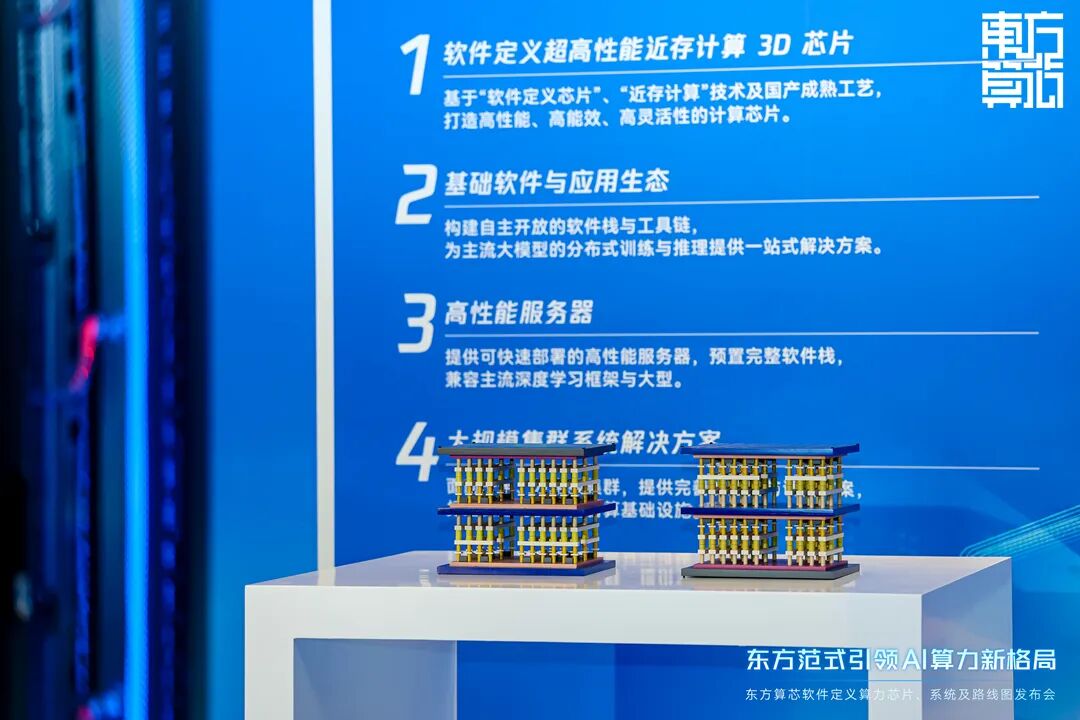
On July 13, Dongfang Suanxin held a launch event for the DF1000 in Shanghai, showing the chip for the first time[1]. Wang Weilin, Zhaoxin's general manager and chief engineer, was invited to the event and gave a talk titled "Shanghai Zhaoxin x Dongfang Suanxin: Building Shanghai's Compute Foundation Together"[1].
Wang framed the collaboration as a practical example of linked innovation in the AI chip industry. Through standardized hardware adaptation and connected low-level software, the two companies plan to tightly integrate the capabilities of the ZX86 CPU and the AI compute chip, building a domestic industrial chain that spans from general-purpose computing to dedicated AI processing[1]. The goal is an integrated compute base tailored to China's government agencies, enterprises, and broader industrial ecosystem.
DF1000's "Software-Defined + 3D Near-Memory Computing"
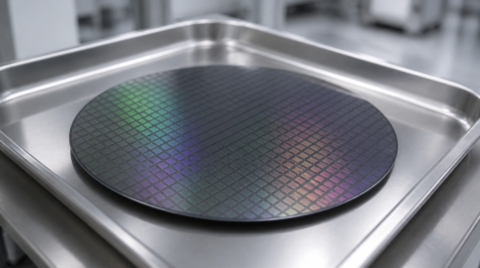
The star of the announcement, the DF1000, is the first domestically produced 3D AI chip to combine "software-defined" design with "near-memory computing"[1]. Near-memory computing refers to a method of stacking the logic layer that performs computation and the memory layer that holds data vertically, shortening the distance between them to speed up data movement. The DF1000 stacks a memory wafer and a logic wafer using 3D hybrid bonding (a technique that joins multiple chips through extremely fine bonds), compressing the interconnect spacing from tens of micrometers down to the sub-micrometer level[2].
In terms of performance, the chip delivers 520 TFLOPS at BF16 precision while using a mature domestic 14nm process, with memory read/write bandwidth of 6.4 TB/s and a scale-up bandwidth that ties chips together of 900 GB/s[1][2]. Dongfang Suanxin says this design breaks through three long-standing bottlenecks facing compute systems: the "memory wall," the "bandwidth wall," and the "power wall"[2]. The company claims that, without using conventional HBM (high-bandwidth memory), it can achieve more than five times the bandwidth of HBM at the same capacity, and that the DF1000 has already completed full tape-out verification and demonstrated stable operation across a 128-card cluster[2].
ZX86's Track Record and the Goal of Avoiding Cutting-Edge Nodes
Zhaoxin has spent years developing its own instruction set architecture, ZX86[1]. While maintaining compatibility with x86, the company has built it up as independent intellectual property, offering two product lines: "KaiXian" for PCs and embedded uses, and "KaiSheng" for servers[1]. Its coverage spans AI PCs, laptops, desktops, servers, and IoT devices, and it is reportedly seeing volume adoption in fields such as government, finance, education, energy, and healthcare[1].
This partnership centers on a "ZX86 CPU + 3D near-memory AI chip" dual-chip architecture that combines the ZX86 CPU with Dongfang Suanxin's chip[1]. Under this division of labor, Zhaoxin's CPU handles general-purpose computing while Dongfang Suanxin's AI chip handles AI training and inference, with the goal of building a domestic compute base that does not depend on the most advanced overseas processes[1].
Dongfang Suanxin has laid out a phased product strategy of "mass-producing one generation, developing the next, and pre-researching the one after"[2]. It plans to launch the successor DF2000 in the fourth quarter of 2026 and the DF3000 in the fourth quarter of 2027, each roughly doubling various performance figures over the previous generation[2].
Summary
Combining Zhaoxin's ZX86 CPU with Dongfang Suanxin's DF1000, this partnership is an attempt to handle both general-purpose computing and large-scale AI processing entirely with domestic technology. Its defining idea is to raise performance through 3D near-memory computing while staying on a mature 14nm process, avoiding dependence on HBM and cutting-edge nodes. Whether the roadmap reaches the successor chips as planned, and whether the design performs in real-world deployments, will be the key points to watch.
Source: https://www.zhaoxin.com/news_view.aspx?nid=2&typeid=289&id=2053
Source: https://finance.sina.cn/stock/jdts/2026-07-13/detail-inihsisv4251366.d.html