Google has announced that it is expanding the tools used to identify whether content was created with AI across Search, Gemini, Chrome, Pixel and Cloud[1]. Built around its SynthID digital watermark and the C2PA Content Credentials industry standard, the effort aims to let anyone check where an image or video came from[1]. The company also says it is deepening its partnership with other players in the industry, including OpenAI and Meta[1].
SynthID Has Watermarked Over 100 Billion Pieces of Content
Google introduced SynthID three years ago[1]. SynthID is a digital watermarking technology that embeds signals imperceptible to the human eye into AI-generated content, and the company has integrated it into its own generative media models and products[1]. To date, it has watermarked more than 100 billion images and videos, along with 60,000 years of audio[1]. As AI-generated content spreads rapidly, Google has steadily built the foundation needed to identify where such content originated[1].
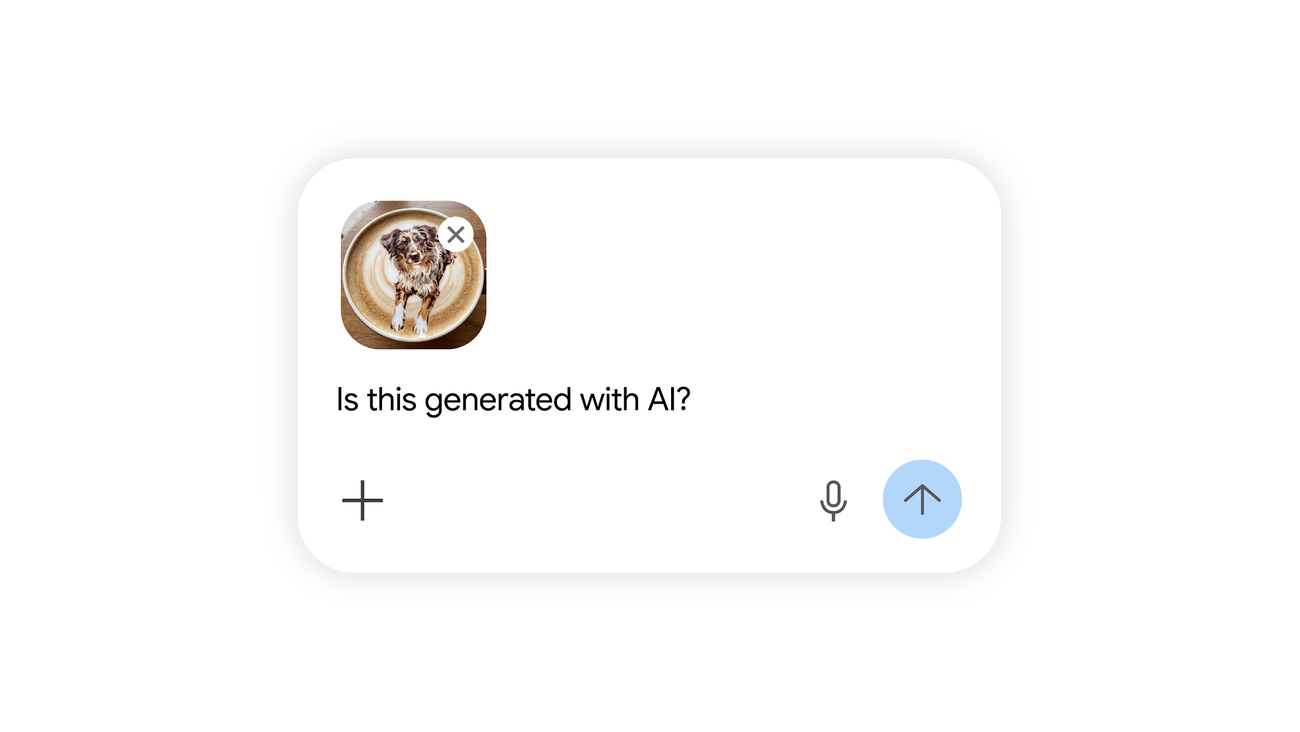
Just Ask "Is This Made with AI?"
Google recently added SynthID verification for images, video and audio to the Gemini app[1]. The feature has already been used 50 million times globally, and it is expanding to Search today and to Chrome over the coming weeks[1]. Specifically, you can learn about an image's origin using Search features such as Lens, AI Mode and Circle to Search, as well as Gemini in Chrome[1]. Simply asking "Is this made with AI?" or "Is this AI generated?" is enough to check[1].
Google is also adding verification for C2PA Content Credentials[1]. This makes it easy to confirm whether content is an unaltered original from a camera or has been modified, and by which tools[1]. It begins rolling out in the Gemini app today and will come to Search and Chrome over the coming months[1]. The company says this builds on work such as YouTube's labels that identify AI-generated content and Backstory, which aims to make detection tools faster and more reliable[1].
Pixel Records Authenticity at the Moment of Capture
The other pillar of identification is the C2PA Content Credentials industry standard[1]. It is designed to show how content was created and modified, with or without the use of AI[1]. Pixel 10 was the first smartphone to provide Content Credentials for images in its native camera app, and Google says it will extend this to video on Pixel 8, 9 and 10 phones in the coming weeks[1]. By documenting content at the point of capture, the aim is to certify that the material was taken by a camera[1]. The company argues that in the age of generative media, being able to identify authentic, unedited content can be just as important as knowing when something was made or edited with AI[1].
Industry Collaboration and a Cloud Detection API
Because digital content travels across many platforms, industry-wide adoption of interoperable tools is essential[1]. According to Google, companies such as OpenAI, Kakao and ElevenLabs are bringing SynthID technology to more of their AI-generated content[1]. Google has also open-sourced its SynthID text watermarking technology, and it is working with NVIDIA to watermark AI-generated video from NVIDIA's Cosmos world foundation models[1].
For businesses, Google is launching a new AI Content Detection API on Google Cloud's Gemini Enterprise Agent Platform[1]. It can spot AI content made not only by Google but also by other popular models, with uses ranging from backend operations such as sorting feeds and preventing insurance fraud to user-facing tasks such as fact-checking and labeling synthetic media[1]. Google is starting with a group of trusted partners and plans to keep refining the API based on their feedback[1].
As a member of the C2PA steering committee, Google is also helping advance global standards for provenance technology[1]. Meta, a fellow steering committee member, will start labeling camera-captured media with Content Credentials on Instagram[1]. As a result, authentic photos and videos shot natively on Pixel phones should be recognized and labeled as such when shared on Instagram[1].
Summary
Centered on SynthID and C2PA Content Credentials, Google is rapidly expanding the ability to check whether content is AI-generated across Search, Gemini, Chrome and Pixel. With Pixel recording authenticity at the moment of capture and industry collaboration from the likes of OpenAI and Meta, the environment for tracing where content comes from is steadily taking shape. As the rollout reaches Search and Chrome, the moments in which we can casually verify "Is this made with AI?" look set to increase.
Source: https://blog.google/innovation-and-ai/products/identifying-ai-generated-media-online/