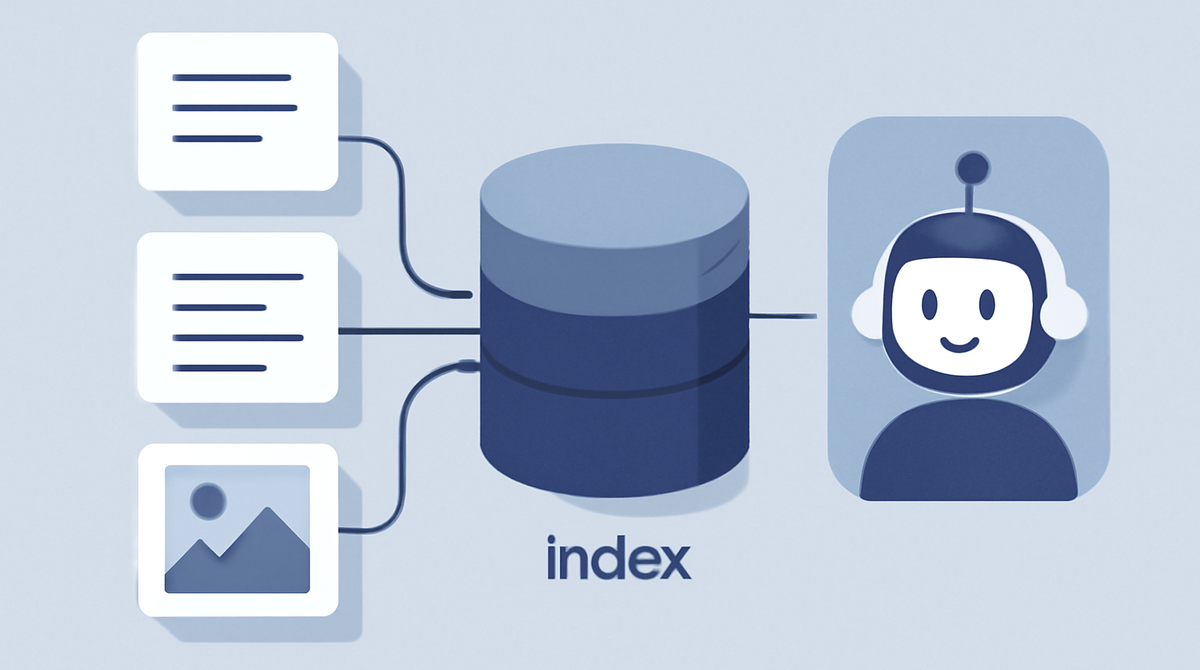
On May 5, 2026, Google rolled out three major updates to the Gemini API's File Search tool[1]. The release adds simultaneous image and document retrieval (multimodal support), custom-metadata filtering, and page-level citations, directly tackling two long-standing pain points in retrieval-augmented generation (RAG): noise reduction and source traceability.
What the three new capabilities change
The first pillar is multimodal support. File Search has been text-centric until now, but the tool has switched its inner engine to Gemini Embedding 2, released on March 10, so images and text can now be projected into the same embedding space[1][2]. Gemini Embedding 2 accepts up to 8,192 text tokens, up to six PNG/JPEG images, MP4/MOV video up to 120 seconds, and audio data within a single request, and turns them into a 3,072-dimensional vector[2].
The official post highlights three early adopters: research platform K-Dense, GIF library Klipy, and source-context platform Code Fundi[1]. Klipy CEO Givi Beridze, for instance, says, "Recognition accuracy on text inside images of varying quality and resolution improved markedly. Because the model abstains from guessing, hallucinations are eliminated, and users can now zero in on the exact GIF moment they want"[1].
The second update, custom metadata, lets developers attach arbitrary key-value labels — things like department: Legal or status: Final — and apply them as filters at query time[1]. Simply dumping files into a store breeds noise as scale grows, but scoping with metadata excludes irrelevant documents and improves both speed and accuracy at once, Google explains[1].
The third, page-level citations, exposes the page number that grounded each answer through the page_number attribute on retrieved_context whenever the source document has page structure such as a PDF[3]. It is a direct answer to a familiar RAG failure mode — "where exactly did this come from?" — and lowers the bar for adoption in business contexts where verifiability matters.
Pricing reshuffled toward a "near-free RAG"
Alongside the announcement, storage and query-time embedding generation have been re-classified as free[1][3]. Developers pay only for the embedding tokens consumed during initial indexing, at USD 0.15 per one million tokens (about JPY 24)[1][3]. The retrieved context is delivered to a Gemini model as a regular request, so input-token charges still apply on top of that.
That price holds up well against the conventional setup of standing up your own vector database and calling the Gemini Embedding API. Google emphasizes that File Search lives inside the File API and the generateContent API, abstracting chunking, embedding, and context injection; in practical terms, developers can skip "build the retrieval pipeline" entirely and focus on "how to use the retrieved context"[1][3].
How it lines up against the competition
File Search now overlaps roughly with Vector Stores in OpenAI's Assistants API and the context-editing capabilities of Anthropic's Claude API. What sets Google's update apart is the combination of multimodal coverage that handles images and documents in the same place, plus page-numbered citations returned as a standard feature. Because the citation structure is part of the API response itself, teams no longer need to assemble OCR pipelines or hand-rolled citation formatting — a notable cut in implementation cost.
That said, use cases that demand data sovereignty or fine-grained control over the retrieval algorithm still leave room for self-hosted vector databases such as Pinecone, Weaviate, or pgvector. File Search is locked to Gemini Embedding 2 as the embedding model and is not designed to be swapped out for an alternative[1][3]. Treating it as "a ready-to-run RAG foundation tuned for the Gemini ecosystem" is closer to the truth.
Summary
With multimodal support, metadata filtering, and page-level citations, the Gemini API's File Search tool meaningfully lowers the implementation cost of building verifiable RAG. Storage and query-time embeddings are now free, and billing collapses to USD 0.15 per one million tokens at indexing time, so the same pricing model carries you from small experiments to production. As "a fully managed RAG offering from Google" that draws cleanly on Gemini Embedding 2's capabilities, it has emerged as a strong option for developers.
Source: https://blog.google/innovation-and-ai/technology/developers-tools/expanded-gemini-api-file-search-multimodal-rag/
Source: https://blog.google/innovation-and-ai/models-and-research/gemini-models/gemini-embedding-2/
Source: https://ai.google.dev/gemini-api/docs/file-search