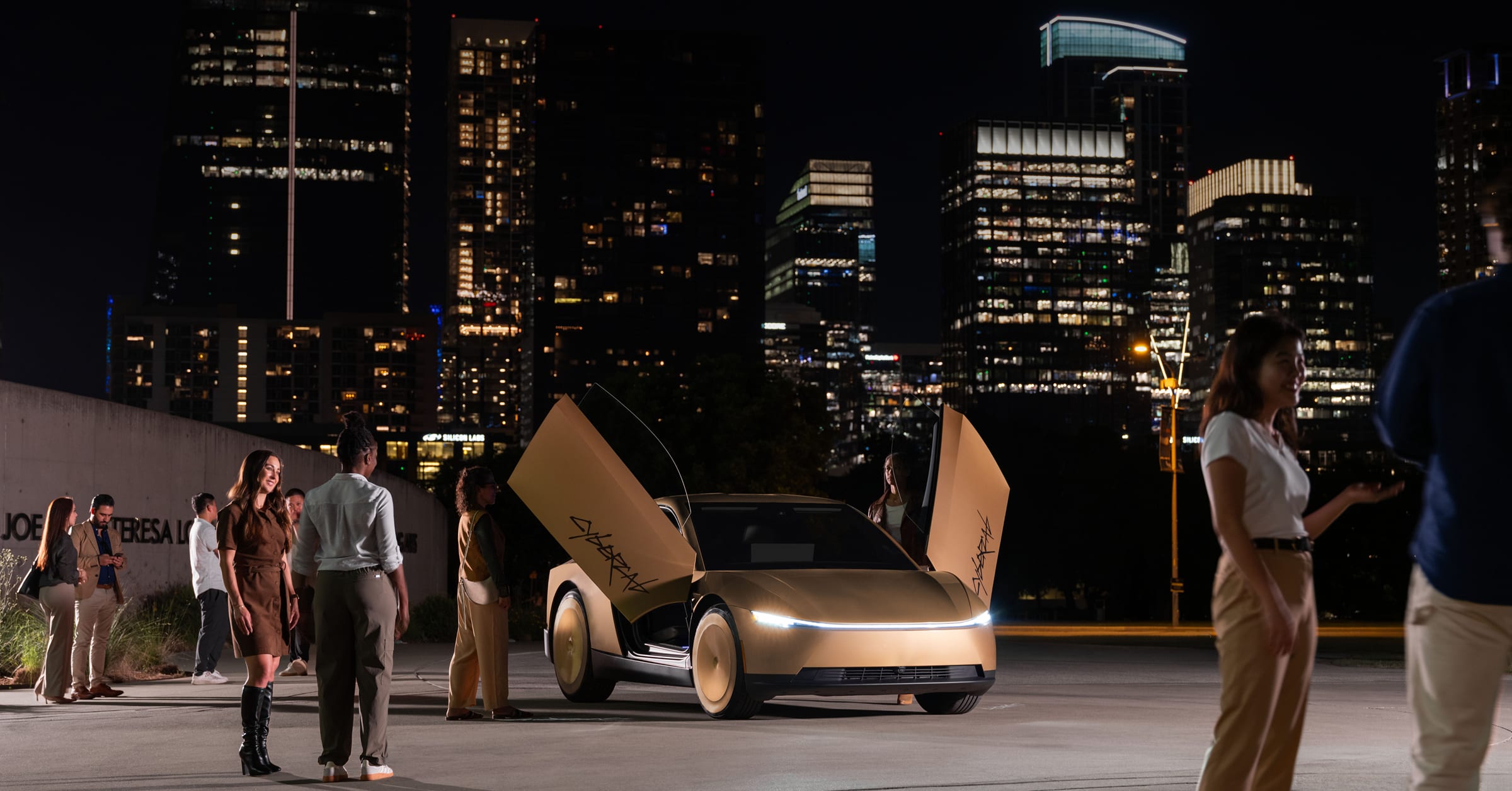
Tesla has begun commercial service with the Cybercab, a two-seat autonomous vehicle, in Austin, Texas. Within hours of the first paying rides, the National Highway Traffic Safety Administration opened an investigation. The issue is not a crash. It is the basis on which Tesla declared that a car with no steering wheel, no pedals and no mirrors meets federal safety standards.
A vehicle with no driver's seat is now on public roads
The Cybercab is the first vehicle Tesla designed purely for driverless operation. It seats two, and it has no permanently attached steering wheel, accelerator, brake pedal or mirrors. Driving is handled by Tesla's AI4 computer running the company's Full Self-Driving software.
Tesla started with a small number of vehicles carrying paying passengers in Austin and says it will expand the fleet and the service area gradually. The company has run a robotaxi network in the city since last year using modified Model Y vehicles, but this is the first time a purpose-built car is carrying riders.
What NHTSA is really asking about
NHTSA opened the audit query on September 3, the same day the Cybercab entered commercial service in Austin, and announced it publicly the following day, Friday, September 4. The audit query carries the identifier AQ26002 and covers roughly 1,000 vehicles.
In the United States, automakers have long declared for themselves whether a vehicle complies with the Federal Motor Vehicle Safety Standards. According to NHTSA, Tesla self-certified that the Cybercab meets all of those standards.
The complication is that the FMVSS were written around a human driver. Requirements for brake pedals, steering wheels and mirrors quietly assume that someone sits in a driver's seat. NHTSA says it will examine the process and the technical data Tesla relied on when certifying the vehicle, and in particular how far that certification rested on the company's own determination that certain standards simply do not apply to the Cybercab.
NHTSA administrator Jonathan Morrison said the agency fully supports the safe development and deployment of automated vehicles, but that as the federal regulator it needs to make sure all of the laws are followed. No recall or suspension has been ordered, and the Cybercab is still operating in Austin.
The four-year road Zoox already walked
There is a precedent here. Zoox, owned by Amazon, self-certified its box-shaped robotaxi in 2022, a vehicle that likewise has no steering wheel or pedals. NHTSA issued a special order seeking more information and, the following year, opened the same kind of audit query it is now using with Tesla.
Zoox was still deep in testing at the time, but the inquiry clearly lengthened its path to commercial service. The company maintained that self-certification was sufficient, yet in 2025 it received only an exemption to demonstrate the technology rather than to operate it commercially. Zoox then went through the formal route, filing for a temporary Part 555 exemption from eight Federal Motor Vehicle Safety Standards. Final approval arrived in July 2026, with a condition attached: the company may add up to 2,500 vehicles a year to its commercial fleet over the next two years. Several weeks later, Zoox began charging for rides in Las Vegas.
Tesla skipped the exemption queue that every other developer has waited in and went straight to commercial operation on the strength of self-certification alone. Whether it faces a similarly long process is not yet clear.
The rulebook itself is mid-rewrite
What makes this harder to read is that the standards are moving too. The Department of Transportation has proposed removing the manual-control requirements for vehicles designed to drive themselves.
NHTSA acknowledged alongside the investigation that it is revising parts of the FMVSS in order to unleash American innovation and improve road safety. It added that it hopes to finish that work and remove unnecessary barriers in the coming months, while making clear that until then the existing standards remain in force.
In other words, Tesla has started running a design that may well be legal in a few months under rules that have not been rewritten yet. How the audit ends may depend as much on the timing of that rulemaking as on the technical data.
Summary
The Cybercab's commercial debut means the United States has entered a phase where a car with no steering wheel carries paying passengers. NHTSA's audit query raises a separate question: whether that step was taken by skipping an established process. This is less a dispute about technology than about who guarantees safety and through which procedure, and together with the pending rule changes it will shape how quickly autonomous services can scale from here.
References
- NHTSA: NHTSA Opens Investigation into Tesla Cybercab Self-Certification Following Austin Deployment https://www.nhtsa.gov/press-releases/investigation-tesla-cybercab-self-certification
- NHTSA ODI: Audit Query AQ26002 Open Resume https://static.nhtsa.gov/odi/inv/2026/INOA-AQ26002-17078.pdf
- Federal Register: Zoox-Grant of Temporary Exemption From Portions of Various Requirements of the FMVSS https://www.federalregister.gov/documents/2026/07/31/2026-15485/zoox-grant-of-temporary-exemption-from-portions-of-various-requirements-of-the-federal-motor-vehicle