Xiaomi's Japanese arm, Xiaomi Japan, is launching the entry-level REDMI 17 smartphone in Japan on August 28, 2026[1]. The handset is built around three headline claims: a 7,500mAh battery, six years of security updates, and up to four OS version upgrades. The expected street price starts at 34,980 yen including tax, dropping to 29,980 yen with the early-purchase discount that runs through October 14.
A 7,500mAh Cell in an 8.8mm Body
The standout number here is the battery: 7,500mAh at the typical rating[2]. Entry-level phones commonly land somewhere around 5,000mAh, so this is a 50 percent step up. Xiaomi Japan says its internal lab simulation, modeled on ordinary daily use, delivers more than two days of runtime[1].
A larger cell normally means a heavier phone, but the REDMI 17 measures 170.12mm tall, 78.42mm wide and 8.8mm thick, weighing 232g[2]. Holding thickness to 8.8mm is a respectable result for a device sold on capacity. That said, 232g is not light, so anyone who spends long stretches holding a phone one-handed should try it in a store first.
Charging is unusually well equipped for the price bracket. The phone supports 45W turbo charging, which is rare in entry models, and a compatible 45W AC adapter is bundled as a complimentary accessory[1]. Xiaomi's internal lab figures put a full day of use at 35 minutes of charging, and a full 100 percent charge at roughly 96 minutes[3]. Wired reverse charging up to 22.5W is also supported, so the phone can top up earbuds or another handset. Note that the USB Type-C to Type-C cable needed for reverse charging is sold separately[1].
Longevity is addressed directly as well. Xiaomi states the battery retains at least 80 percent of its original capacity after 1,000 full charge cycles[1], which lines up with the long update commitment described below.
What Six Years of Security Updates Actually Buys
The REDMI 17 comes with six years of security updates and up to four OS version upgrades[1]. Both figures are measured from the launch date, so buying later leaves less support time on the clock.
Entry-tier Android phones have often shipped with shorter support windows. Six years of updates on a phone priced around 30,000 yen is not just a lower cost per year of ownership. It also removes the pressure to replace the device on a fixed cycle, which widens the options for trade-in or handing the phone down.
The software is Xiaomi HyperOS 3, based on Android 16[2]. Xiaomi HyperIsland consolidates notifications and frequently used controls in one place, and AI features including Google Gemini and Circle to Search are supported[1][3].
A 6.9-Inch Screen and a Dynamic RGB Light
The display measures 6.9 inches at 1,600 by 720 with a refresh rate of up to 120Hz[2]. That resolution is HD+ class, so pixel density is modest relative to the screen size. The trade-off cuts power draw, which is a coherent choice for a phone sold on battery life. Brightness is rated at 675 nits typical and 825 nits in high brightness mode, with a 1400:1 contrast ratio.
The panel is covered by Corning Gorilla Glass 7i and carries three TÜV Rheinland certifications: Low Blue Light, Flicker Free and Circadian Friendly[2][3]. Ingress protection is rated IP64 (IPX4/IP6X), and wet touch support keeps the screen responsive with damp fingers[2][3].
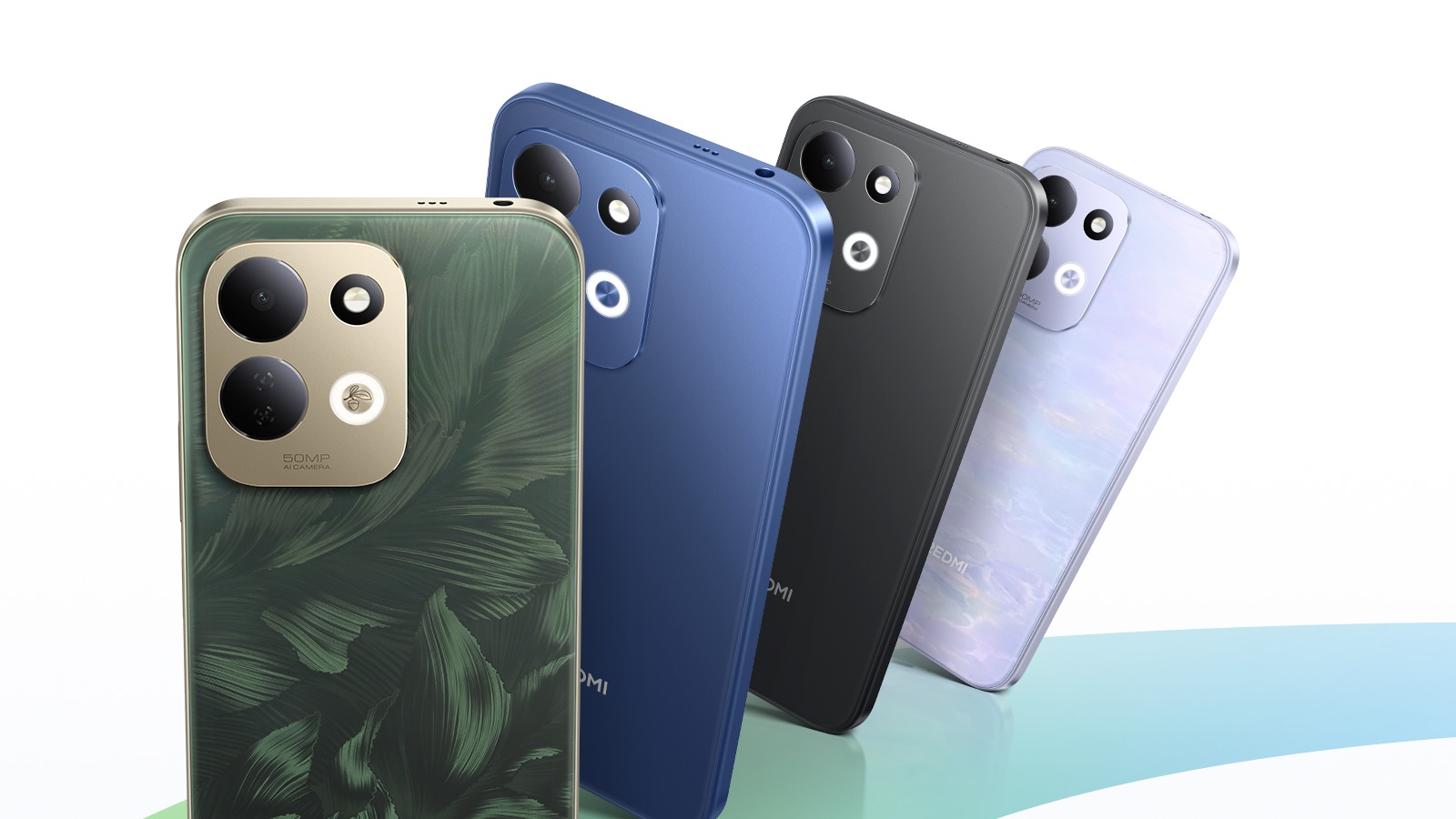
On the design side, the phone uses a metal camera deco and slim bezels. The camera deco houses a dynamic RGB light with eight colors that signals incoming calls, active calls and charging status[1]. It is a practical feature with a bit of playfulness attached. Four colors are offered: Black, Deep Blue, Lotus Purple and Oak Green[2].
For audio, dual stereo speakers are paired with a volume boost of up to 300 percent[3]. A 3.5mm headphone jack remains, and FM radio works when headphones are connected[1][2]. That is a quiet but meaningful inclusion for anyone still using wired earphones.
Helio G91-Ultra Inside, with No 5G Listed
The processor is a MediaTek Helio G91-Ultra: a 12nm octa-core part combining Cortex-A75 and Cortex-A55 cores at up to 2.0GHz, with Mali-G52 MC2 graphics[2]. Memory is 4GB, and storage comes in 128GB or 256GB using LPDDR4X and eMMC 5.1. Memory expansion can push the effective total to 8GB, and microSD storage expansion goes up to 2TB with a separately sold card.
The rear camera pairs a 50-megapixel main sensor (F1.8, 5P lens) with an auxiliary lens, and the front camera is 8 megapixels at F2.05[2]. Video capture is listed at up to 1080p/30fps on both sides, with no mention of 4K recording. The still-image resolution is ample, but the video side clearly involves compromises worth knowing about in advance.
One connectivity detail stands out: the official specification sheet lists GSM, WCDMA and LTE FDD/TDD bands only, with no 5G (NR) bands[2]. That contrasts with its sibling launching the same day, the REDMI Note 17 Pro Max 5G, which carries 5G in its name[4], and it marks the REDMI 17 as a deliberately pared-back model. Wi-Fi covers 2.4GHz and 5GHz, and Bluetooth 5.4 includes LDAC support. Biometrics combine a side-mounted fingerprint sensor with AI face unlock.
Pricing and Availability
| Item | Details |
|---|---|
| Release date | August 28, 2026 (Friday) |
| Expected street price | 4GB/128GB: 34,980 yen incl. tax; 4GB/256GB: 44,980 yen incl. tax |
| Early-purchase discount | Launch day through October 14: 29,980 yen for 128GB, 39,980 yen for 256GB (both incl. tax) |
| Display | 6.9-inch, 1,600 x 720, up to 120Hz, Gorilla Glass 7i |
| Processor | MediaTek Helio G91-Ultra (12nm, octa-core, up to 2.0GHz) |
| Memory / storage | 4GB + 128GB/256GB (memory expansion to 8GB, microSD to 2TB) |
| Battery | 7,500mAh, 45W turbo charging, 22.5W reverse charging |
| Cameras | 50MP main plus auxiliary lens, 8MP front, video up to 1080p/30fps |
| Dimensions | 170.12 x 78.42 x 8.8mm, 232g |
| OS and support | Xiaomi HyperOS 3 based on Android 16, 6 years of security updates, up to 4 OS upgrades |
Retail partners include EDION, Joshin, Bic Camera, Yamada Denki and Yodobashi Camera. Online, the phone is available through the official Xiaomi site (mi.com), the official Xiaomi Rakuten Ichiba store, Amazon, Yahoo! Shopping and the official Xiaomi Japan TikTok Shop, alongside Xiaomi's own retail stores[1].
The box includes an AC adapter, a USB Type-C cable, a SIM ejector pin, a soft case, a pre-applied screen protector and a quick start guide, all listed as complimentary accessories[2]. Buyers also receive two months of Spotify Premium at no cost, limited to first-time Spotify Premium users[3].
Summary
The REDMI 17 is an entry-level smartphone that commits fully to longevity through two pillars: a 7,500mAh battery and six years of security updates. The compromises are visible, with a 1,600 by 720 display and no 5G support, but 45W turbo charging, a 3.5mm headphone jack and microSD support keep the practical fundamentals solid for the price. It arrives on August 28, 2026, starting at 29,980 yen including tax while the early-purchase discount applies, which places it within easy reach for anyone shopping primarily on battery life.
Source [1]: https://prtimes.jp/main/html/rd/p/000000253.000098799.html
Source [2]: https://www.mi.com/jp/product/redmi-17/specs/
Source [3]: https://www.mi.com/jp/product/redmi-17/
Source [4]: https://prtimes.jp/main/html/rd/p/000000254.000098799.html