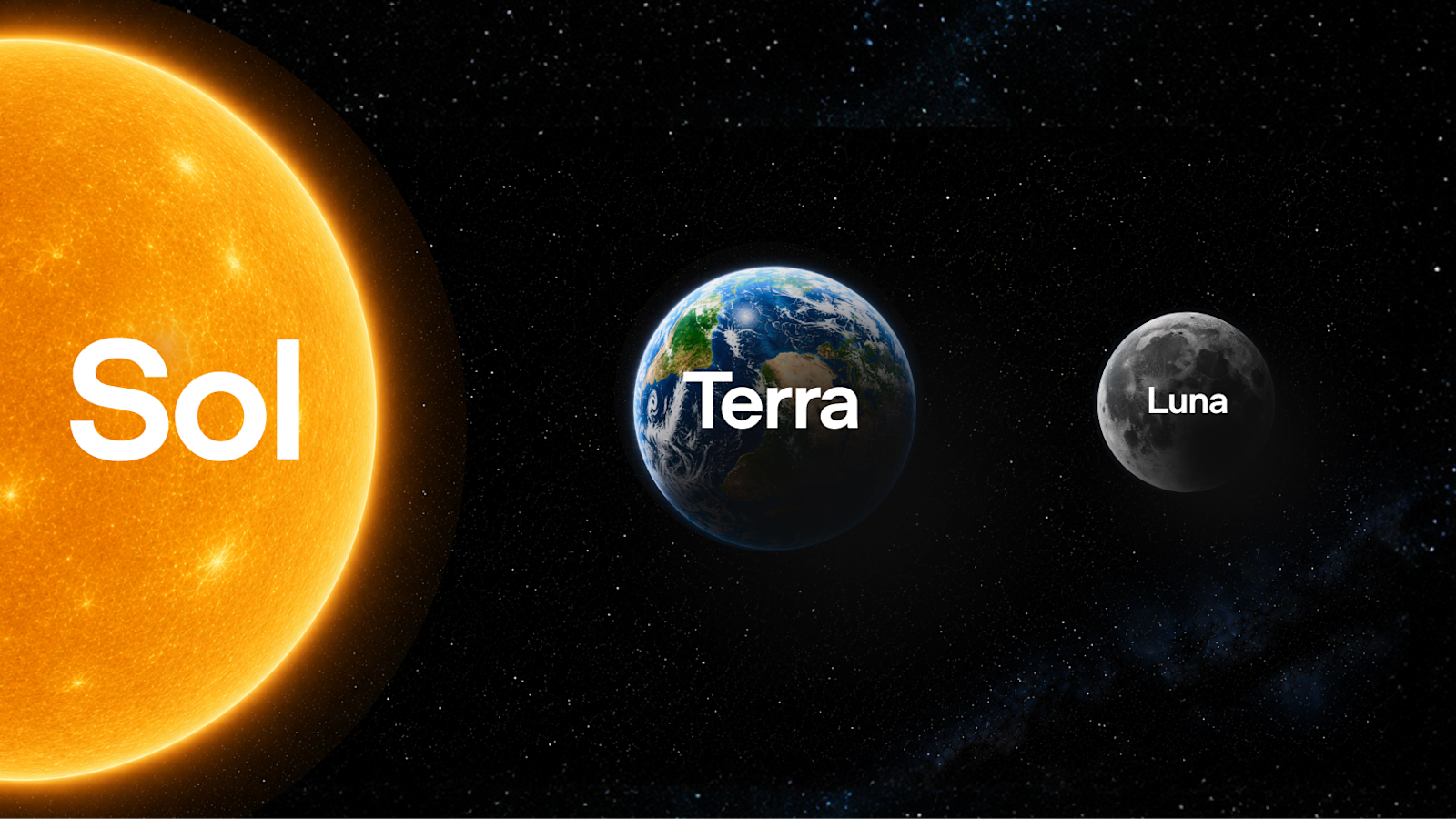
OpenAI announced on June 26 (U.S. time) that it has begun a limited preview of its next-generation large language model family, the GPT-5.6 series[1]. The lineup consists of three models: the flagship "Sol," the balanced everyday-work model "Terra," and the fast, low-cost "Luna." For now, they are offered to a limited set of partners through the API and Codex. While the company says the models improve performance in coding, biology, and cybersecurity, it also notes that it has paired these gains with its most robust safety stack to date.
Three Models: Sol, Terra, and Luna
GPT-5.6 is made up of three models you can choose between depending on the task. The flagship "Sol" targets the hardest problems, such as complex coding and security research. "Terra" is a mid-tier model for everyday work that, according to OpenAI, keeps performance competitive with the previous GPT-5.5 while costing half as much. "Luna" is the fastest and most affordable model, suited to lighter tasks such as summarization, drafting, and routine automation[1].
The launch also brought a tidier naming scheme. The number (5.6) identifies the generation, while Sol, Terra, and Luna denote capability tiers. Because each tier can advance on its own cadence, users can choose more easily based on the balance of intelligence, speed, and cost.
On the feature side, OpenAI added a new "max" reasoning effort that gives Sol the most time to reason deeply, along with an "ultra" mode that uses subagents to divide up and accelerate complex work[1].
Performance Gains in Coding, Biology, and Cyber
OpenAI shared a set of evaluation results alongside the release. For coding work, it says GPT-5.6 Sol set a new state of the art on "Terminal-Bench 2.1," a benchmark for command-line workflows that require planning, iteration, and tool coordination. In biology, it says Sol produced stronger results than GPT-5.5 while using fewer tokens on "GeneBench v1," which measures long-horizon genomics and quantitative-biology tasks[1].
In cybersecurity, OpenAI says it improved performance and efficiency on long-horizon tasks such as vulnerability research and exploitation. On the "ExploitBench" benchmark, it reports Sol reached a level competitive with the existing "Mythos Preview" model while using only about one-third of the output tokens. At the same time, OpenAI states clearly that Sol does not cross the "Cyber Critical" threshold in its Preparedness Framework safety guidelines. In tests using Chromium and Firefox, it found bugs and the building blocks of an exploit, but did not autonomously produce a full working attack under the conditions tested[1].
Its Most Robust Safety Stack and a Phased Release
GPT-5.6 launched with what OpenAI calls its most robust safeguards to date. It uses a layered, defense-in-depth approach that combines refusal behavior trained into the model, real-time classifiers that review output as it is generated, account-level review, and differentiated access. To find universal jailbreak techniques, OpenAI says it dedicated over 700,000 A100-equivalent GPU hours to automated red teaming[1].
The preview also has a backdrop of coordination with the U.S. government. OpenAI says it shared the models' capabilities and its plans with the government ahead of the launch and, at the government's request, is starting with a small group of trusted partners whose participation was shared with the government. The company also says this kind of government access process should not become the long-term default, noting concerns that it keeps tools from users, developers, and defenders who need them[2]. During the preview, it warns that safeguards may slow or refuse even legitimate work, and says it intends to study that behavior[1].
Pricing, Access, and How It Is Offered
GPT-5.6 is priced per 1 million tokens for input and output separately. Sol is 5 USD (about 810 yen) for input and 30 USD (about 4,860 yen) for output; Terra is 2.50 USD (about 405 yen) input and 15 USD (about 2,430 yen) output; and Luna is 1 USD (about 162 yen) input and 6 USD (about 972 yen) output[1]. *Converted at 1 USD = 162 JPY (as of June 2026)
OpenAI also revised prompt caching, which reuses input that has already been processed. It now supports explicit cache breakpoints and a 30-minute minimum cache life. Cache writes are billed at 1.25x the normal input rate, while cache reads continue to receive a 90 percent discount[1].
In terms of availability, the models are offered during the preview to a limited set of trusted partners and organizations through the API and Codex. They are not available in ChatGPT for now, but OpenAI says it plans to make them broadly available across ChatGPT, Codex, and the API within a few weeks. In July, it also plans to begin running Sol on the chipmaker Cerebras at up to 750 tokens per second[1].
Summary
OpenAI's newly unveiled GPT-5.6 is a next-generation model family in three tiers: the flagship Sol, the mid-tier Terra, and the low-cost Luna, with improved performance in coding, biology, and cybersecurity. The company strengthened its layered safeguards alongside those gains, and after coordinating with the U.S. government, it began offering the models cautiously as a limited preview. General availability in ChatGPT is expected in a few weeks, and how the models' real-world usability and safety are judged will be the next focus as competition among AI companies continues.