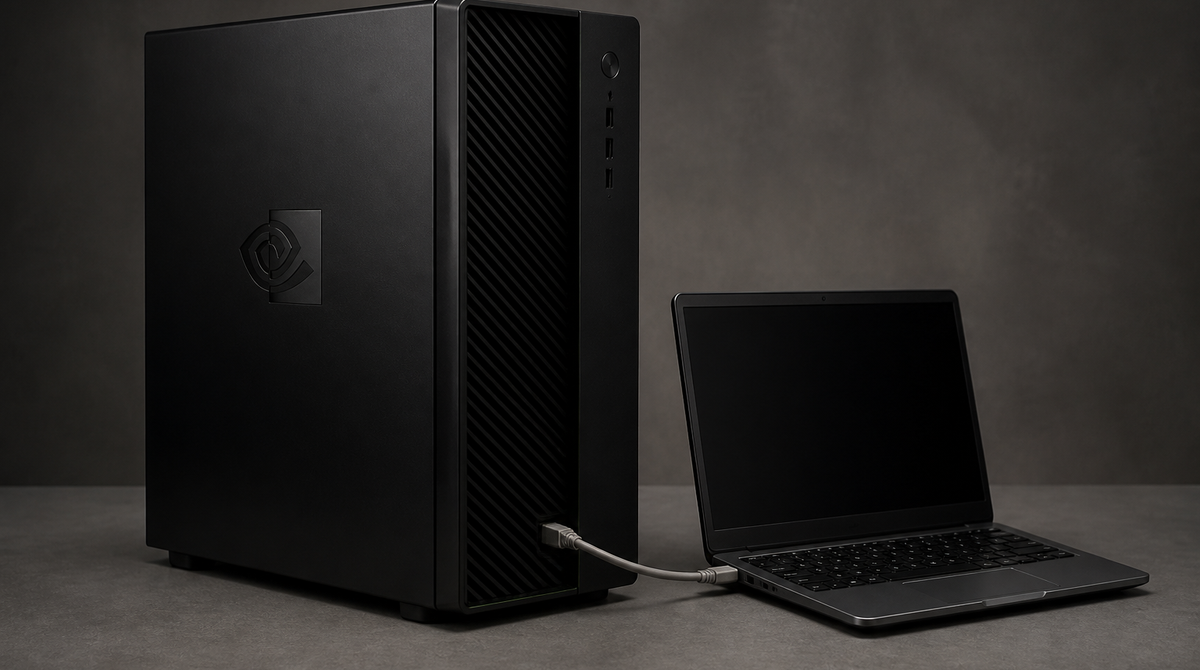
NVIDIA has released a beta of NVIDIA PAIR, software that pools the idle GPUs sitting in household PCs into a single inference environment. Announced on September 3 (US time) to coincide with the opening of IFA 2026 in Berlin, it is licensed under Apache 2.0 and costs nothing. Rather than splitting a model across several GPUs, PAIR hands an entire request over to whichever machine happens to be free, a deliberately simple design.
Turning idle GPUs into a single endpoint
PAIR stands for Personal AI Router. Installed on each PC in the home, it uses mDNS to discover other machines on the same network automatically. Connections are established through manual pairing with a 6-digit code, so no unintended PC joins the cluster on its own. Traffic between machines is encrypted with mTLS.
A node can also be configured to send requests without performing any inference itself. That makes it possible to fire off a job from a working laptop and have a desktop GPU in another room pick it up.
It slots in front of existing local inference tools
What makes PAIR interesting is that it requires no changes to an existing setup. It runs as a proxy that takes over the ports used by Ollama and LM Studio. An AI agent simply sends requests to Ollama or LM Studio as it always has, PAIR intercepts them, and redistributes them to the Ollama or LM Studio instances running on each node. No rewiring of the agent harness is needed.
Routing decisions are based on queue depth and GPU utilization. Nodes busy with a game or a video render are skipped automatically, which prevents inference from stuttering someone else's session mid-use. Unlike model sharding or tensor parallelism, which present multiple GPUs as one large GPU, PAIR moves whole requests to another PC, so ordinary home Ethernet or Wi-Fi is enough to make it work.
Macs can serve as inference nodes too
Windows, Linux, and macOS are all supported. Non-NVIDIA hardware is welcome as well, and Macs with Apple M4 silicon can join as inference nodes. NVIDIA says it has validated GPUs going back to the GeForce RTX 20 series and has confirmed operation with up to 18 GPUs. A gaming PC from a few generations ago, still sitting in a closet, may well count as usable capacity.
In a demonstration, five subagents were run in parallel on Hermes Desktop using Qwen3.6-35B-A3B. Spread across three machines, a GeForce RTX 5090 desktop, an RTX Spark laptop, and a DGX Spark, the workload finished roughly twice as fast as on a single machine. Multi-agent workloads where several subagents think at once, and running multiple sessions concurrently, are the main use cases PAIR has in mind.
The claim that 165 TFLOPS sits idle every day
Behind all this is how quickly locally runnable models have matured. NVIDIA notes that downloads of the top 20 models on Hugging Face reached 1.3 billion in 2026, growing at four times the pace of the previous year. It attributes the momentum to the arrival, within a few months, of several local models claiming performance on par with Claude Opus 4.7.
Compute, meanwhile, goes to waste. By NVIDIA's estimate, more than half of US households own two or more PCs, yet average utilization sits at around 17 percent of the day, a little over 4 hours. Take a home with two RTX Spark laptops, a DGX Spark, an RTX 5090 laptop, an RTX gaming PC, and a MacBook Pro, and roughly 165 TFLOPS of compute is left untouched.
Put that to work at 60 percent utilization on Qwen3.8-27B, and NVIDIA estimates around 120 million tokens per day. The company says that is equivalent to about 1,200 USD (about 186,000 yen) a month of GPT 5.6 Luna cloud usage, against an electricity bill of roughly 120 USD (about 19,000 yen) a month in much of the United States.
※1 USD = 155 JPY
Summary
NVIDIA PAIR is a router that turns the GPUs scattered across a household into a single point of entry for inference. It discovers machines over mDNS, pairs them with a 6-digit code, protects traffic with mTLS, and distributes requests based on queue depth and GPU utilization. Because it takes over the Ollama and LM Studio ports, agents need no rebuilding. It has been validated with up to 18 GPUs, including Macs with Apple M4, so the more PCs on hand, the greater the benefit. Released under Apache 2.0, it looks set to raise the practical ceiling for local AI.