
NVIDIA on April 28, 2026 released Nemotron 3 Nano Omni, an open multimodal model that combines vision, audio, and language into a single system. The model uses a hybrid Mixture-of-Experts architecture with 30 billion total parameters but activates only 3 billion per token, and NVIDIA claims up to 9x higher throughput than other open omni models at the same level of interactivity. Weights, datasets, and training techniques are all published, positioning Nemotron 3 Nano Omni as the "eyes and ears" sub-agent in larger agentic systems.
Why Unify, and What the Numbers Show
Today's agent systems typically chain separate models for vision, speech, and language, which adds inference passes, fragments cross-modal context, and pushes up cost and latency. NVIDIA's pitch is to roll the perception layer into a single open model that pairs with higher-tier reasoners like Nemotron 3 Super and Ultra, or with proprietary cloud models. Source: NVIDIA, "NVIDIA Launches Nemotron 3 Nano Omni Model, Unifying Vision, Audio and Language for up to 9x More Efficient AI Agents" (https://blogs.nvidia.com/blog/nemotron-3-nano-omni-multimodal-ai-agents/)
The performance numbers are aggressive. NVIDIA highlights 9x higher throughput at equal interactivity versus other open omni models, and says the model leads six leaderboards covering complex document intelligence, video understanding, and audio understanding. NVIDIA's developer blog adds concrete comparisons: on a single H200 with an 8K input / 16K output configuration, Nemotron 3 Nano Omni delivers 3.3x the inference throughput of Qwen3-30B-A3B and 2.2x that of GPT-OSS-20B. On MediaPerf video tagging, it processes 9.91 hours of video per hour against roughly 3.8 h/h for Qwen3-VL. Source: NVIDIA Developer, "NVIDIA Nemotron 3 Nano Omni Powers Multimodal Agent Reasoning in a Single Efficient Open Model" (https://developer.nvidia.com/blog/nvidia-nemotron-3-nano-omni-powers-multimodal-agent-reasoning-in-a-single-efficient-open-model/)
Pure reasoning is not left behind either. On AIME 2025 without tool assistance, Nemotron 3 Nano Omni reaches 89.1 percent accuracy, edging past Qwen3-30B-A3B at 85.0 percent. NVIDIA appears to have avoided the typical multimodal regression on math-heavy benchmarks. Source: NVIDIA Developer, "NVIDIA Nemotron 3 Nano Omni Powers Multimodal Agent Reasoning in a Single Efficient Open Model" (https://developer.nvidia.com/blog/nvidia-nemotron-3-nano-omni-powers-multimodal-agent-reasoning-in-a-single-efficient-open-model/)
Architecture: 30B-A3B + Conv3D + EVS, 256K Context
Architecturally, Nemotron 3 Nano Omni is a 30B-A3B hybrid Mixture-of-Experts model paired with Conv3D and EVS (Efficient Video Sampling). Context length is 256K tokens, designed to handle long videos, long-form documents, and multi-file agent inputs in a single inference stream. Inputs span text, images, audio, video, documents, charts, and graphical interfaces; outputs are text.
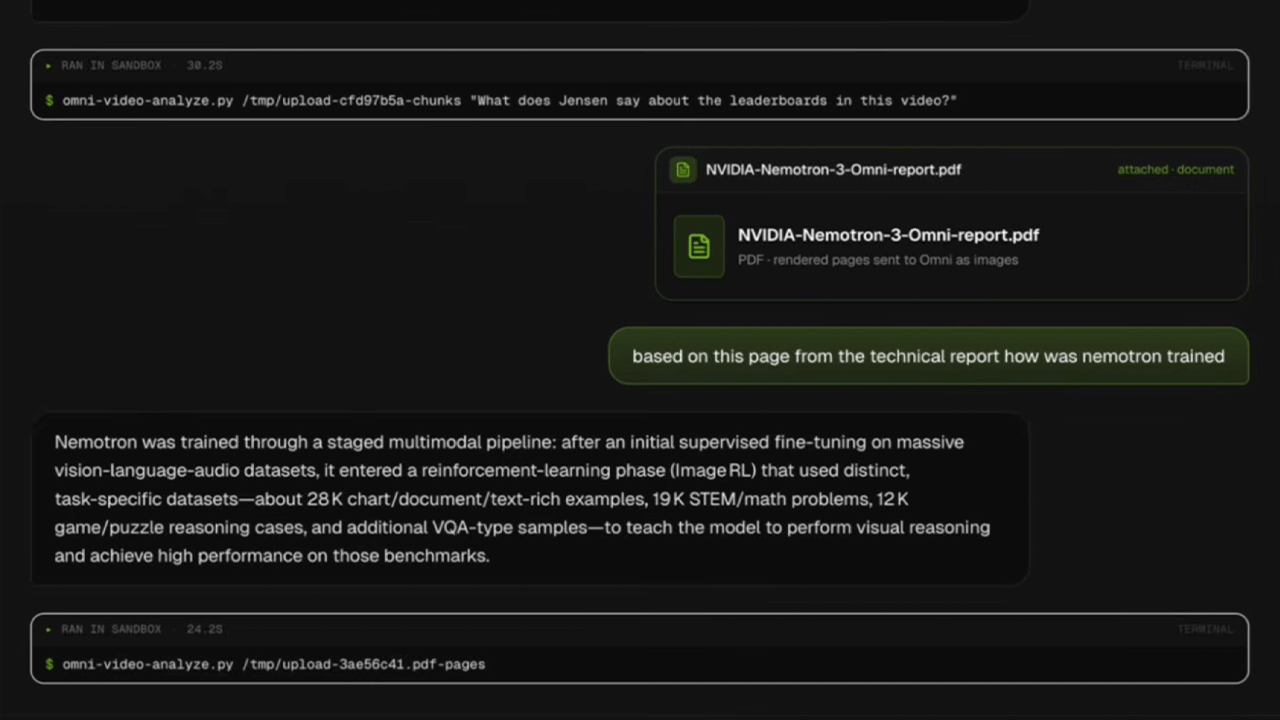
The integration of vision and audio encoders directly into the model is notable. By eliminating the separate perception models that agents previously chained together, Nemotron 3 Nano Omni keeps visual and audio context attached to language reasoning without repeated inference passes. NVIDIA points to three primary use cases: computer-use agents, document intelligence, and audio-video understanding.
In customer support, an agent could analyze a screen recording, listen to call audio, and check data logs in one stream. A finance agent could parse PDFs, spreadsheets, charts, and voice notes in parallel. Source: NVIDIA, "NVIDIA Launches Nemotron 3 Nano Omni Model, Unifying Vision, Audio and Language for up to 9x More Efficient AI Agents" (https://blogs.nvidia.com/blog/nemotron-3-nano-omni-multimodal-ai-agents/)
Distribution and Adopters: Over 50 Early Partners Lined Up
Distribution is intentionally broad. Nemotron 3 Nano Omni is available on Hugging Face, OpenRouter, and build.nvidia.com, where it ships as an NVIDIA NIM microservice. More than 25 partner platforms — including NVIDIA Cloud Partners, inference platforms, and cloud service providers — added it on day one. Deployment runs the gamut from local NVIDIA Jetson hardware, NVIDIA DGX Spark, and DGX Station to data center and cloud environments using the same model artifact.
The early-adopter roster is concrete. Companies already deploying the model include Aible, Applied Scientific Intelligence (ASI), Eka Care, Foxconn, H Company, Palantir, and Pyler, with Dell Technologies, Docusign, Infosys, K-Dense, Lila, Oracle, and Zefr in evaluation. The Nemotron 3 family overall — Nano, Super, and Ultra — has crossed 50 million downloads in the past year, and Omni now extends the line into multimodal agentic territory. Source: NVIDIA, "NVIDIA Launches Nemotron 3 Nano Omni Model, Unifying Vision, Audio and Language for up to 9x More Efficient AI Agents" (https://blogs.nvidia.com/blog/nemotron-3-nano-omni-multimodal-ai-agents/)
H Company CEO Gautier Cloix said in NVIDIA's announcement, "To build useful agents, you can't wait seconds for a model to interpret a screen. By building on Nemotron 3 Nano Omni, our agents can rapidly interpret full HD screen recordings — something that wasn't practical before. This isn't just a speed boost: It's a fundamental shift in how our agents perceive and interact with digital environments in real time." H Company's latest computer-use agent runs at a native input resolution of 1920x1080, and NVIDIA reports a significant lift on preliminary OSWorld benchmark evaluations. Source: NVIDIA, "NVIDIA Launches Nemotron 3 Nano Omni Model, Unifying Vision, Audio and Language for up to 9x More Efficient AI Agents" (https://blogs.nvidia.com/blog/nemotron-3-nano-omni-multimodal-ai-agents/)
Open and Optimized: NVFP4, NeMo, On-Prem Deployment
Weights, datasets, and training methodology are all open, so organizations can use NVIDIA NeMo for customization, evaluation, and optimization, and can deploy the model in environments that meet sovereignty or data-localization requirements.
On the hardware side, day-zero NVFP4 (4-bit floating point) support on Blackwell is part of the launch story, with partners like Eigen AI offering NVFP4 inference from launch day. BridgeBench's measurements report 376.2 tokens/second throughput and 670 ms time-to-first-token on the free-tier endpoint. Sources: Eigen AI, "Eigen AI Delivers NVFP4 Inference on Blackwell for NVIDIA Nemotron 3 Nano Omni at Launch" (https://www.eigenai.com/blog/2026-04-28-eigenai-day-0-nvfp4-inference-nvidia-nemotron-nano-omni) / Bridgebench, "Nemotron 3 Nano Omni 30B-A3B Reasoning (Free) Speed Benchmark" (https://www.bridgebench.ai/speedbench/nemotron-3-nano-omni-30b-a3b-reasoning-free)
Summary
Nemotron 3 Nano Omni is NVIDIA's bid to consolidate the perception sub-agent into a single, openly distributed model. The 30B-A3B MoE design keeps active parameters at 3B, the context window stretches to 256K, AIME 2025 sits at 89.1 percent, and the model leads six multimodal leaderboards. With NIM, Hugging Face, OpenRouter, more than 25 partner platforms, and a deployment story that runs from Jetson and DGX hardware to data centers and the cloud, developers now have a viable open option for the vision-and-audio sub-agent slot. In production, the right next step is measuring real-world H200 throughput, post-NVFP4 latency, and domain accuracy on your own workloads, then deciding how to wire Nemotron 3 Nano Omni in alongside Nemotron 3 Super or Ultra.