IBM and NASA have released an open-source AI foundation model called the NASA-IBM Lunar Foundation Model for analyzing lunar observation data. The model brings together ice-deposit prediction, crater mapping, and volcanic history analysis within a single system, improving both accuracy and efficiency compared with previous approaches. As a data platform built with future crewed lunar exploration in mind, it is expected to see wide use across the research community.
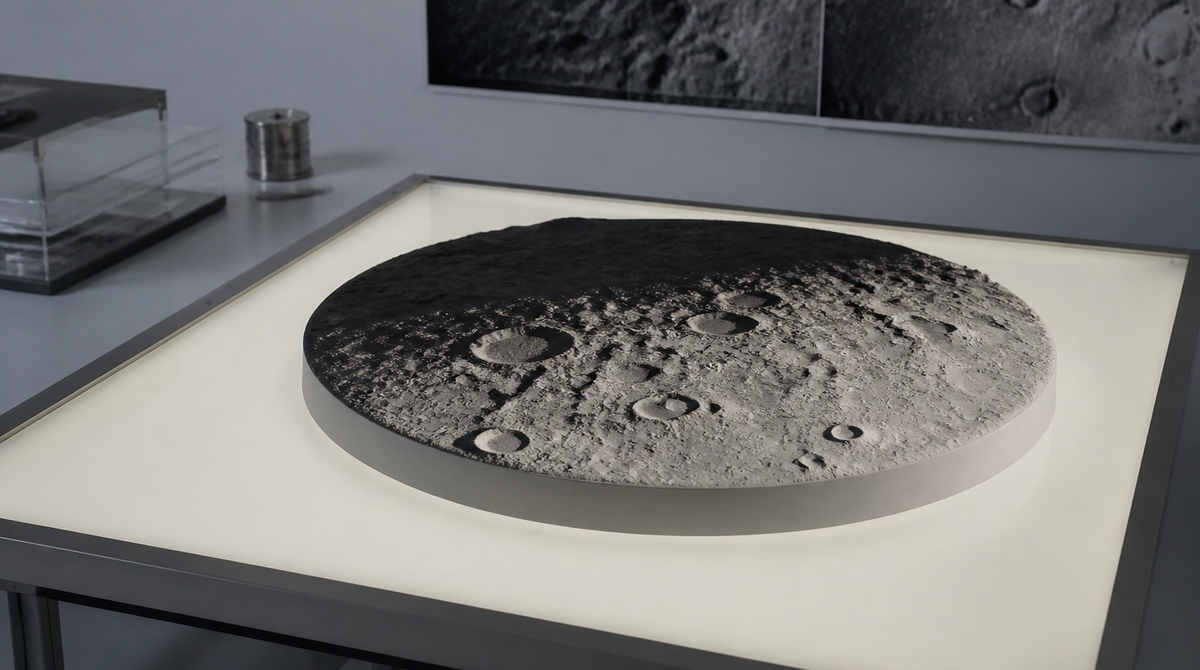
*Thumbnail image is AI-generated for illustration.
Decades of Lunar Data, Long Analyzed by Hand
The Moon's surface may look static, but it has changed continuously over long stretches of time, forming craters, accumulating ice deposits, and bearing traces of past volcanic activity. NASA spacecraft have observed the Moon with sensors for decades, building up an enormous volume of data. Until now, researchers had to either review maps and images by hand or rely on small, task-specific machine learning models. Because no single model could handle multiple types of data at different resolutions together, important surface features could be missed, and analysis often demanded heavy computing resources and time.
Bringing Data From Nine Instruments Into One Model
Lunar data has historically been collected separately across missions, including NASA's Lunar Reconnaissance Orbiter (LRO), the gravity-mapping GRAIL mission, and Japan Aerospace Exploration Agency's (JAXA) SELENE/Kaguya spacecraft. The newly released model unifies more than 30 data layers drawn from nine instruments across these four missions into a single dataset that can be handled within a common framework. IBM and NASA position the new model as an extension of the Prithvi family of open foundation models, which the two organizations have previously released for Earth observation, weather, and heliophysics. Earlier models in the Prithvi series have already been put to practical use, including for assessing flood damage. The model weights and dataset are released as open source, allowing outside researchers to freely use and build on them.
Verifying the Accuracy Gains, From Ice Deposits to Crater Mapping
On performance, the model reduced errors by up to 22% compared with previous methods when predicting the presence of ice in permanently shadowed regions that never receive sunlight. Lunar ice is considered an important resource because it could supply water and oxygen for a future Moon base and for producing rocket fuel. For crater detection, the model outperformed previous approaches by up to 19% even when trained on half the amount of data, a capability expected to help identify safe landing sites. For identifying irregular terrain linked to past volcanic activity, the model achieved roughly 3% higher accuracy than previous approaches despite being trained on imperfect labels. Kevin Murphy, NASA's chief science data officer, said that collecting data is only part of the job, and that it is equally important to make it easier for scientists to explore, underscoring the goal of turning a vast trove of accumulated observation data into new discoveries with AI.
Summary
IBM and NASA have released an open-source AI foundation model capable of jointly analyzing lunar ice, craters, and volcanic terrain. By unifying data from multiple observation instruments, the model achieves higher accuracy with less training data than previous approaches. As a data platform built for future crewed lunar exploration, it is expected to find broad application across the research community.