Microsoft has released MAI-Cyber-1-Flash, its first AI model built in-house specifically for cybersecurity work. Slotted into MDASH, the company's own harness for finding and fixing software vulnerabilities, the combination scores 96 percent on the industry-standard CyberGym benchmark while cutting costs to half of the previous configuration. Alongside it, Microsoft opened a preview of Project Perception, an agentic security system in which red, blue, and green agents keep defense running continuously.
Handing 90 Percent of the Work to a Smaller Model
MAI-Cyber-1-Flash is a compact, lightweight model tuned to dig out hard-to-find vulnerabilities buried in complex codebases. It descends from the company's MAI-Thinking-1 reasoning lineage and was built from scratch in-house on its own data rather than adapted from an outside model.
The design thinking behind it is refreshingly explicit. Microsoft starts from the premise that with attack volume where it is today, the real constraint for defenders is token cost rather than raw accuracy. So the lightweight model takes on up to 90 percent of everyday tasks, and only the genuinely hard remaining 10 percent gets routed to a larger, more expensive model, specifically GPT-5.4. That division of labor cuts costs by 50 percent compared with the best current MDASH configuration, which pairs GPT-5.4 with GPT-5.4 mini and GPT-5.3 codex.
MDASH itself is a multi-agent harness that carries vulnerability work from identification through remediation. Tuned by leading security practitioners, it runs more than 100 agents across several frontier models to find, validate, and fix issues. What changed here is that a purpose-built model now sits at its core.
A 12-Point Gap on CyberGym
CyberGym, the benchmark used for the evaluation, measures how well a system can reason across a large codebase to locate real vulnerabilities. Because it tests reasoning over sprawling amounts of code, it has become the de facto standard in the security space.
The MDASH and MAI-Cyber-1-Flash combination reached 96 percent there. Microsoft says that puts it 12 points above Anthropic's Mythos security platform, and ahead of the Gemini and GPT configurations as well. In the published chart, the four comparison systems cluster roughly between 83 and 86 percent, so one entrant broke away from an otherwise tight pack.
Mustafa Suleyman, CEO of Microsoft AI, highlighted the result at the announcement and said the system was shipping into production immediately. This was clearly built to be a product, not a research note.
Red, Blue, and Green Agents Behind Project Perception
Released alongside the model is Project Perception, an agentic security system. It is already available in preview, and at launch it is reached from inside Microsoft Defender.
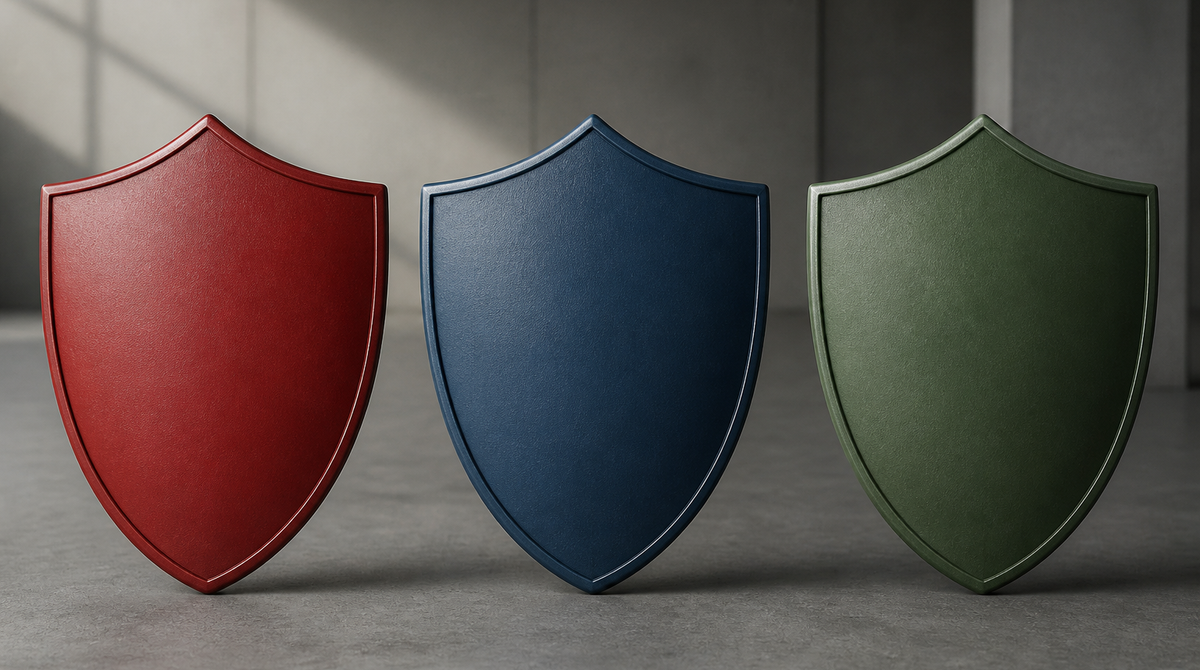
The structure is described through three colors of agents. Red agents probe like an attacker, mapping where the gaps are and which attack paths hold up. Blue agents investigate what has been detected and separate out what counts as meaningful risk. Green agents do the hands-on work of remediating and hardening. Because all three share the same context, a finding reaches a fix without a hand-off to a human at every step.
The package covers more than the agents themselves: actuators that turn a decision into a real action, a harness that orchestrates everything, organizational context, and signals and sensors spanning endpoints, identities, clouds, and apps. Pricing is consumption-based, measured in Security Compute Units (SCUs). Heavier tasks consume more SCUs, so the bill reflects the work actually performed.
Microsoft frames Perception as the move from AI that assists to AI that acts. It plays a different role from the conversational Microsoft Security Copilot, and the two are positioned to work together.
Where Human Judgment Stays
The more automation rises, the more the question of where to draw the line matters. Microsoft's answer is that strategy stays human while scale becomes autonomous. Defenders set the objectives and guardrails, and every high-impact action stays under human sign-off. Agent decisions remain scoped, traceable, and replayable after the fact.
The model went through several layers of checking as well. MAI-Cyber-1-Flash was developed with security-first calibration, evaluated by Microsoft's AI Red Team, tested through both automated and expert-led adversarial exercises, and independently assessed by a third party. On the operational side, customers get role-based controls, tenant isolation, encryption, and auditability, with execution confined to sandboxes that have no internet access.
Underpinning all of this are the more than 100 trillion security signals Microsoft takes in each day and the operational insight drawn from 1.6 million customers. Being able to trace outcomes, what was exploitable, what was contained, and what actually worked, is what gives the company material to keep retraining the model.
Summary
MAI-Cyber-1-Flash is the first cybersecurity-specific model Microsoft has built itself. By handling 90 percent of routine work cheaply and passing only the hardest cases to a larger model, it delivers 96 percent on CyberGym alongside a 50 percent cost reduction. Project Perception, released with it, runs red, blue, and green agents in a continuous loop from discovery through remediation and is available in preview from Microsoft Defender. It is a useful reference point for thinking about how far defensive automation can go, and where human approval should sit.