
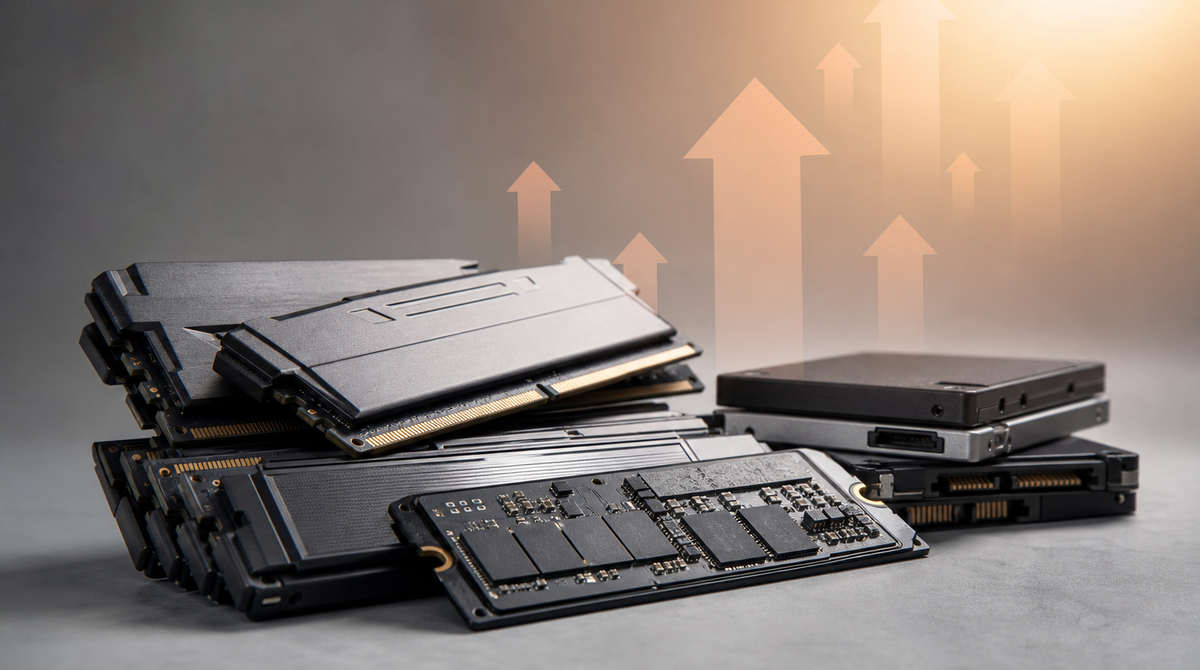
Taiwanese research firm TrendForce projects that DRAM contract prices will climb 58 to 63 percent quarter over quarter in Q2 2026, with NAND Flash rising 70 to 75 percent over the same period[3][4]. Touched off by the large wafer agreement OpenAI announced in October 2025, production capacity at Samsung, SK hynix, and Micron has shifted toward HBM and server-bound DDR5, leaving the consumer DRAM, SSD, and HDD markets caught in a spiral of shortages and price hikes[1][2]. Micron has decided to wind down its consumer brand "Crucial" by the end of February 2026 and concentrate supply on strategic customers[5][6].
The OpenAI Mega-Contract: 900,000 Wafer Starts Per Month
The trigger was October 3, 2025, when OpenAI disclosed an agreement with Samsung and SK hynix as part of its "Stargate" initiative to secure DRAM equivalent to 900,000 wafer starts per month across the two suppliers[2]. The figure is a forward target, but the implied capacity buildup immediately shrank the spare bandwidth of both makers. South Korean media report that SK hynix plans to expand its 2026 DRAM output to eight times the current year[1].
DRAM spot prices spiked in November. New orders poured into Micron, which was outside the OpenAI deal, and TrendForce now forecasts Q2 2026 DRAM contract prices up 58–63 percent quarter over quarter and NAND Flash up 70–75 percent[3][4]. HBM is consuming a disproportionate share of DRAM wafer capacity, leaving less room for general-purpose DDR5 lines — another driver of the squeeze.
What Micron's Earnings Reveal About the Server-DRAM Pivot
In its fiscal Q1 2026 results, Micron's Core Data Center Business Unit (CDBU), which covers data center DRAM and storage, posted standout growth. Revenue reached USD 2.379 billion (about JPY 375.9 billion) with operating profit of USD 890 million (about JPY 140.6 billion), pushing the gross margin to 56.4 percent[1]. The prior quarter logged revenue of USD 1.557 billion (about JPY 246.0 billion), operating profit of USD 391 million (about JPY 61.8 billion), and a gross margin of 24.8 percent — the contrast points to a sharp rise in per-unit pricing on non-HBM DDR5 server contracts. * Converted at JPY 158 per USD
The supply outlook is not encouraging. On the December 17, 2025 earnings call, Micron stated that "the aggregate industry supply will remain substantially short of the demand for the foreseeable future" and warned that the memory tightness will persist through calendar 2026[1][7]. The company plans to grow DRAM and NAND bit shipments by roughly 20 percent in 2026, yet expects to fall short of demand across every market segment.
The squeeze is most painful for consumers. On December 3, 2025, Micron announced that it would close the Crucial consumer brand at the end of February 2026[5][6]. Even at the cost of retiring a marquee brand built up over roughly three decades, the company is steering wafer capacity toward HBM and server DDR5.
The "Panic-Buy" Read and Why PCs Are Best Bought in 2027
Yusuke Ohara, the PC Watch columnist who analyzed the situation, frames the surge as a panic buy[1]. If AI demand were truly the prime driver, CPU supply would have tightened too — yet Xeon, EPYC, and Ryzen all remain comfortably available, he argues. AMD's EPYC 9005 shares the same die as the Ryzen 9000 series, so a runaway server boom would inevitably distort consumer Ryzen pricing as well.
On top of that, NVIDIA's Grace Hopper and Blackwell-class accelerators (GH200, GB200, GB300) integrate LPDDR5X at the package level rather than using general-purpose DDR5. The chain Ohara sees is therefore: "OpenAI wafer deal → vendors hoard DRAM as insurance → the hoarding cascades into SSDs and HDDs"[1].
The exit ramp is the real question. Long-term contracts will keep market flow constrained through 2026, but as those agreements roll off around Q1 2027, Ohara expects supply to bounce back sharply[1]. Buyers who can wait on PCs, smartphones, or game consoles are likely to find more choices in 2027.
Summary
The 2026 memory rally is shaped by both genuine demand and cascading hoarding triggered by the OpenAI wafer agreement. TrendForce projects Q2 hikes of up to 63 percent for DRAM and 75 percent for NAND, while Micron has closed the Crucial business to redirect resources to server customers. For anyone weighing a new PC, a memory upgrade, or an SSD swap, waiting until early 2027 — when current contracts roll over — should make for a calmer purchase.
Source [1]: https://pc.watch.impress.co.jp/docs/topic/feature/2073359.html
Source [2]: https://openai.com/index/samsung-and-sk-join-stargate/
Source [3]: https://www.trendforce.com/presscenter/news/20260331-12995.html
Source [4]: https://www.tomshardware.com/pc-components/dram/dram-and-nand-contract-prices-to-climb-again-in-q2
Source [7]: https://investors.micron.com/static-files/088991c5-a249-4f66-a0a6-258d9b66f3f9