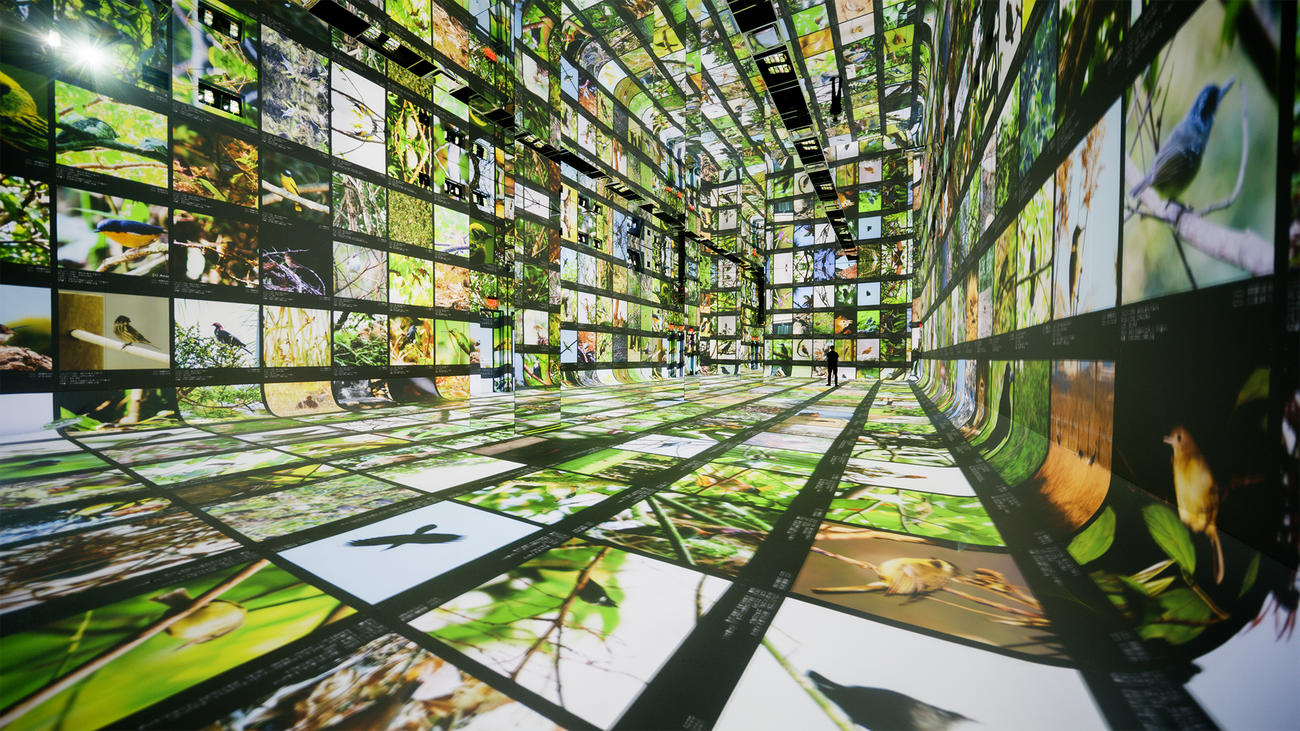
Google has revealed that it served as both a technology and creative partner for Dataland, billed as the world's first museum of AI arts, which opened in Los Angeles on June 20 local time[1]. The venue occupies roughly 2,300 square meters inside The Grand LA, a mixed-use development designed by Frank Gehry, where data becomes pigment and the art keeps evolving in real time. The opening marks a milestone in a collaboration with media artist Refik Anadol that stretches back a decade[2].
A museum of the senses, where data becomes pigment
Dataland is a museum in which works are generated from data itself and change shape in real time in response to how visitors react. Its 25,000-square-foot (about 2,300-square-meter) interior is designed as an immersive environment that engages not only sight but also sound and even scent[1].
The inaugural exhibition is "Machine Dreams: Rainforest." Built around the Large Nature Model, a foundational AI developed by Refik Anadol Studio, it trains on a vast trove of data from the natural world and transforms it into generative visuals spanning 1.2 billion pixels[1]. When visitors move or express emotion, soundscapes are generated on the spot and scents are even adjusted algorithmically. Rather than presenting works one-way, the space changes its expression through dialogue with those who visit, a key departure from the conventional museum.
The Google Cloud technology behind "Machine Dreams"
What drives the in-gallery experience behind the scenes is a suite of Google Cloud tools. The Gemini Enterprise Agent Platform and Compute Engine coordinate multiple AI models, including generative adversarial networks (GANs), diffusion models, and Gemini, to bring the gallery's visuals to life[1]. From ticketing at the front door to the pixels shifting on the walls, the cloud keeps the entire museum running smoothly.
Sustainability is another defining feature. The real-time generation runs on Google Cloud's computing infrastructure, which is powered by 87 percent carbon-free renewable energy, keeping an eye on sustainability even while sustaining large-scale generation[1]. AI-driven art creation is often associated with enormous power consumption, so disclosing the energy mix of the operating infrastructure speaks to the museum's stance.
A decade of collaboration between Google and Refik Anadol
Dataland sits on the extension of a long collaboration between Google and Refik Anadol. When Anadol joined the first cohort of Google's Artists and Machine Intelligence (AMI) program in 2016, generative AI had not yet become a global headline[1].
The two went on to projection-map the Los Angeles Philharmonic's archives onto architecture in 2018, visualize Google Quantum AI data in 2020, and broaden the work into "MRI of the Earth," which reframes planetary data through an AI lens[1]. In 2025, they produced "Machine Dreams: Biophilia," a large-scale installation in which Refik Anadol Studio's Large Nature Model and Gemini turn regional ecosystem data into an ever-shifting landscape, for Google's Mountain View campus. A consistent idea runs through it all: technology can be a new medium for expression that amplifies, rather than replaces, human craft.
Nurturing the next generation with the AI Artist Residency
To coincide with the museum's opening, Google Arts & Culture is supporting the Dataland AI Artist Residency. This six-month incubator program provides four artists with grants of 25,000 USD (about 4 million yen) each[1].
Participating artists receive mentorship from Refik Anadol Studio along with access to advanced Google Cloud tools and machine learning models. The work created during the residency is slated to be featured later this year on Dataland's stage and on the Google Arts & Culture website[1]. By opening up cutting-edge tools to a broader community of creators rather than a handful of specialists, the program aims to give the next generation of digital artists a seat at the table.
※1 USD = 161 JPY (as of June 19, 2026)
Summary
Dataland is a museum, billed as the world's first for AI arts, where works are generated from data and shift in real time in response to visitors' movements and emotions. The opening exhibition "Machine Dreams: Rainforest" runs the Large Nature Model along with Gemini, GANs, and diffusion models on Google Cloud, producing an immersive experience that uses 1.2 billion pixels of generative visuals plus sound and scent. As a decade-long collaboration between Google and Refik Anadol reaches a milestone, a residency supporting four artists also opens advanced tools to the next generation of creators.
出典:https://blog.google/company-news/outreach-and-initiatives/arts-culture/dataland-ai-art-museum/
出典:https://www.theartnewspaper.com/2026/06/18/refik-anadol-dataland-opens-los-angeles