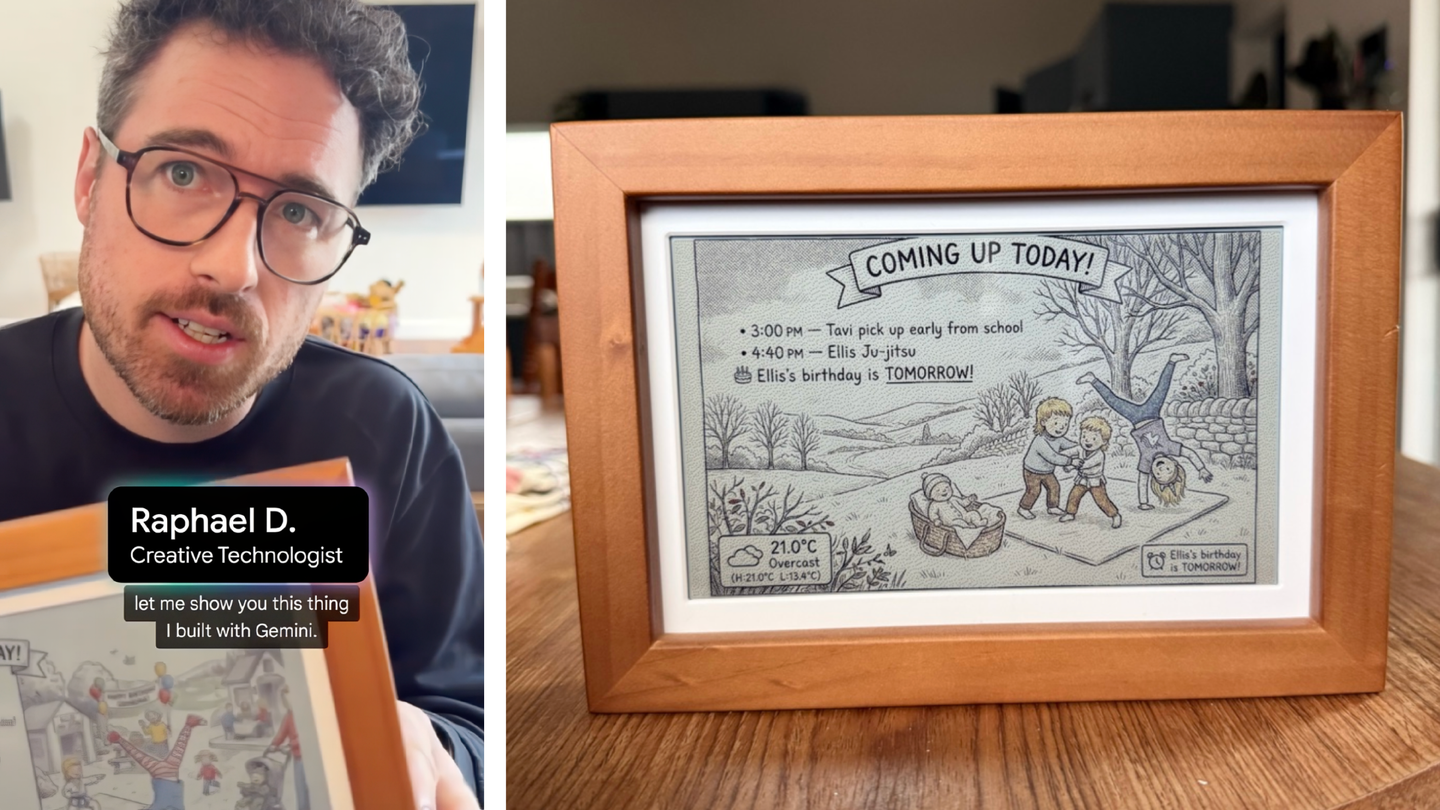
On July 31, Google published a post about Glanceboard, a family schedule device that Raphael, a creative technologist at the company, built on his own[1]. Every morning it turns the day's plans and weather into a single illustration and shows it on an E Ink display, and the code is being released as open source. The starting point was a simple one: a morning that does not begin with bright screens and notifications.
Turning the schedule and the weather into one picture
What Glanceboard does is straightforward. Each morning it checks the family's shared Google Calendar and the local weather, then prompts Nano Banana to generate an illustration of the children dressed for the forecast[1]. The finished image goes straight to an E Ink display, so the family can see the day's schedule, what to wear, and what to pack at a glance[1].
In the photo on Google's blog, an E Ink panel set in a wooden frame carries a "COMING UP TODAY!" banner, a short bulleted schedule, the temperature and conditions, and a line drawing of children playing outdoors. Rather than a text-only agenda, it presents the day as a scene.
Raphael says the format is a good way to get kids engaged and organized without the stress[1]. Pictures work even for a child too young to read a list, and the design leans into that.
Gemini 3.6 Flash and Nano Banana split the work
Glanceboard runs on two models: Gemini 3.6 Flash and Nano Banana[1]. Gemini 3.6 Flash handles the interpretation, deciding how the calendar entries and weather data should be turned into a single composition, while Nano Banana, the Gemini image model, produces the artwork.
Gemini 3.6 Flash is a relatively new model that became generally available on July 21, aimed at coding, knowledge work, multimodal processing, and AI agent use cases. According to the Artificial Analysis Index, it uses 17 percent fewer output tokens than the earlier Gemini 3.5 Flash[2]. Even for something that runs once a morning, a model with shorter output helps on both responsiveness and cost.
No cloud accounts, just a lightweight local server
The second notable point is that everything stays local. Glanceboard operates on a lightweight local server, with no cloud accounts and no bright screens required[1]. Family calendars are fairly private by nature, and keeping the processing at home makes the setup easier to live with.
Choosing E Ink for the display follows the same logic. There is no backlight, so the board can sit on a kitchen table or by the front door without competing for attention. It behaves like a message board on the wall, something you glance at only when you need it.
Open source, and meant to be rebuilt with Antigravity
Google is open-sourcing the project's code[1]. The framing is less "read this for reference" and more "ask Google Antigravity to make you one, too"[1]. Full details, including the hardware Raphael used, are collected in the GitHub repository[1].
Google Antigravity is Google's agentic development platform, described on its official site as a way for anyone to build in the agent-first era. It spans Antigravity 2.0 for managing multiple local agents in parallel, the terminal-first Antigravity CLI, the Antigravity SDK for prototyping custom agents in Python, and the Antigravity IDE with a deep understanding of your codebase[3]. It is available to developers at no charge[3].
Seen that way, Glanceboard is less a gadget showcase than a worked example of assembling everyday automation with Antigravity. The same idea could just as easily become a shopping list or a chore rota instead of a family calendar.
Summary
Glanceboard combines Gemini 3.6 Flash and Nano Banana to turn a family's schedule and weather into one illustration each morning and display it on E Ink. Processing stays on a local server, and no cloud account is needed. The code and hardware details are published on GitHub, and Google says Antigravity can build the same thing for you. As a use of generative AI, it is an appealing one: not a sweeping business overhaul, but a quieter first few minutes of the day.
[2] https://gigazine.net/gsc_news/en/20260722-google-gemini-3-6-flash/