

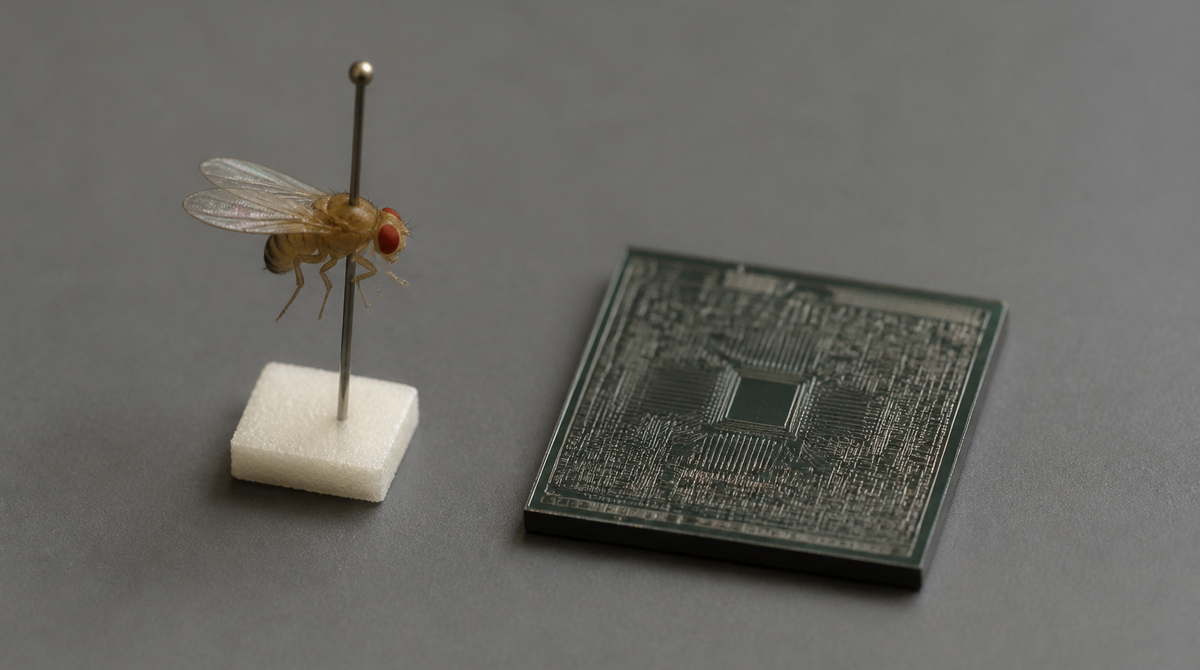
A project called FLM (Fly Language Model), published on September 11, wires the wiring diagram of a fruit fly brain directly into a language model as a computing element. A measured connectome of 166,700 nodes sits alongside a frozen 1.2B model, and only a readout layer of about 270,000 parameters is trained. The striking part is that the author ran a control of the same size, found it slightly better, and stated plainly that fly anatomy showed no advantage.
Using a Fly Brain as a Reservoir
FLM follows the idea of reservoir computing: signals are pushed through a network whose internal weights stay fixed, and only the layer that reads the echo is trained. What makes this build, named GPF (Generative Pre-trained Fly), unusual is that the fixed weight matrix does not hold artificial random values. It holds the fruit fly central nervous system connectome released as MaleCNS v1.0.
The graph contains 166,700 nodes and 25,582,938 directed connections, with matrix values derived from normalized anatomical contact counts. The 2,048-dimensional token embeddings of the language model are compressed to 128 channels through a fixed Gaussian projection, and each node receives one channel. The state update follows x = tanh(W(0.6x + 0.4Bc)), mixing 60 percent of the previous state with 40 percent of the new input as the fly graph advances one step.
Only 270,000 Parameters Are Trained
The backbone is Liquid AI LFM2.5-1.2B-Instruct, and none of its 1.17 billion parameters move. Training touches only two bias-free matrices, 128 by 128 and 2,048 by 128, for a total of 278,528 parameters, or 0.024 percent of the whole. The training material is small as well: 64 conversations plus 32 synthetic examples.
The code is on GitHub under the MIT license and runs on Python 3.12. A browser demo is available, with the author noting that replies can be imperfect because the model is tiny.
A 0.0222 Nat Gain, and a Control That Edges Ahead
Evaluation covered 32 conversations and 1,236 tokens, measured as negative log likelihood in nats per token. Lower values mean the model predicts the next token more accurately.
The frozen backbone scored 1.381995. Adding the fly readout brought it down to 1.359816, with a standard deviation of 0.000110 across three seeds, a gain of 0.0222 nats. A parameter-matched control that simply reads the input directly, however, reached 1.359328 and edged past the fly version. The gap is 0.000488 nats, and the control won on all three seeds, numbered 27, 28 and 29.
The author's conclusion is direct: the connectome graph does measurably shape predictions, but it does not outperform the simpler control on this evaluation.
Separating Out What the Graph Actually Does
What stands out is that the work does not stop at whether the effect exists. It takes apart what the graph contributes.
Zeroing the weight matrix W removed the residual exactly, confirming that the graph genuinely participates in the computation. Relabeling the node identities broke performance without retraining, meaning the structure of the wiring is tied to the result. Yet an inspection of the recurrence showed that differences in initial state shrink by a factor of 0.6 per token, leaving almost no long-range memory.
The fly-derived residual changed the predicted token at only 1.51 percent of positions, with a standard deviation of 0.047 percent. There is influence, but it is far from dominant.
How to Read the Result
In work that carries biological circuitry into machine learning, a small gain is often narrated as the elegance of the wiring. The value here lies in running a matched control and showing that the gain does not come from the structure. A positive headline would have been easy to write from the improvement over the backbone alone.
That said, the evaluation spans 32 conversations, 1,236 tokens and three seeds. That is small ground for generalization, and different settings, such as the compression to 128 channels or the mixing ratio, could produce different numbers. This is not a verdict that fly wiring is unsuited to language processing. It is a report that, under these conditions, no advantage could be shown.
Summary
FLM attaches a fruit fly connectome of 166,700 nodes to a language model as a fixed computing element and trains only a readout layer of 278,528 parameters. It improved on the backbone by 0.0222 nats, while a simple control of the same size came out 0.000488 nats ahead. The wiring clearly takes part in the computation, but no evidence emerged that its structure helps.
※The image is for illustrative purposes.