AMD is finally bringing its compact local-AI workstation, the Ryzen AI Halo, to market. Micro Center began taking pre-orders exclusively on June 8, with a price of 3,999 USD (about 640,000 yen). Built around the flagship Ryzen AI Max+ 395 APU and a large pool of memory, the box is tuned for local inference and development, squaring up directly against NVIDIA's DGX Spark.
※1 USD = 160 JPY
What the Ryzen AI Halo Is
The Ryzen AI Halo is the AI mini-PC AMD teased at CES 2026 earlier this year. Inside is the silicon known as Strix Halo, the same basis as the Ryzen AI Max 300 series. The goal is straightforward: pack AMD's AI technology into a single box and deliver it as a ready-to-use local AI environment. At the time of the teaser, AMD said it would arrive during the second quarter, and with Computex on the horizon, the system has now been formally unveiled.
What makes the timing notable is that the underlying Ryzen AI Max silicon has been available for roughly a year. MINISFORUM and others already ship plenty of AI-focused small-form-factor PCs using the same chip. In other words, the hardware itself brings little that is new, so AMD is wagering on something else entirely.
A Compact Chassis and Core Configuration
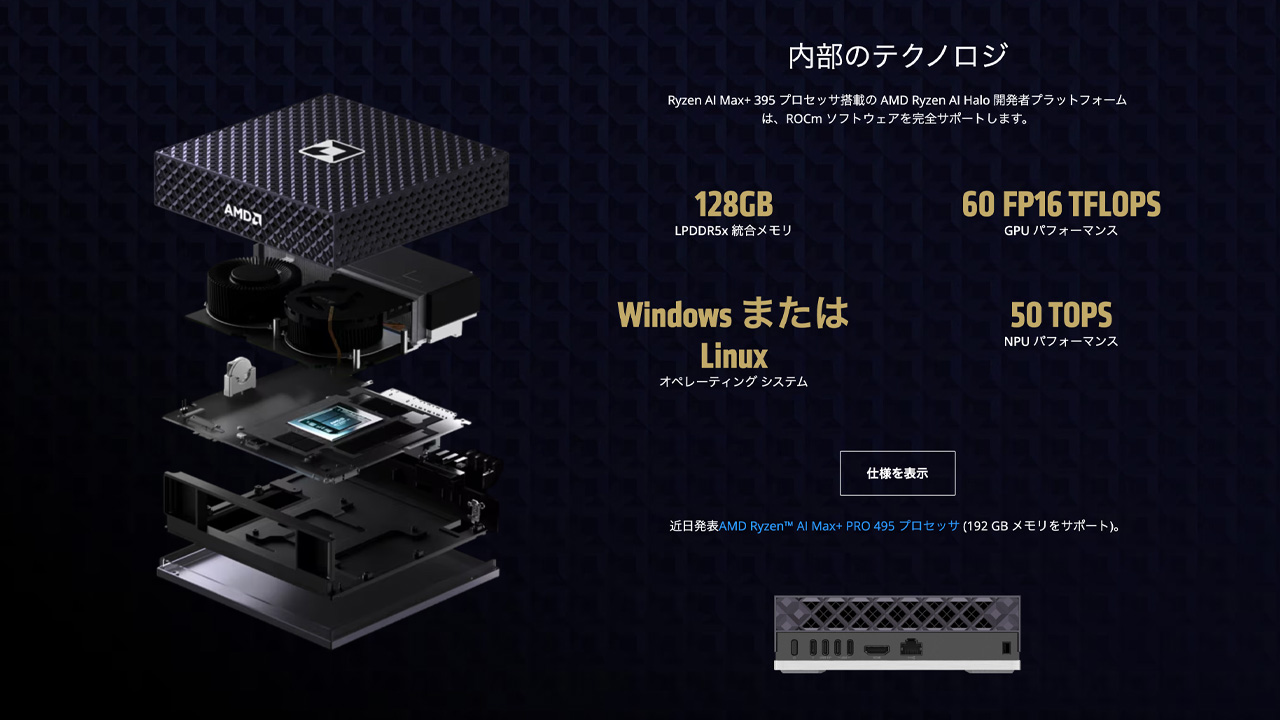
The unit stands just 43.2mm tall and weighs a little over a kilogram, likely making it one of the smallest and lightest implementations among AI development boxes to date. At its core, the Ryzen AI Max+ 395 combines a 16-core Zen 5 CPU, an integrated Radeon 8060S GPU, and an XDNA 2 NPU rated at roughly 50 TOPS.
Memory is 128GB of LPDDR5x shared between the CPU and GPU, and AMD says it can handle models up to 200 billion parameters locally. Storage is a 2TB PCI Express Gen4 SSD, sitting right in the middle of the capacities seen across this category over the past year. The box supports both Windows and Linux, and both configurations ship with an equivalent AMD software stack.
The Real Value Is in the Software
Rather than new hardware, what AMD pushes to the front with this product is its software work. Where partners have shipped relatively generic boxes, AMD is taking a page from NVIDIA and delivering an entire ecosystem of validated models, frameworks, and guides. This is the first time AMD has loaded a full first-party ecosystem into a single box.
At the center is the AMD Ryzen AI Development Center. It serves as a starting point for new users and as the front end for installing, managing, and updating the AI software on the box. In practice, it behaves like an AI package manager with AMD supplying the packages, and the key advantage is that AMD can validate everything distributed through it. AMD has also prepared a set of playbooks for getting started with the ROCm ecosystem and various AI tasks: five ship pre-loaded on the system, and another ten are published on AMD's website. The intent is clearly to reduce friction so the box just works out of the gate.
Taking Aim at NVIDIA's DGX Spark
AMD sees NVIDIA's DGX Spark as its main rival. NVIDIA's software stack is a formidable moat, and its silicon includes dedicated hardware for matrix math along with support for data types such as FP8. AMD's RDNA 3.5 architecture lacks those dedicated mechanisms, so the Ryzen AI Halo enters the fight with both advantages and disadvantages. AMD intends to press its strengths hard, particularly on performance. It is also eyeing users who have been buying high-end Macs for local inference.
Weighing the Price and Operating Costs
At 3,999 USD (about 640,000 yen), the Halo is clearly pricier than existing Ryzen AI Max+ 395 mini-PCs, which sit around 3,300 USD (about 530,000 yen). With nothing new on the hardware side, AMD has to justify the premium through support, vertical integration, and its software stack.
The same price band also includes mini-PCs built on NVIDIA's GB10. ASUS's Ascent GX10, for example, is priced almost identically in a 2TB SSD configuration. AMD is not trying to undercut the Spark/GB10 ecosystem here, and judging by the pricing, it does not treat NVIDIA's bundled 200GbE networking as a material differentiator. Instead, AMD argues on operating costs: running models locally can dramatically lower the cost per token. The catch is that cloud pricing scales roughly with token usage, so this "power math" only pays off for workloads that consume a substantial number of tokens.
A 192GB Model Is Already on the Way
Alongside the Ryzen AI Max+ 395 version, AMD is already looking ahead. The company has confirmed Halo systems based on its new Ryzen AI Max PRO 400 chips will follow shortly, taking advantage of higher performance and memory capacity, specifically support for 192GB configurations. The first-generation Halo will be an only child for only a short while.
Summary
The Ryzen AI Halo is positioned not as a hardware breakthrough but as AMD's own local-AI development machine, bundling validated software and an ecosystem into one box. At 3,999 USD (about 640,000 yen) it costs more than comparable rivals, and whether AMD can justify that through software and usability will decide how it is judged. Pre-orders are open at Micro Center as of June 8, and with a 192GB model coming soon, developers who want to run AI locally have one more option to consider.