
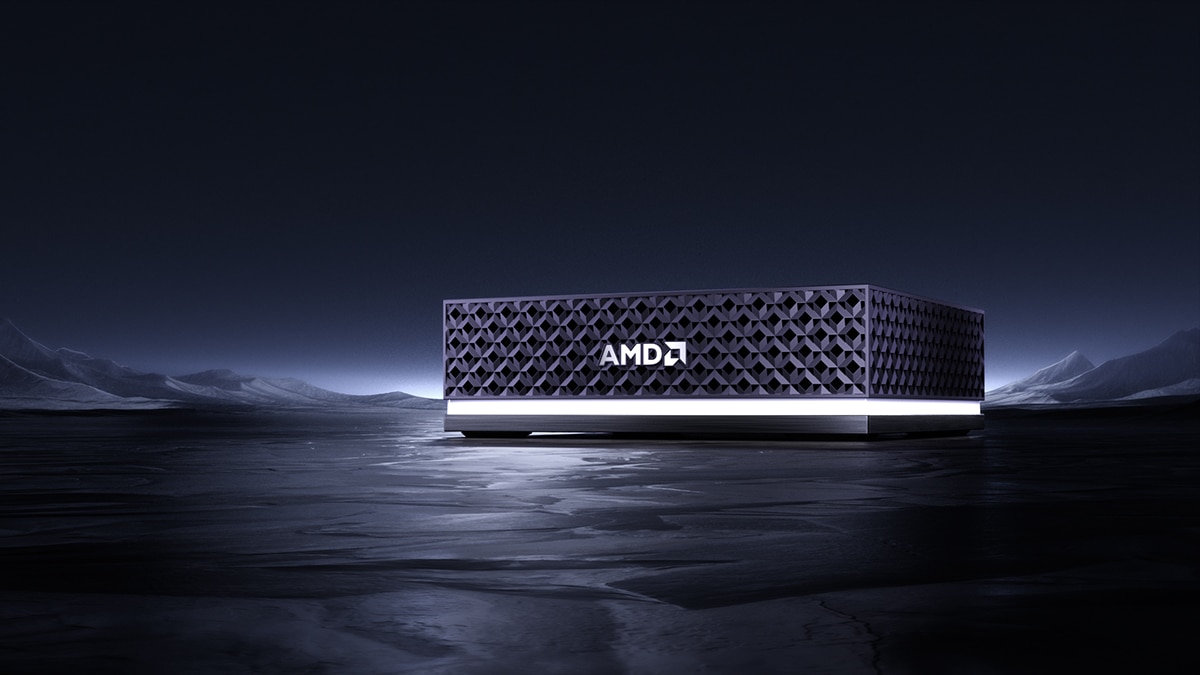
AMD has launched the Ryzen AI Halo, a compact PC built specifically for running AI models on your own desk, in the United States. Priced at 3,999 USD (about 640,000 yen), it is pitched around the idea of running large language models and image-generation models locally, without leaning on the cloud. The product clearly has NVIDIA's DGX Spark in its sights and stands out as a fresh option for developers.
A Developer Machine for Running AI Without the Cloud
The Ryzen AI Halo is a small PC designed to keep AI development and inference entirely local. Its biggest draw is a generous 128GB of unified memory, which AMD says can handle models of up to 200 billion parameters depending on the setup. Running generative AI in the cloud racks up costs based on usage, but running it on a machine you own lets you experiment freely without worrying about extra charges. That is the core of AMD's pitch.
On the software side, the platform supports AMD's own GPU compute stack, ROCm, and ships preconfigured with tools such as LM Studio for running local models, ComfyUI for image-generation workflows, and the VS Code development environment. The goal is to cut down the gap between powering on and actually running a model, so developers can spend their time building rather than configuring.
Inside Is the Top Strix Halo SoC
At its heart sits AMD's flagship SoC known as Strix Halo, the Ryzen AI Max+ 395. The CPU packs 16 Zen 5 cores and 32 threads, with a 3GHz base clock and a 5.1GHz maximum. Graphics are handled by an integrated Radeon 8060S with 40 RDNA 3.5 compute units, while the dedicated NPU for AI processing is rated at up to 50 TOPS.
The system comes with 128GB of LPDDR5X-8000 memory and a 2TB PCIe 4.0 SSD as standard. Connectivity is well covered, with 10GbE wired LAN, Wi-Fi 7, Bluetooth 5.4, four USB-C ports, and HDMI 2.1b. The aluminum chassis measures a compact 149 x 149 x 43mm, so it takes up little space on a desk.
Squarely Aimed at NVIDIA's DGX Spark
AMD positions this product explicitly as a rival to NVIDIA's own compact local-AI machine, the DGX Spark. The DGX Spark originally arrived at 3,999 USD, but ongoing LPDDR5X memory and NAND supply constraints have pushed it up to around 4,699 USD (about 760,000 yen). By holding the line at 3,999 USD, the Ryzen AI Halo gains roughly a 700 USD (about 110,000 yen) price advantage.
AMD also stresses functional differences. Where the DGX Spark is Linux-only, the Ryzen AI Halo supports both Windows and Linux, and AMD highlights its dedicated NPU as an advantage. On performance, AMD says that across several large models it measured token throughput 4 to 14 percent higher than the DGX Spark, and that on tasks such as image generation it runs about 4 times faster on average than Apple's Mac mini with the M4 Pro. These are AMD's own figures, and results will vary with conditions.
Price, How to Buy, and a Few Caveats
The Ryzen AI Halo comes in two versions, one with Windows 11 Pro and one with Linux. The hardware is identical and both cost 3,999 USD. Sales run through Micro Center in the US, and for now the system is in-store pickup only, with no online shipping. In-store availability is expected around July 10. At present, purchase and use are limited to the US, and there is no word on availability in Japan or other regions.
A higher-end model powered by the Ryzen AI Max+ PRO 495, which AMD says supports up to 192GB of memory and 300-billion-parameter models, is also due in the third quarter of 2026. Its price has not been announced.
At the same time, other vendors offer mini PCs built on the same Ryzen AI Max+ 395, and depending on the configuration they can be cheaper. Corsair's AI Workstation 300, for example, is listed from 2,699 USD (about 430,000 yen) for the 1TB model and from 3,399 USD (about 550,000 yen) for the 4TB model. How much value you place on a ready-made development environment and dedicated support will likely decide whether the Ryzen AI Halo is worth it.
Summary
The Ryzen AI Halo is a small PC that promises large-scale local AI development, armed with 128GB of unified memory and a Strix Halo generation SoC. Its strategy of holding at 3,999 USD while offering Windows support and a dedicated NPU to undercut the pricier DGX Spark is clear, but for now it is US-only and in-store pickup only, and cheaper third-party options exist. It is a strong choice for developers who want to run AI locally, though it is worth weighing availability and the price gap against competitors before buying.
*Converted at 1 USD = 161 JPY (as of July 3, 2026)