US AI startup PrismML announced "Bonsai 2 27B" on September 17, 2026 (local time), a 27-billion-parameter multimodal AI model. Using a proprietary ternary quantization technique, the company compressed the model to roughly a ninth of its original size while retaining 98.2 percent of its benchmark performance. The result opens the door to running capable AI agents entirely on local hardware such as laptops and gaming GPUs.
A Compression Method Built on Three Values
PrismML built Bonsai 2 27B on top of Alibaba's "Qwen3.8 27B," representing each weight with only three possible values: −1, 0, and +1. Weights that are normally stored in 16 bits are reduced to an average of 1.76 bits, shrinking the 27-billion-parameter model down to 5.9 gigabytes. Every group of 128 weights shares a single 16-bit scale factor, and a Hadamard rotation is applied to blocks of 1,024 weights before quantization to limit the loss of accuracy. Only about 26 million parameters, roughly 0.1 percent of the total, are kept at higher precision, limited to recurrent state pathways and normalization weights. The vision component, about 470 million parameters, ships separately as a 0.63-gigabyte file.
How Much Performance Is Lost
Across 20 benchmarks, the uncompressed Qwen3.8 27B averaged 85.4 points, while Bonsai 2 27B scored 83.9, a 98.2 percent retention rate. Broken down by category, math retained 99.5 percent, coding 99.3 percent, and instruction following 101.7 percent, showing almost no degradation. Agentic tasks involving tool calls retained 97.3 percent, while long-horizon tasks such as Terminal-Bench and SWE-bench Verified, which require many sequential steps, dropped to roughly 75 percent retention. Compared with IQ2_XXS, an existing quantization method that compresses to a similar 7.3 gigabytes with an average score of 75.2, Bonsai 2 27B scores considerably higher on AIME26, a benchmark for advanced math problems, and LiveCodeBench, a coding benchmark, marking a clear step up from prior compression approaches rather than a simple size reduction.
Supported Hardware and Speed
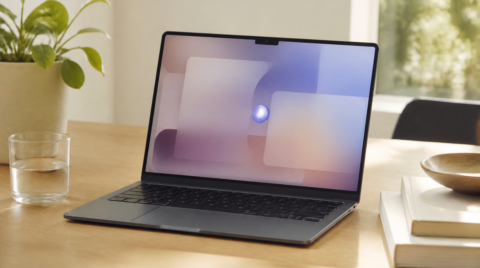
Bonsai 2 27B runs both in CUDA environments on NVIDIA GPUs and in MLX environments on Apple Silicon. Reported throughput reaches 142.5 tokens per second on a GeForce RTX 5090, 96.7 tokens per second on an RTX 4090, and 32.1 tokens per second on the data-center-oriented NVIDIA L4. On Apple chips, the M5 Max reaches 46.8 tokens per second and the M5 Pro reaches 27.7 tokens per second. As a rough guideline, PrismML recommends at least 16 gigabytes of memory on a laptop or a GPU with at least 24 gigabytes of VRAM. Because the model uses a proprietary packing format, it does not run on stock llama.cpp; it requires either PrismML's own fork or a dedicated MLX implementation for Apple devices. A WebGPU demo that runs directly in the browser is also available. The model is released under the Apache 2.0 license, with weights published on Hugging Face.
A Step Toward AI That Doesn't Depend on the Cloud
Bonsai 2 27B is intended for use cases where connectivity or privacy constraints matter, such as coding assistants, computer-use automation, and analysis of documents that cannot leave an organization. PrismML founder and CEO Babak Hassibi said the original Bonsai 27B proved that powerful models don't have to be confined to cloud infrastructure, and that this new model pushes that idea further. Ion Stoica, an advisor to PrismML and a UC Berkeley professor, also noted how little capability is lost despite such a dramatic reduction in footprint. The first-generation Bonsai 27B, released roughly two months before this announcement, retained about 95 percent of its base model's performance, meaning this new version represents a further improvement on that mark.
Summary
PrismML's newly announced Bonsai 2 27B compresses a 27-billion-parameter AI model down to 5.9 gigabytes while retaining 98.2 percent of its performance. While a gap remains on long, complex agentic tasks, the model shows almost no degradation in coding, math, and instruction following. Efforts to run high-performance AI models locally, without relying on cloud computing resources, look set to keep expanding.